


Background
Idaho State University (ISU) launched an interdisciplinary research project to develop Lit-VR, a VR serious game designed to deepen college students' engagement with 17th century English literature. The project is a collaboration between Farjana Eishita, assistant professor in the Department of Computer Science, and Curtis Whitaker, professor in the Department of English, supported by graduate researcher Shojibur Rahman and undergraduate Reece Foulkrod.
The Deployment
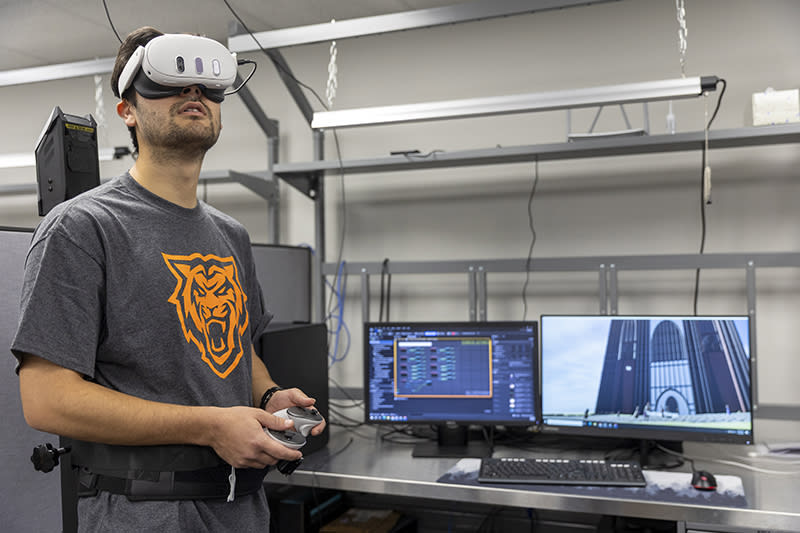
Lit-VR drops students into a recreated Renaissance-era London via a VR headset. Players begin at Westminster Abbey in the 17th century, visiting Poets' Corner to collect information about classical authors before navigating iconic landmarks including the House of Commons, Shakespeare's Globe, and London Bridge — earning rewards and learning about the literature, government, and geography of the era. In the final stages, players travel to the London Docklands to discover a destination overseas. The full platform will comprise five interconnected experiences to be completed over a full semester.
The platform is classified as a serious game — designed primarily for educational outcomes, blending gameplay mechanics with curriculum-aligned learning objectives. Eishita's lab specialises in applying immersive technologies to learning environments.
Hardware and Software
Students use a VR headset to engage with the experience. The Lit-VR software is developed in-house at ISU by the research team.
Development Status
As of May 2026, the project remains in its developmental stage. A working prototype was targeted for spring 2026, with user play testing planned for the fall 2026 semester. Rahman has been responsible for designing the Tudor London VR environment, implementing gameplay flow, and planning user studies to evaluate how students interact with and learn from the experience.
Rationale
Whitaker, a self-described visual learner, argues that much of English Renaissance literature is fundamentally London literature, and that experiencing the city spatially helps students situate poems and plays in their proper geographical and historical context. Eishita envisions the platform evolving into a mainstream educational tool as VR hardware becomes more accessible and content diversifies.

