


Background
The Lower Saxony Ministry of the Interior and Sport in Hannover, Germany runs its digitisation programme on the Scaled Agile Framework (SAFe). At the heart of that framework are quarterly PI-planning events — multi-day meetings where managers and stakeholders align on plans for the coming months. Like most organisations, the ministry had moved these meetings to videoconferencing, which raised familiar concerns about "video-conferencing fatigue" and weaker collaboration.
To test whether immersive technology could do better, the ministry partnered with the XRLab@MCM at the University of Münster's Marketing Center to run and independently evaluate VR-based planning meetings against the existing videoconferencing setup. The ministry's head of digitalisation for public administration, who also leads Germany's Extended Reality (Metaverse) testbed at GovTech Campus Germany, led the agile events.
The deployment
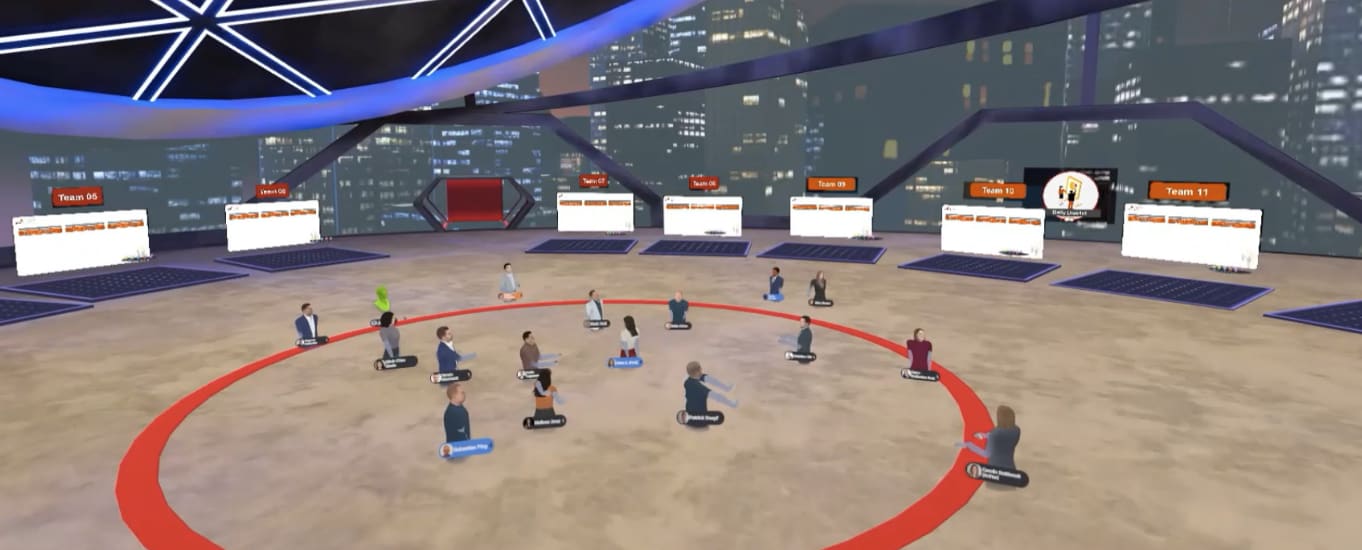
Across three quarterly PI-planning events between June and December 2022, managers met as avatars in a shared 3D "enterprise metaverse" for retrospectives, results presentations and confidence votes, replacing or supplementing the equivalent Skype for Business sessions. Teams ranged from roughly ten people in breakout sessions up to full plenary meetings of more than a hundred participants.
Two linked studies were run: a longitudinal comparison of a videoconferencing-only event (June, 125 managers) with a part-VR event (September, 44 managers in VR), and a between-subjects session in December where 105 managers split between VR and videoconferencing for the same 45-minute retrospective.
Hardware and software
- Headsets: standalone Pico Neo 3 VR devices, with an optional 30-minute onboarding session to familiarise participants with the technology.
- Collaboration app: the Arthur virtual-collaboration platform, using a customised virtual space with spatial audio, shared whiteboards and notes.
What the study found
Managers consistently rated the VR meetings higher than videoconferencing across all five "scaled business agility" dimensions. Perceived agility rose by an average of 26% the first time VR was used and 16% in the later VR-only session, with proactive problem-addressing showing the largest single gain at 32%. The gains were not free, however: independent measurement by PwC and the University of Münster found participants rated the VR meetings 20% more exhausting than videoconferencing, even as they also reported stronger social presence, more fun, greater comfort and more positive anticipation of the next planning event. The researchers note that roughly 40% of the first-event uplift may be a one-off "newness effect" that wears off as VR becomes routine.
"The more direct communication and collaboration might explain why the enterprise metaverse is considered a more agile meeting environment."
Why VR helped
The study attributes the advantage to spatial audio and the ability to move into a "quiet corner" of the virtual room to talk in sub-teams without leaving the meeting — something the videoconferencing chat-room model could not match — together with three-dimensional whiteboards and notes that made visualising and changing plans easier. A tentative cost analysis suggested that one-off headset purchases for all participants would cost roughly the same as a single in-person planning event while avoiding its travel emissions.


