

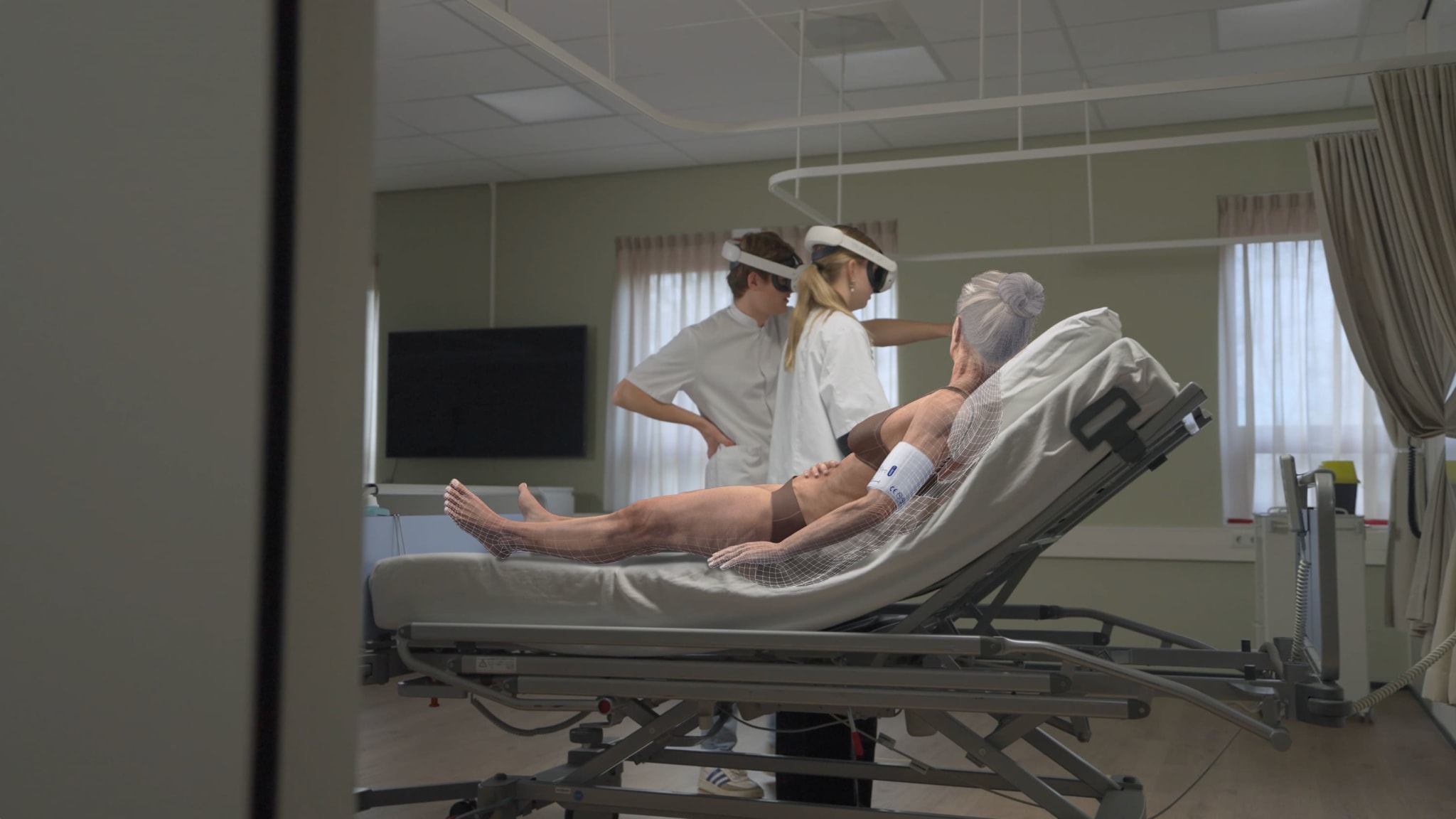
A nursing school in the Netherlands has integrated TrueSim's mixed reality simulation platform into its bachelor nursing programme to address a longstanding gap in acute care training. Clinical placements do not reliably expose students to complex or rare acute presentations, and the high stakes of real patient care can inhibit students from acting decisively. TrueSim allows students to practise individually, stepping into a mixed reality environment where they encounter a deteriorating virtual patient and work through the ABCDE methodology step by step.
The platform runs on Meta Quest 3 headsets, projecting a holographic patient into the student's physical space. Students see visible symptoms — chest movement, breathing sounds, facial expressions — and must assess and respond in sequence. Each session concludes with immediate structured feedback showing what was handled correctly and where improvement is needed. Students report that the realism of the simulation creates genuine urgency, while the private, self-paced format removes the performance anxiety of being observed by lecturers or peers.
Lecturers have observed measurable changes in student performance. Students arrive at clinical placements noticeably more confident and methodical in their approach. They make stronger connections between theory and practice, and their application of the ABCDE framework becomes more consistent. The platform's realism also drives intrinsic motivation — students actively seek repeat sessions to improve their performance.
TrueSim was founded in 2022 by Jasen Hashem and Pieter Tegelaers, both former intensive care nurses at Máxima Medical Center in Veldhoven. The company won the Dutch National Healthcare Innovation Prize in 2020 for its prototype and has since deployed its platform across more than 25 healthcare organisations and educational institutions in the Netherlands and Belgium. The training covers over 80 medically validated clinical scenarios using both ABCDE and SBAR methodologies.


