


Researchers at the Shiley Eye Institute and Viterbi Family Department of Ophthalmology, part of UC San Diego School of Medicine and UC San Diego Health, tested a commercially available mixed-reality headset as the primary display for endoscopic dacryocystorhinostomy (DCR) — a minimally invasive operation that reopens tear drainage when the duct is blocked. The results were published in the peer-reviewed journal AJO International in July 2026, and the institute announced them on 13 August 2026.
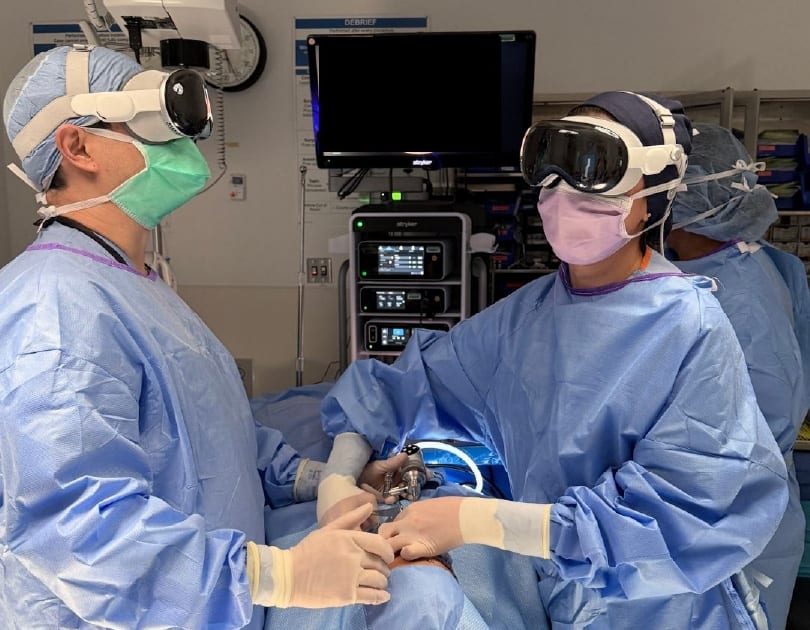
In the conventional setup the surgeon works while looking away from their own hands, because the endoscope picture appears on a tower-mounted monitor placed wherever the room allows. In the headset arm, an Apple Vision Pro placed the same live endoscope feed directly in each surgeon's own line of sight, letting them keep a forward-facing posture for the whole case. A photograph published by the institute shows two scrubbed surgeons operating in headsets side by side, with the endoscopy tower's monitor dark behind them.
The study was a consecutive, non-randomised comparative series at a single academic centre, carried out under institutional review board approval. Thirty-two consecutive endoscopic DCR procedures for primary unilateral nasolacrimal duct obstruction were analysed: 16 performed with the headset and 16 size-matched controls performed with the traditional monitor. Two fellows were the primary surgeons and three attending surgeons assisted.
Operative time was shorter in the headset group — 34.4 ± 8.6 minutes against 42.7 ± 8.5 minutes, a reduction of roughly 8.3 minutes or about 19 per cent (p = 0.006). Functional success was 100 per cent in both groups, 16 of 16, with no intraoperative or postoperative complications and follow-up of four to twelve months. Surgeon workload measured on the NASA Task Load Index fell from a median of 40.0 to 19.2 (one-sided p = 0.031; mean reduction 14.3 points, 95% CI 2.4 to 26.2). All five surgeons favoured the headset, with the largest improvement in physical demand, and surgeons reported better comfort and a more neutral head and neck posture. The authors note that the individual NASA-TLX subscale differences did not survive correction for multiple comparisons.
The paper also carries an exploratory cost and space analysis, contributed by co-author Horace Dediu, comparing the headset against the operating-room visualisation equipment it stands in for. On that comparison the headset occupies a small fraction of both the cost and the physical footprint of standard operating-room equipment.
The authors are explicit about the limits. Thirty-two cases at one institution, with no randomisation, makes this a preliminary and hypothesis-generating result; they call for larger controlled studies before firm conclusions are drawn about efficiency, ergonomics or cost.

