

Background
Action Contre la Faim's Emergency Readiness and Response Unit identified persistent limitations in conventional humanitarian emergency response training. In-person simulation exercises typically cost tens of thousands of euros per workshop and serve fewer than 20 participants, with international logistics adding months of delay to upskilling distributed field teams across the organisation's operations in 56 countries. The COVID-19 pandemic demonstrated both the necessity and the inadequacy of existing remote collaboration tools for the spatial coordination and multi-stakeholder negotiation required during a crisis response. Local staff in resource-constrained contexts bore primary operational responsibility while receiving substantially less training investment than headquarters personnel, contradicting wider sector commitments to localisation.
CORTEX2 consortium and funding
XRisis emerged from the EU Horizon Europe CORTEX2 Open Call Track 2 cascade funding programme (Grant agreement 101070192). Nuwa secured the grant in July 2024 and partnered with Action Contre la Faim's Emergency Readiness and Response Unit on a 12-month project running from August 2024 through June 2025. The CORTEX2 consortium, led by DFKI (German Research Centre for Artificial Intelligence), provided both financial support and access to four research-stage enabling technologies that became the platform's technical foundation. A Service Level Agreement model for commercial follow-on is targeted at Q2 2026 under the SimExBuilder brand.
Platform architecture
The XRisis platform is a Unity-based multi-user simulation running on European bare-metal cloud infrastructure in Germany and France, with deliberate prioritisation of EU data sovereignty and GDPR compliance. Four CORTEX2 technologies were integrated:
- Rainbow CPaaS (Alcatel Lucent Enterprise): real-time voice and video across VR headsets, desktop applications, and web browsers, via the Rainbow C# SDK
- Video Call Alternative Appearance (DFKI): MediaPipe-based face tracking driving Ready Player Me avatars for privacy-aware presence
- Conversational Virtual Agent (CEA): LLM-based dialogue grounded in Action Contre la Faim's Standard Operating Procedures and training materials
- Linagora summarisation agent: automatic PDF summaries of training sessions for facilitator debriefs and post-exercise analysis
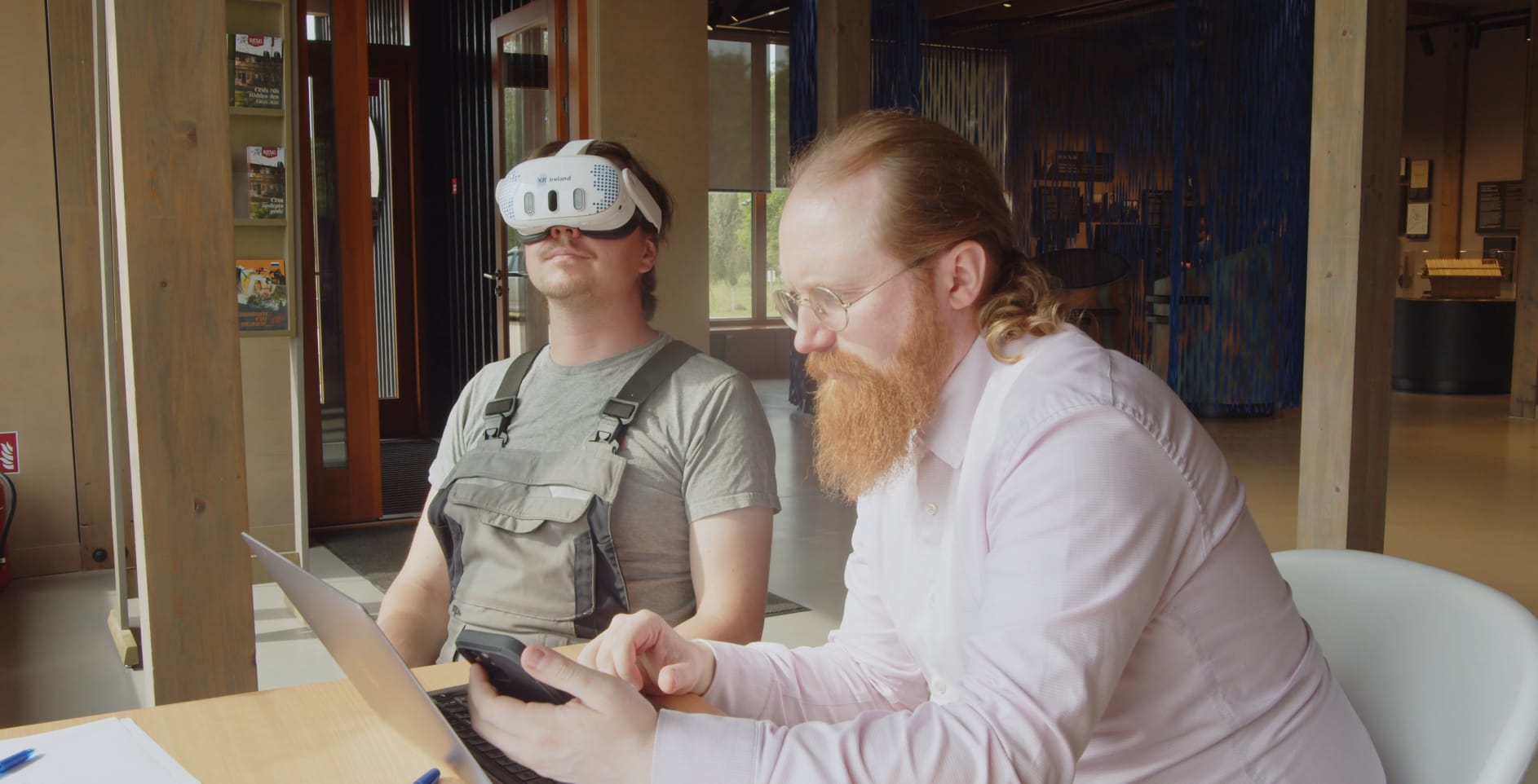
A Unity multiplayer server, a WebSocket server for object and state synchronisation, and a separate web application for facilitator inject management coordinated the simulation. Participants joined via VR head-mounted displays, desktop computers, or web browsers depending on hardware availability, a design choice that proved important during validation.
Three-pilot validation
Final validation took place on 14 May 2025 in Paris with eight participants drawn from Action Contre la Faim's internal emergency roster, organised as two teams of four representing Programme Lead, Logistics, and Finance functions. Five of the eight had completed emergency deployments; six had participated in three or more previous simulation exercises. A rehearsal on 25 March 2025 had identified earlier integration bugs and workflow friction points.
Pilot 1: Arrival briefing. Each participant engaged individually with Mentor Maud, an AI avatar explaining emergency management cycle phases (preparation, alert, response, recovery, mitigation) and concepts including Emergency Preparedness and Response Plans, Emergency Cells, Rapid Emergency Action Teams, and Multi-Sectorial Assessments. Rated 3.2 out of 5, the lowest of the five components, with participants reporting that elaborate VR environments created unnecessary cognitive load when the task primarily involved absorbing conceptual information.
Pilot 2: Collaborative alert and response. Four-person teams in a virtual coordination office responded to a storm-induced flooding scenario in the fictional Soffeta province, with media reports of 8,000 initial displacements and government projections of 200,000 impacted. Teams established an Emergency Cell, conducted information analysis, and outlined sectoral response strategy across water, sanitation, food security, and shelter. Rated 3.6 out of 5 (collaborative work) and 3.4 out of 5 (response strategy tool), with co-located physical presence in the same room creating awkward dynamics when participants tried to collaborate virtually.
Pilot 3: Implementation and stakeholder negotiation. Participants confronted day-14 field challenges including negotiating access with local authorities, coordinating distribution logistics, and addressing community equity concerns, through one-to-one dialogue with AI stakeholder avatars exhibiting realistic cultural communication styles, bureaucratic caution, or community advocacy perspectives. Rated 4.2 out of 5, substantially the highest score. Participants reported authentic emotional engagement and recognised the value of safe practice for soft skills that are notoriously hard to develop through conventional training.
Outcomes and lessons
System Usability Scale assessment produced an average score of 59%, below the 68% threshold generally considered acceptable but typical for complex professional tools at this stage. Overall added value across all five components averaged 3.5 out of 5; overall satisfaction averaged 3.3 out of 5, with 50% of users awarding the maximum 5 of 5 and others more cautious, a pattern consistent with selective rather than universal fit.
The strategic conclusion was clear-eyed: XR delivers measurable value for situated practice of complex interpersonal skills but provides limited benefit over conventional e-learning for theoretical knowledge transfer. Desktop participation proved adequate for most uses, with VR headsets enhancing immersion without fundamentally changing learning outcomes, a finding that removes the requirement for organisations to invest in expensive head-mounted displays. AI speech recognition struggled with accented English from non-native speakers, identified as a blocker for international deployment across humanitarian operations.
From XRisis to SimExBuilder
The validation achieved Technology Readiness Level 7 (system prototype demonstration in operational environment). The platform subsequently evolved through the ImmErgenSim brand into SimExBuilder, a low-code simulation authoring tool targeting humanitarian, healthcare emergency preparedness, industrial safety, and education sectors, with commercial launch planned for Q2 2026. The work was recognised as one of ten 2025 Unity for Humanity Grant winners from nine countries, alongside continued dissemination through EuroXR 2025, IDRC 2025, XR Expo Stuttgart, Viva Technology Paris, and Eirmersive meetups.