


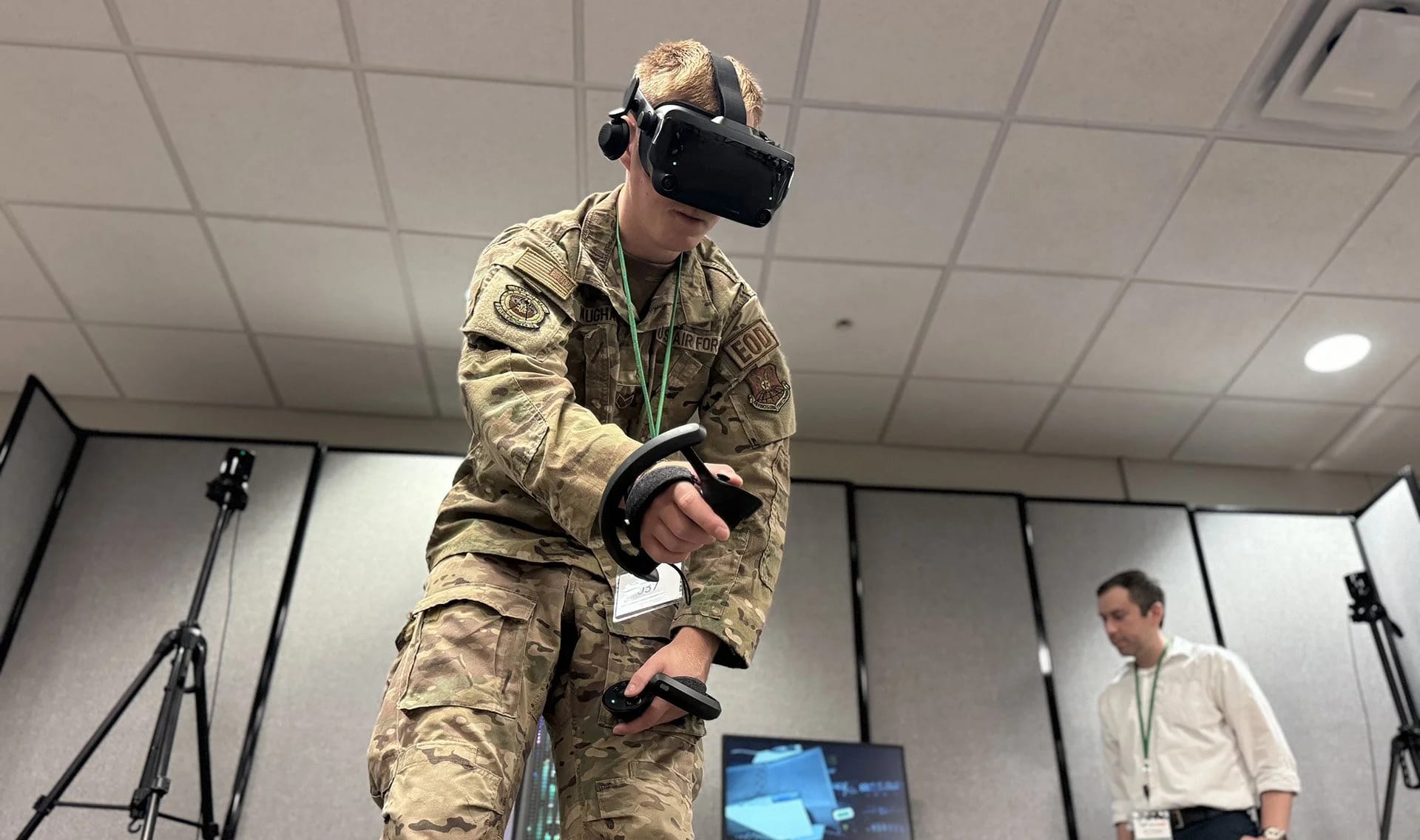
Air Force Global Strike Command (AFGSC) has piloted a virtual reality trainer for explosive ordnance disposal (EOD) Airmen who respond to nuclear weapons incidents. The command sought a new training model because existing training was available only at a select location. It worked through STRIKEWERX, the innovation hub of the Cyber Innovation Center (CIC), which brought in Adaptive Immersion Technologies (AIT) as the technology partner.
How the trainer works
AIT's game-based platform runs virtual reality missions that mirror real-world hazards, conditions and radiation physics. Trainees are placed at a virtual aircraft crash site and work through scenario decision-making under varying conditions such as weather and time of day. The platform is multiplayer, and trainees receive feedback on the cognitive skills required during actual operations. A case-study photo of an Airman testing the prototype shows a headset, hand-held motion controllers and room tracking sensors.
Rollout and results
Testing confirmed improvements in reliability, usability and training impact, and the project is still described as a prototype. Further development has continued:
- More than $2 million in additional funding from the Defense Threat Reduction Agency has supported further software enhancements.
- Two additional systems have been installed at Kirtland AFB.
The CIC case study reports the following outcomes for the VR trainer. The source does not state the baseline or measurement period.
- Nuclear qualified EOD units: an 8X increase in training repetitions per year, a 97% reduction in set-up time and an 83% reduction in cost.
- Nuclear certified EOD units: about a 3X increase in training repetitions per year, a 98% reduction in set-up time and a 94% reduction in cost.
The CIC received a Globee Award for the collaboration in October 2026. An AFGSC project champion said the prototype has the potential to change how the Air Force trains in EOD.


