

Background
Akademi Laut Malaysia (ALAM) is Malaysia's leading maritime education and training institution, operated by Malaysian Maritime Academy Sdn. Bhd., a wholly-owned subsidiary of the MISC group (Malaysia International Shipping Corporation Berhad, part of the Petronas group). Founded in 1976, the academy has trained more than 15,000 maritime professionals for onshore and offshore operations from its 75-acre campus at Kuala Sungai Baru in Melaka, overlooking the Straits of Malacca.
Simulation has been part of ALAM's teaching for two decades. The academy's relationship with the marine technology group Wärtsilä began in 2006 with the launch of its Maritime Simulation and Communication Centre, which built up a Full Mission Ship-handling Simulator alongside full-mission engine room and liquid cargo operations rigs.
The deployment
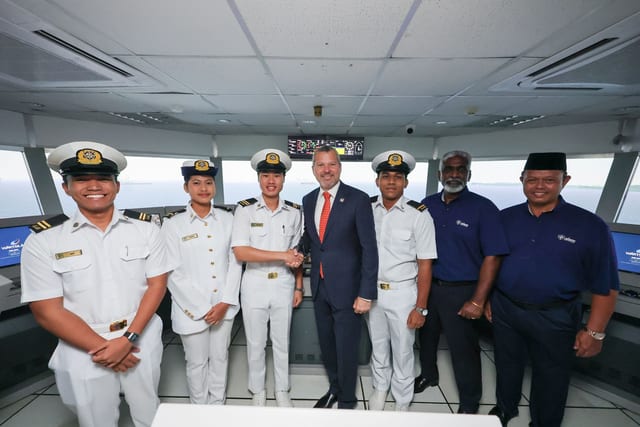
On 17 July 2025 ALAM inaugurated its Maritime Experiential Learning Centre, a new simulator training hub supplied by Wärtsilä. The launch was officiated by Arsenio Dominguez, Secretary-General of the International Maritime Organization, during his first courtesy visit to Malaysia, and was held in conjunction with Malaysia Maritime Week 2025.
The centre was established through a strategic collaboration between ALAM and Wärtsilä to advance immersive maritime education, and replaces and extends the academy's earlier simulation capability with cloud-enabled systems that reproduce real-world vessel operations.
Simulators and technology
The navigation side of the suite is built around a full-mission ship's bridge with 270-degree visualisation, backed by three part-task bridges with 120-degree visuals, dynamic positioning capability and extended reality (XR) training functions. On the technical side, the delivery covers full-mission and multi-functional network classroom set-ups for both engine-room and liquid cargo handling training, plus GMDSS and ECDIS classroom simulators and Wärtsilä cloud-based simulation for blended learning.
Characteristics the academy and vendor single out include:
- High-definition visuals with virtual reality compatibility, so scenarios can be run as immersive sessions rather than screen-only exercises
- Advanced physics and environmental effects reproducing real ship-handling and hydrodynamic conditions
- Cloud simulation, allowing remote access and scaling beyond the physical campus
- Automated grading tools giving objective, consistent assessment of cadet performance
- A touchscreen interface for rapid scenario configuration across different vessel types and operating conditions
A distinguishing element is Wärtsilä's advanced dual-fuel simulator technology. Alongside conventional engine types, it lets ALAM teach seafarers to operate on prospective sustainable fuels including methanol and ammonia — competencies the industry needs as it moves toward decarbonised operations.
Recognition
At the inauguration Wärtsilä announced that ALAM had been admitted to its MASTERS programme (Maritime Advancement in Simulation, Technology and R&D Services), making the academy the first MASTER centre in the Asia Pacific region. The programme formalises Wärtsilä's relationship with maritime training and R&D providers that are both heavy users of its simulation products and active collaborators on advancing maritime training practice.
Training scope
ALAM's simulator-based training covers ship-handling and manoeuvring at operational and management level, bridge resource and team management, marine pilot training, ship-to-ship and VLCC operations, offshore supply vessel manoeuvring, engine-room operations and resource management, LNG bunkering, IGF Code courses, and liquid cargo and ballast handling for LNG, oil and chemical carriers. The bridge and engine-room simulators are fully integrated and depict a modern vessel, so navigation and engineering teams can be exercised together.
ALAM's chief executive framed the centre as support for a broader ambition to become the maritime university of choice in Asia, while Wärtsilä's simulation and training lead pointed to the breadth now available — from basic navigation and engine-room operations through to complex procedures, research studies and integrated emergency response drills, all rehearsed in a controlled and safe setting.

