

Background
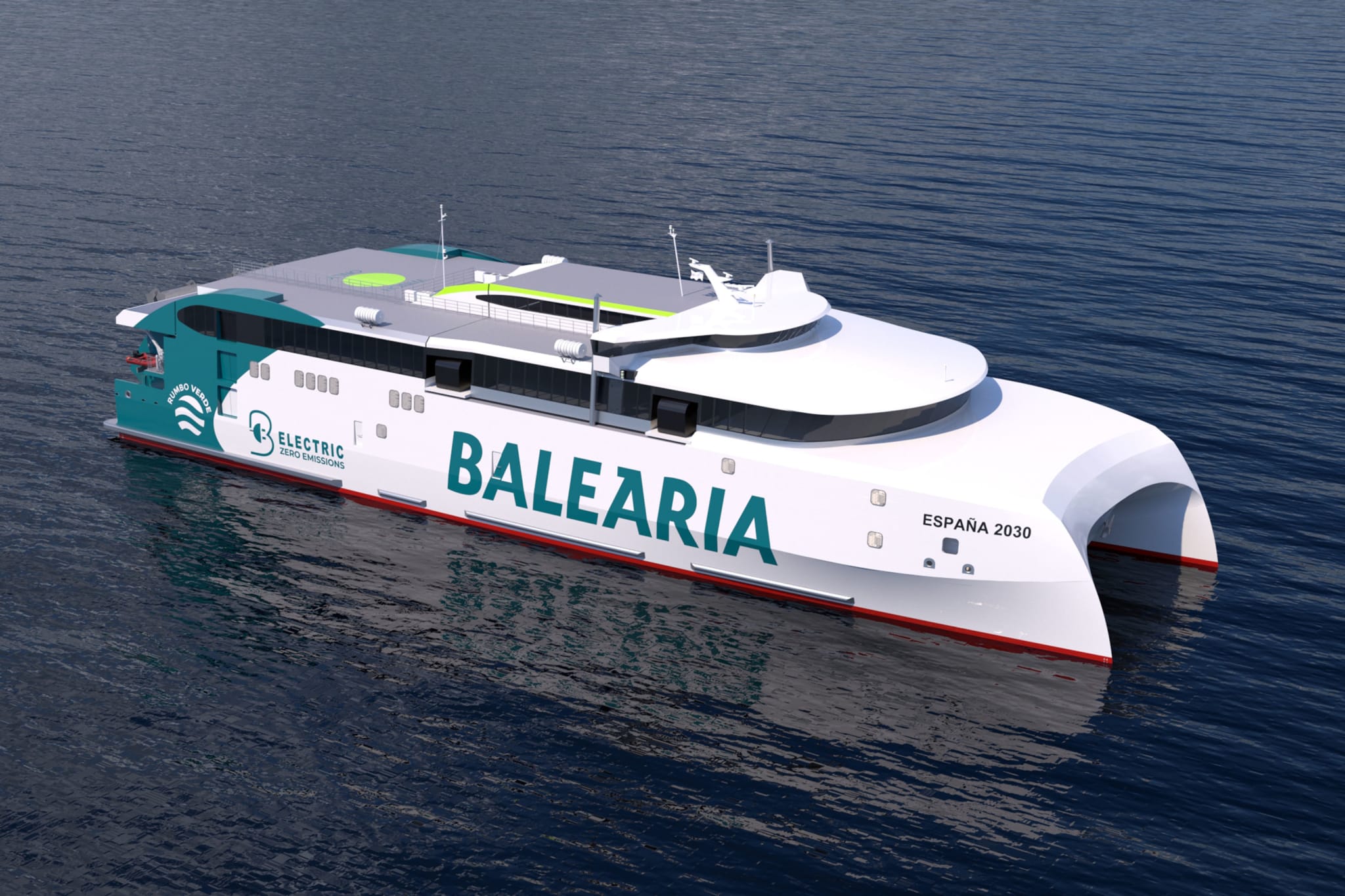
Spanish ferry operator Baleària is building two 87 m by 25 m all-electric ropax fast ferries, España 2030 and Maroc 2030, to run the 29-km crossing between Tarifa in Spain and Tangier in Morocco — what the operator calls the first green shipping corridor between Europe and Africa. The €135M pair is designed by Australian naval architects Incat Crowther and built at Astilleros Armon's Gijón shipyard for launch in 2027, backed by a 15-year route contract from the Port Authority of the Bay of Algeciras. Each ship carries 804 passengers and 225 vehicles at 26 knots on 16 MW of electric propulsion drawn from 11,500-kWh battery banks, recharged in 40 minutes by robotic shore-connection arms during a one-hour layover.
Reviewing the ships before they are built
The programme is run through a single 3D model that the project's stakeholders can stand inside rather than read off a drawing. The structural models are authored in SSI ShipConstructor, and augmented and mixed reality stream them to Microsoft HoloLens headsets, so the parties can visualise, review and test the ship at full scale well before any plate is cut on the shop floor.
Incat Crowther chief executive Brett Crowther describes the model as central to the Baleària project precisely because stakeholders could engage with it throughout — a collaboration that began well before construction and continued through it. Digital models are not themselves new to ship design; 3D product models have been used for two decades to build complex floating storage and regasification units. What has changed is that the model is now put in front of non-specialists at 1:1 scale, in a headset, and their reactions are treated as design input.
The approach was proven on Incat Crowther's earlier seven-vessel commuter ferry programme for Sydney Harbour, where the operator's own masters and crew assessed the design in headsets before build.
Reported benefits
The stated gains are workflow ones rather than measured savings:
- The plate shop receives instructions sooner, and fabrication is more efficient and more accurate.
- Assembly is faster, and misunderstandings between distributed parties are avoided.
- Fewer late modifications to class and construction drawings than under the previous two-dimensional process.
- Knowledge moves between collaborators on different continents without anyone travelling.
SSI expects mixed and augmented reality to take on more of the design, verification and maintenance workload as the tooling matures.
Project partners
Alongside the shipyard, the programme involves naval engineering and maritime consultant Cotenaval, Spanish utility Endesa and Moroccan electricity distributor Amendis on the vessels and their shore-power infrastructure, and Bilbao-based Oliver Design on the passenger interiors. The ports of Tarifa and Tangier have earmarked US$72M between them for onshore power supply — 5 MW and 8 MWh of shoreside battery storage at Tarifa, 8 MW and 8 MWh at Tangier.

