


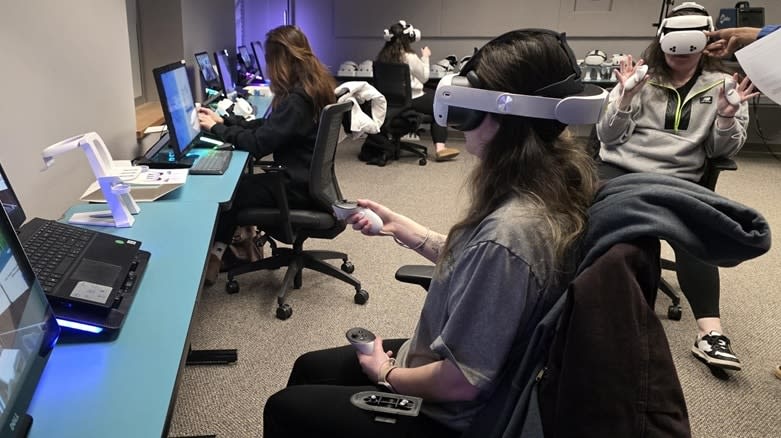
Carroll Community College in Westminster, Maryland runs a Virtual Reality (VR) Lab that supports instruction across disciplines. The college piloted VR in late 2020 with just two headsets to gauge interest, rather than making a large initial investment. Positive feedback then guided a phased expansion, and federal Higher Education Emergency Relief Fund (HEERF) COVID-relief dollars became a key catalyst, enabling the purchase of additional hardware and VR-ready computers as the programme grew. The lab has since moved from a small library space into a larger, dedicated room (A132C in the Great Hall) so more students can use it at once; sessions are free for Carroll students and staff and run by appointment, staffed in part by student workers.
Faculty across departments use VR to support course objectives: medical and industry simulations let students rehearse procedures without real-world risk, soft-skills scenarios build confidence in public speaking and conflict resolution, STEM courses use interactive 3D models and virtual labs, and humanities students experience history and art, such as the 1943 Berlin Blitz or Van Gogh's "Starry Night". The college also licenses shared software subscriptions, including Bodyswaps, across departments such as physical therapist assistant, social sciences and business to control costs. To address motion-sickness concerns, VR content can also be delivered via projectors or monitors as an accommodation, with shorter sessions or augmented-reality alternatives.

