

Background
Medical technology students at Chulalongkorn University's Faculty of Allied Health Sciences learn diagnostic laboratory work in a Clinical Microbiology course taken in their third and fourth years. Theory is followed by a single three-hour practical session in a simulated laboratory that the department prepares for roughly 100 students at a time. Because students do not all learn at the same pace, some were still orienting themselves to the bench when the session ended.
Asst. Prof. Dr. Navaporn Worasilchai, a lecturer in the Department of Transfusion Medicine, built Metaverse Lab-XR to give every student unlimited practice time before that session. The work was carried out with Dr. Patchara Tanubamrungsuk and researchers at the university's Excellence Center of Medical Mycology Diagnosis (MedMyCoE).
The deployment
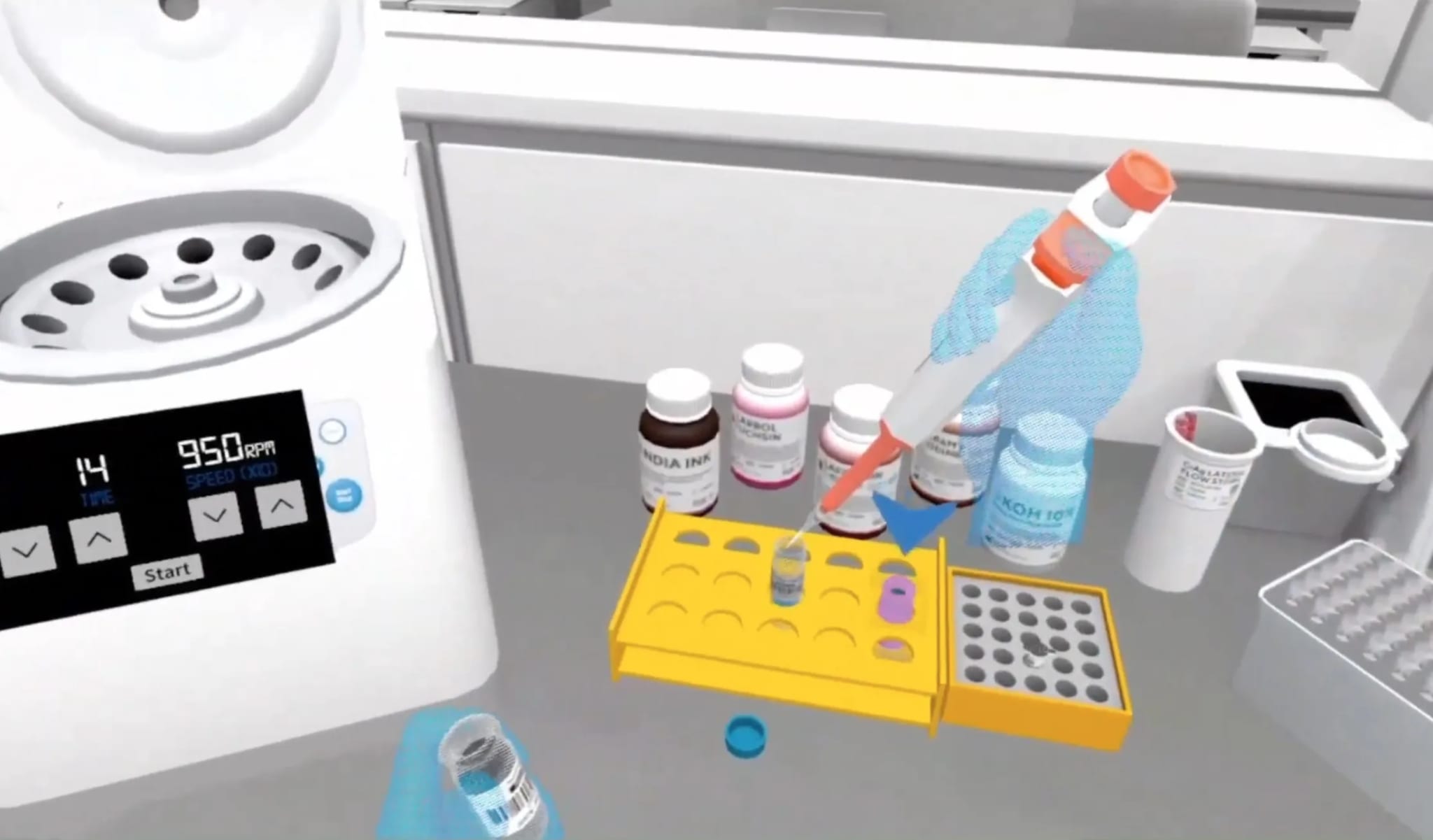
Metaverse Lab-XR has been in routine use in the course since early 2024. It places a student alone in a virtual hospital laboratory — the setting they will work in after graduation — where they carry out the full diagnostic workflow rather than a single isolated task.
The first module covers fungal infection diagnosis, chosen because its specimens are among the most hazardous the course handles: tissue, hair, skin, tears, cerebrospinal fluid and blood, with some fungi transmissible by inhalation. Students work through the pre-analytical checks, select reagents, read the patient history and judge whether the specimen actually answers the clinician's question.
Built-in error scenarios
The simulation deliberately injects faults for students to catch:
- a patient called by the wrong name
- a specimen that does not match what the doctor requested
- a negative fungal result despite clear clinical signs of infection
Each run ends with an assessment against the lesson's objectives, and a facilitator — an expert instructor — debriefs the scenario afterwards to surface what went wrong and why.
Soft skills alongside procedure
The system is explicitly designed to train non-technical skills as well as bench technique: communicating with doctors and nurses across a multidisciplinary team, and critical management — deciding whose results must be prioritised rather than working first-come-first-served, and investigating a result that does not fit the clinical picture.
Outcomes
From observation and research, the team measured an improvement of approximately 20% in student learning outcomes. Students reported that the scoring at the end of each run made them replay to beat their classmates' results, and — an effect the team had not anticipated — that practising unobserved felt psychologically safer than working under an instructor's eye, so they arrived at the physical laboratory more confident and better prepared. Rehearsing first in the virtual lab also means the limited stock of infectious material in the simulated lab is used by students who already know what they are doing, cutting both waste and infection risk.
Recognition and next steps
The project, presented as "Metaverse Lab-XR: The World's 1st Comprehensive VR Training for Medical Laboratory Profession", received the Excellent Innovation Award for Outstanding Innovation in Student Development from Thailand's Ministry of Higher Education, Science, Research and Innovation, at a ceremony in Bangkok on 30 September 2025.
Planned additions cover bacterial, respiratory and viral infection scenarios, and harder cases involving patients with underlying conditions. The team hopes virtual labs of this kind will be adopted by other universities and medical technology laboratories in Thailand and abroad, but to date the deployment described here is Chulalongkorn's own teaching use.

