

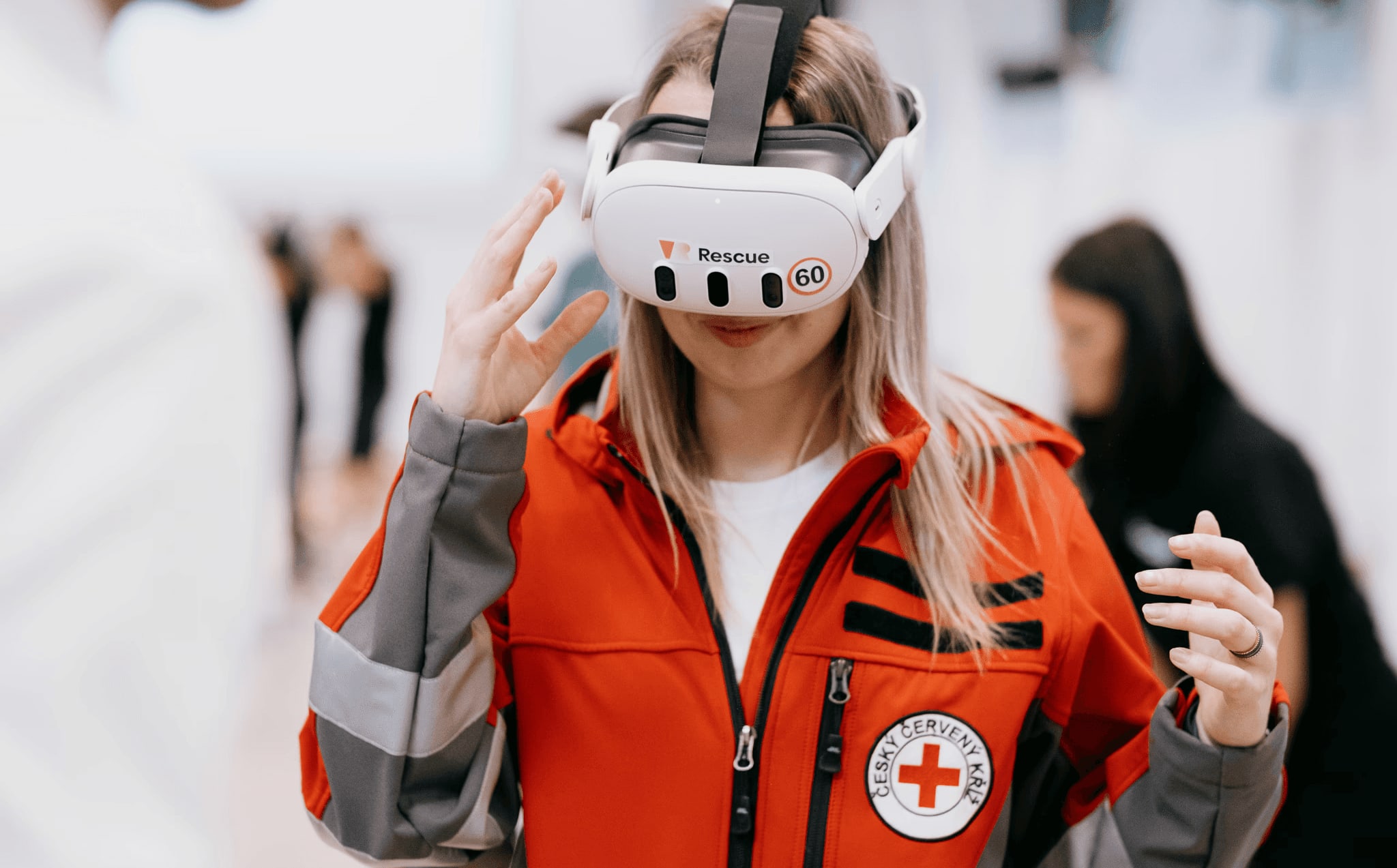
The Czech Red Cross uses VR Rescue, a virtual reality first-aid training experience developed with the organization and medical experts, to teach people how to react in an emergency. Participants wear a standalone headset, face a virtual emergency and perform CPR on a physical mannequin while an AI-powered assistant guides them, evaluates their actions and makes them repeat steps when they make a mistake. A session lasts 15 minutes.
The Red Cross positions the technology as a complement to its conventional first-aid courses rather than a replacement. VR Rescue is made by the Plzeň company VR Training, and the AI assistant follows procedures developed with the Czech Red Cross and doctors from University Hospital Plzeň.
Scale and rollout
Through the #mocPOmoc initiative, organizers are extending the program to schools, libraries, public offices and other locations across Czechia, with an ultimate aim of training 1 million people in first aid.
- More than 240 Czech schools are set to receive the program free of charge, supported by the Czech Insurers' Bureau's Loss Prevention Fund.
- The Czech Red Cross says nearly 100,000 students across all regions should be trained within a year.
- Academic School reported a session in which pupils practised resuscitation with VR headsets in cooperation with the Czech Red Cross.
VR Rescue has been used more widely than the Czech Red Cross rollout alone. Across all its deployments, including use in the city and region of Plzeň, nearly 100,000 people had tried it by late September 2026, and its developer aims to train 100,000 people by the end of 2026. Plzeň Region, for example, has run its own systematic VR first-aid training for nearly 30,000 secondary school students, starting in Klatovy, where schools can train as many as 700 students per week, including during physical education classes.
What comes next
Self-service VR Rescue stations are planned for libraries, public offices and science centers, where users will activate the training with a QR code. Separately, the City of Plzeň already operates a free public VR Point for first-aid training with VR Rescue.
Czech Red Cross Vice President Jana Majrichová says combining traditional courses with virtual reality training is proving very effective, and VR Rescue developer Marek Bárdy says the goal is for first-aid skills to reach the level of basic literacy.


