
Background
On an offshore drillship the nearest hospital can be hours away by helicopter, and the four to six minutes after a suspected cardiac arrest belong to whoever is standing next to the casualty. The industry's baseline qualification, the OPITO BOSIET certificate, covers CPR as one module and is typically renewed once every four years — a long interval for a skill whose compression depth, rate and rhythm decay within months of practice.
Closing that gap the conventional way means flying an instructor out to the vessel: expensive, weather-dependent and disruptive to a drilling schedule.
The deployment
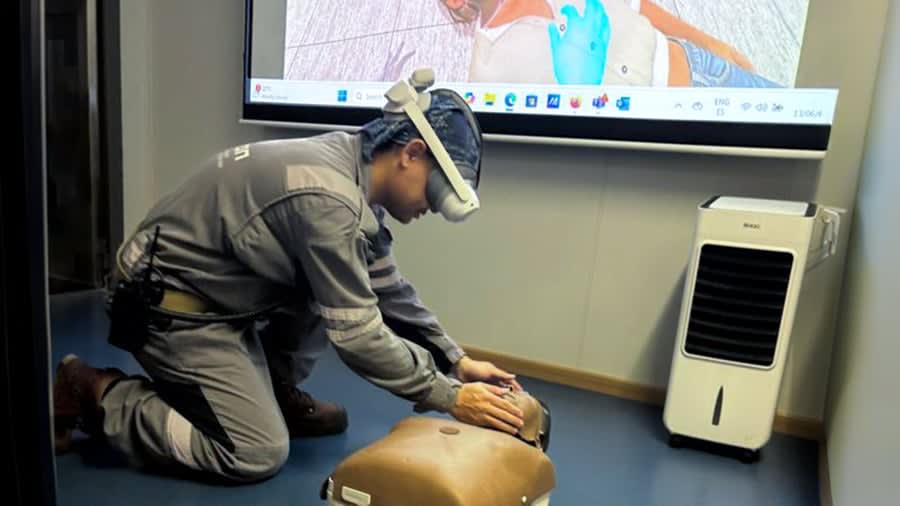
In 2025 Deepsea Networks, an offshore connectivity and managed-services provider, ran a pilot with Spanish VR safety-training developer Ludus Global that both partners describe as the first immersive VR CPR training delivered live on an active drillship. The package was built to drop into a working vessel with no IT involvement:
- A standalone wireless VR headset, set up in the vessel's meeting room within minutes
- The Ludus CPR simulation, running wireless with hand tracking and compatible with any standard CPR manikin
- Built-in offshore connectivity, so the simulation could be deployed and updated at sea
- An OPITO-certified instructor who delivered the sessions and trained the vessel's Offshore HSE Advisor to run them independently afterwards
Because the simulation is hand-tracked and manikin-agnostic, it needs no controllers, no PC, no cables and no sensorised training dummy — the constraints that usually rule VR out offshore. Deepsea moves the headsets in a rugged transit case that charges and manages the fleet.
Outcomes
- Roughly 3× the crew participation of a typical offshore training session
- Higher confidence and engagement, by the crew's own report
- Zero technical setup required from the vessel's team
- Feasibility proven for rapid deployment across other offshore assets
Every session is logged to the Ludus statistics dashboard, so the on-board HSE Advisor can see which crew members struggle with compression depth and which scenarios cause hesitation, and can pull per-person reports — a running picture of readiness rather than a four-year-old certificate.
What's next
Deepsea Networks and Ludus are in discussions to extend the programme to further vessels in Deepsea's network and to more of the Ludus catalogue — first aid, fire safety and confined spaces among them.

