


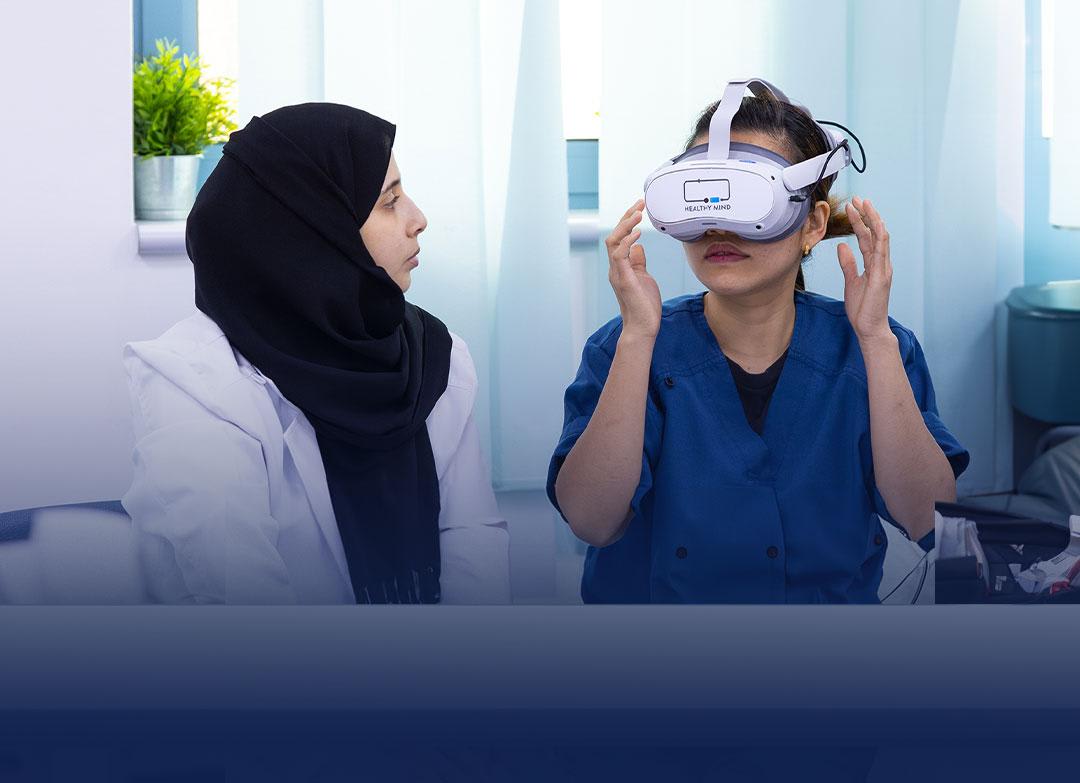
Dubai Health gives patients a therapeutic virtual reality headset during intravenous cannulation so they are distracted from the needle and feel less pain and anxiety. The programme is run by Dubai Health's Center for Innovation and Technology and began at the Dubai Thalassemia Center, whose thalassemia patients need frequent transfusions and therefore frequent needle insertions.
Dubai Health announced the programme on 8 May 2024, describing it as "the first phase of integrating VR technology across Dubai Health hospitals and healthcare centers, with plans to extend its application into medical procedures at Al Jalila Children's Hospital and Latifa Hospital". Those two extensions are stated intent; no source confirms either has gone live.
The clinical evaluation is registered as NCT07099196, "Evaluating the Potential of Virtual Reality in Alleviating Pain and Anxiety Among Thalassemia Patients During Intravenous Cannulation: A Crossover Clinical Trial", sponsored by Mohammed Bin Rashid University of Medicine and Health Sciences with MD student Sameer Asim Khan as principal investigator. It ran from 24 May 2024 to 20 August 2024, enrolled 115 participants and is recorded as completed. Each participant acted as their own control, receiving standard care at the first visit and VR at the next two cannulations. Primary outcomes were pain and anxiety on a 0-10 visual analogue scale, with fatigue, boredom, satisfaction, blood pressure and heart rate as secondary measures. No results have been posted.
The registered device is a "HEALTHY-MIND(c) PICO G2 Virtual Reality headset, which is medically graded and suited for distraction and relaxation in clinical settings", listed under the alternative names medical hypnosis, relaxation tool and therapeutic virtual reality. Healthy Mind is a French therapeutic-VR provider whose content combines immersion with medical hypnosis and breathing exercises. Dubai Health said the technology it selected had "demonstrated clinically effective results in 14 published and 30 ongoing studies". The 2024 announcement also said the study would incorporate "objective measurements such as eye movement tracking and heart rate"; the registered protocol lists only the visual analogue scales plus blood pressure and heart rate, so the eye-tracking claim is unconfirmed.
By 10 February 2026 Khaleej Times reported that more than 100 mainly paediatric patients had used the headsets and that Dubai Health was extending the approach to emergency and mental health settings and to more of its hospitals. Yacine Hadjiat, who in 2024 was an associate professor of innovation in health science and digital health at MBRU, is by then described as director of Dubai Health's Center for Innovation and Technology, a roughly 2,000-square-metre hub inaugurated in September 2025.
A related but separate project at the same centre, Pain Detect, is developing a wearable that measures pain objectively from body signals using AI, aimed at children and intensive-care patients who cannot describe their pain; it holds a 2024 research, development and innovation grant associated with the Dubai Future Foundation. It is not a spatial or immersive system and is not part of this deployment. Dubai Health's innovation portfolio also lists an AI-powered VR neurotherapy project and an extended reality and brain-interface lab, both distinct from this procedural-distraction programme.

