


Background
Confocal microscopy underpins a wide range of academic and industrial workflows, from assay development and screening to product testing and quality control. But the instruments are expensive and heavily shared, and many of the people who need reliable images from them are not microscopy specialists. Time spent learning the controls on a live system is time the instrument is not producing data, and a badly set up experiment wastes both samples and instrument hours.
The deployment
Durham University's bioimaging team runs the ZEISS Certified Professional Course in Confocal Microscopy, a two-day programme delivered in person on its own campus and announced on 26 March 2026. The next scheduled run is 25-26 June 2026, and a place costs £1,000.
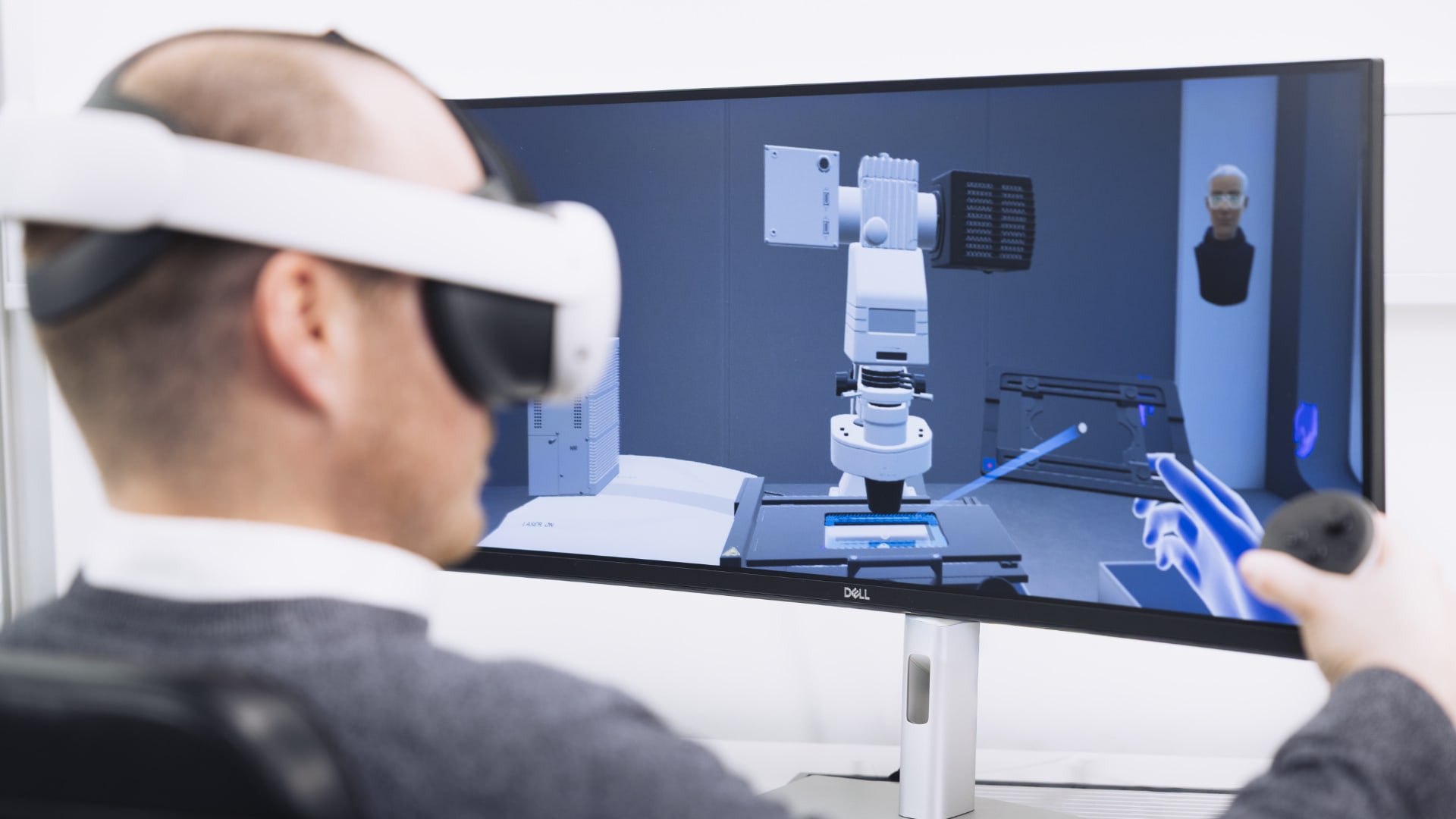
The course puts virtual reality before hands-on practice. Participants work through four custom-built VR training modules and four interactive e-learning modules, then move onto real instruments with Durham's imaging specialists, finishing with application talks from field experts. No previous confocal experience is required.
Inside the virtual laboratory
In the VR modules, learners stand in a virtual imaging suite and work with a virtual confocal microscope. Across the four modules they:
- explore system components and see what actually drives image quality
- adjust acquisition settings in a risk-free environment before touching a real instrument
- design multichannel and 3D volume experiments modelled on typical industrial assays
- practise live-cell imaging and learn how to protect samples while still getting usable data
- test themselves through gamified VR challenges with expert feedback
The stated purpose is to make the subsequent hands-on time on real microscopes focused and efficient rather than exploratory.
Who built it
The programme was jointly developed by imaging and learning specialists at ZEISS, Durham University and the University of Glasgow. Although current ZEISS confocal systems are used to demonstrate the techniques, the teaching is deliberately system-agnostic, so participants can apply what they learn on any confocal platform back in their own laboratory.
Hands-on and instrumentation
Practical sessions use three confocal systems in Durham's facility: an LSM 980 with Airyscan 2 (inverted), an LSM 880 with Airyscan (inverted) and an LSM 800 with Airyscan (upright). A range of biological samples, from human cells and tissues to plant material, is supplied, and participants may bring their own for tailored setup advice.
Context
Durham University joined the ZEISS Labs@Location partnership programme in May 2026, a network of research institutions that host training, system demonstrations and collaborative research around advanced bioimaging platforms. The VR course is offered through the university's continuing professional development programme and is open to researchers, technicians and imaging professionals from academia and industry across the UK, Europe and beyond.

