

Background
Heijmans, one of the Netherlands' largest construction and infrastructure firms, has run its GO! (Geen Ongevallen / “No Accidents”) safety programme since 2013. To make hazard awareness stick on busy sites, the company added a virtual-reality strand: crews now rehearse dangerous construction-site situations in a simulated environment, making mistakes safely instead of on a live site.
The deployment
Working with KPE Groep, a developer of training programmes for the construction and real-estate sector, Heijmans built a suite of six VR safety modules: working at height, order and cleanliness, the saw shed, attitude and behaviour, slinging loads, and excavation-damage prevention. New modules are added each year. The simulations are deliberately photoreal — the team filmed inside a real Heijmans workshop so the scene is recognisable and feels like the work floor rather than a game.
How it is delivered
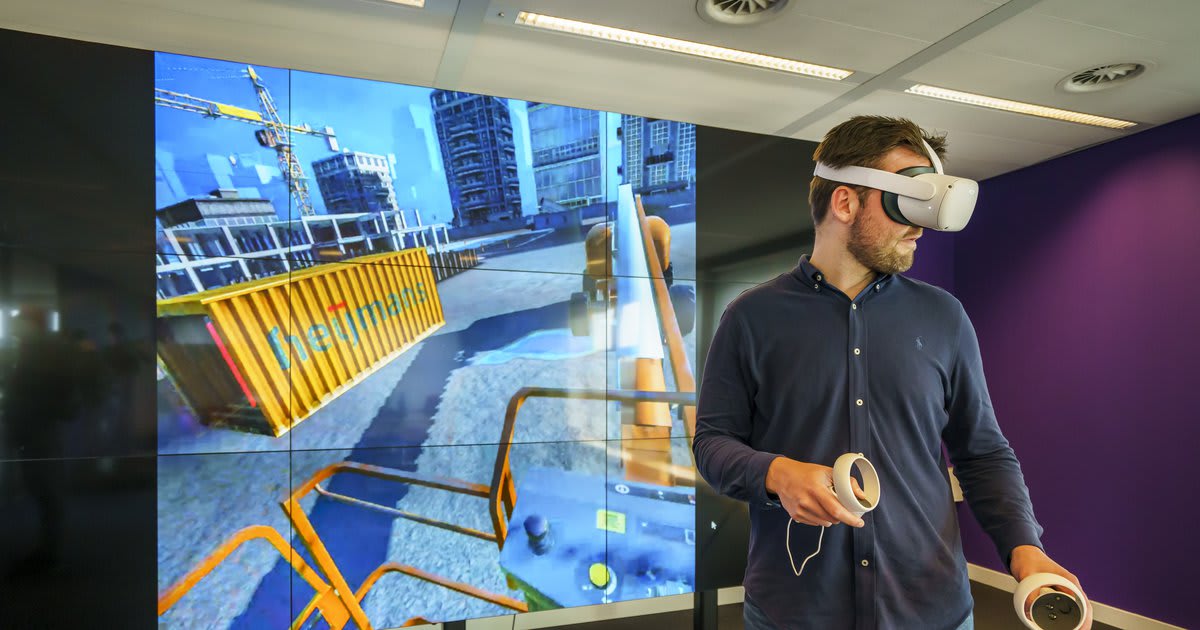
Sessions run on site during the monthly toolbox meeting, to groups of around fifteen workers, with a specially trained Heijmans colleague guiding each participant. The trainer watches the wearer's point of view on a large screen and reads their reactions; colleagues waiting their turn watch the same feed and learn from each other. Each scenario is debriefed afterwards — what went well, what could be safer, and whether participants showed safe behaviour.
Hardware and software
- Workers wear a standalone Meta Quest 2 headset with two 6DoF controllers and move through the scene hands-on.
- The training content is custom real-time 3D, developed by KPE Groep and rendered on-device.
- The saw-shed module, for example, has the wearer check for missing safety glasses or hearing protection, set the machine up correctly and react to material kickback.
Outcomes
Reception has been strong: over 90% of participants say the training helps them work more safely, and the modules score an average of eight or higher out of ten. Trainers report visible behaviour change, with crews working more consciously after a session. Heijmans also feeds evaluation insights back into improving the modules, and keeps VR alongside hands-on instruction rather than replacing it.
What's next
The first modules won several industry awards. Heijmans and KPE are now offering the VR trainings to the wider construction sector through a paid subscription, with KPE handling sales through its industry network.

