


Background
IFFEN — the Institut Français de Formation en Énergétique — is a vocational training centre near Paris, in Villeneuve-Saint-Georges, specialising in refrigeration, air conditioning and renewable-energy trades. One of its core programmes prepares technicians for the attestation d'aptitude à la manipulation des fluides frigorigènes, the mandatory French certification required to handle refrigerant gases in cooling and air-conditioning systems.
Handling these fluids demands rigorous technical skill and a precise grasp of safety and environmental rules. A regulatory change due from January 2027 will extend the certification to cover higher-risk refrigerants — flammable gases, ammonia and CO₂ — which are more hazardous to work with and require training centres to invest in specialised, safety-hardened equipment.
The deployment
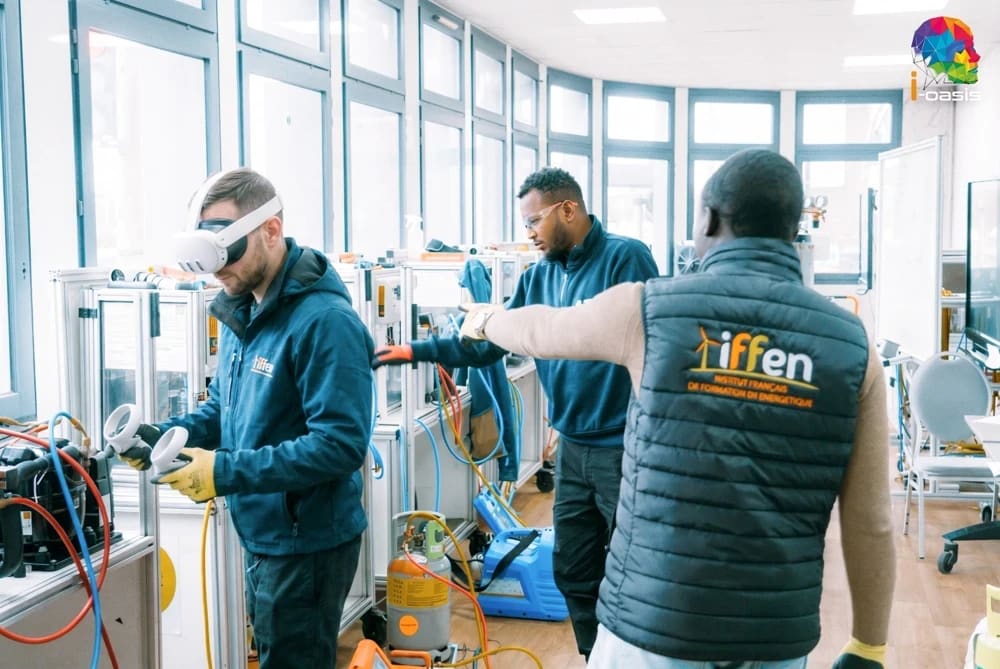
To modernise this training and de-risk it, IFFEN worked with i-Oasis, a French immersive-training developer, to add a virtual-reality stage to the course. The programme now follows a structured, hybrid path: classroom theory, then a VR simulation, then hands-on practice on real equipment.
The module built by i-Oasis immerses the learner in a faithful reproduction of a real intervention environment, where they can manipulate equipment, follow protocols and observe the effects of their actions. Learners work in a standalone VR headset with hand controllers on the training floor, and the graphic and audio fidelity is used to sustain concentration, engagement and retention.
Learning by error
The central benefit is the ability to learn by making mistakes safely. In VR a trainee can try different actions, get things wrong, see the consequences and correct their technique — with no risk to themselves, to colleagues or to equipment. Before moving on to hands-on practical work (travaux pratiques), each learner passes a VR-based assessment under a trainer's supervision, which validates a minimum level of procedural competence and surfaces any remaining gaps.
Outcomes and significance
According to i-Oasis and IFFEN, learners who complete the immersive preparation approach the practical sessions with more confidence, a better understanding of the systems and sharper awareness of the risks. Critical errors are reduced, and trainers can concentrate on the more advanced aspects of the course rather than correcting basic mistakes. Both organisations present the approach not as a one-off experiment but as a structural part of training for the refrigeration trades — a shift in pedagogy as much as a piece of technology.


