

Background
Instituto Jô Clemente (IJC) is a São Paulo civil-society nonprofit that has worked for more than six decades with people who have intellectual disabilities, autism spectrum disorder and rare diseases, combining health services with education, rights advocacy and supported employment. One of its long-running activities is the expedição urbana — supervised group outings across the city by public transport — and the journey almost every participant makes is the roughly one-kilometre trip from the institute's Vila Clementino headquarters to Santa Cruz metro station, normally walked with a monitor at their side.
The deployment
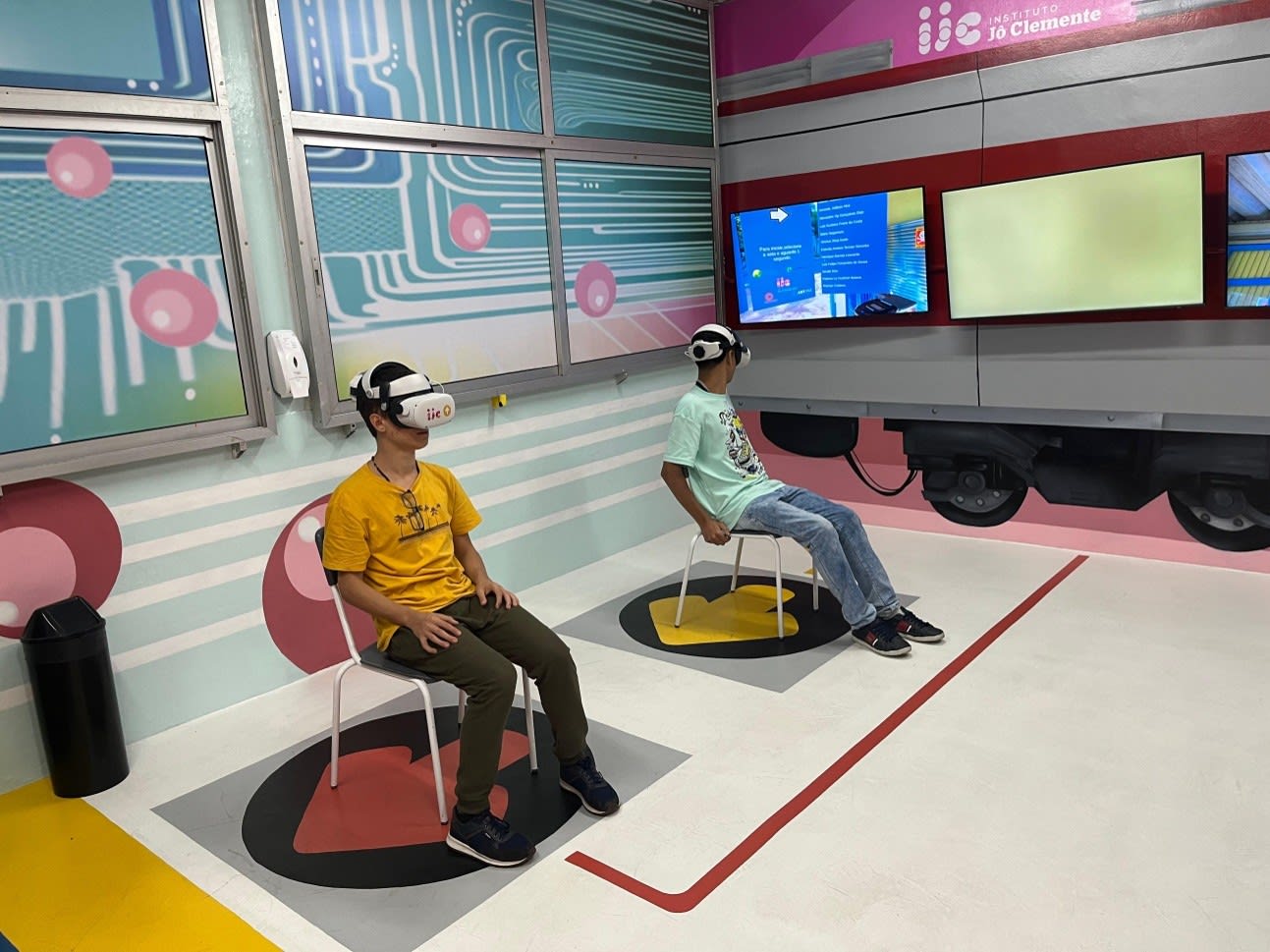
In August 2024 IJC opened a dedicated virtual reality room at its headquarters, funded by the Alstom Foundation and built with the LSI-TEC laboratory at the University of São Paulo's Escola Politécnica. Participants sit in the room wearing Meta Quest 2 headsets and rehearse the route in a simulated São Paulo, while a monitor guides them and a wall-mounted screen mirrors what they see. The physical room is painted by the graffiti collective Os Três with metro trains, station totems and street signage, and the floor is marked with directional arrows so the space itself reinforces the journey.
The simulation reproduces the obstacles that make the real trip difficult: crossing the road, passing through station turnstiles, riding the escalator, reading signage, judging time and choosing what to do next. A game-style scoring system rewards correct decisions along the route, which the developers say makes the training faster and more enjoyable than instruction alone. A former IJC service user, Vitória Rosa — now an inclusion assistant at the institute — worked as a consultant on the first rounds of testing.
Phase two
The second phase, announced in February 2025 and expanded in August 2026, moves the training beyond a single station. Alongside the existing headquarters-to-Santa-Cruz route, the environment now recreates a longer journey requiring transfers at Ana Rosa (Line 1 – Blue) and Consolação (Line 2 – Green) before arriving at Faria Lima (Line 4 – Yellow), one of the city's densest employment districts. The choice of destination is deliberate: the programme is explicitly aimed at preparing participants to commute to a job on their own. Alstom Foundation funding also paid for additional headsets and spare chargers so the room can run without interruption.
By the end of 2026 the environment is due to extend outside the stations altogether, adding street crossings, public spaces and commercial areas encountered on a normal commute.
Outcomes
More than 700 people with intellectual disabilities or autism have been through the experience, and the institute estimates a further 1,800 family members, carers and support-network members benefit indirectly. The programme targets 375 placements in the job market. IJC's educational director reports the most direct result so far: participants who previously had to be walked to Santa Cruz station by a member of staff now make the trip alone.
Partners
- Instituto Jô Clemente — deploying organisation, hosts the VR room and delivers the training
- Alstom Foundation — funder, covering software development, equipment and staff training
- LSI-TEC (USP) — developed the VR software with a team of undergraduate and research students
- Metrô de São Paulo and Motiva — supporting partners

