

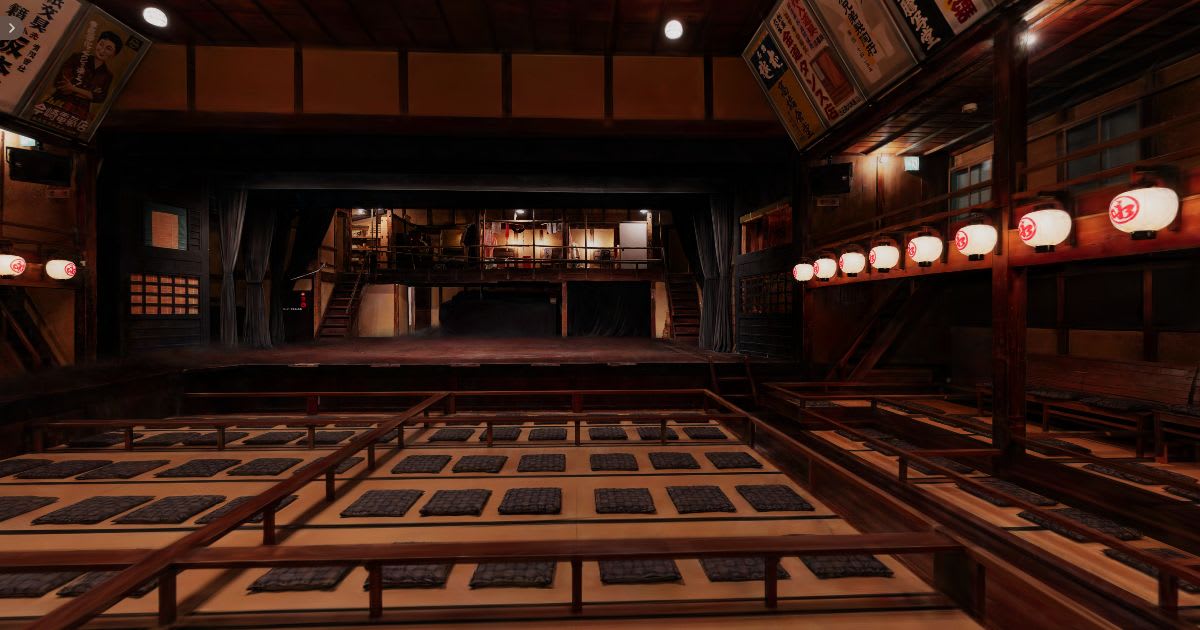
On 28 August 2026 HoloLab Inc. published Eirakukan VR, a walkable 3D digital archive of Izushi Eirakukan — the oldest surviving playhouse in Japan's Kansai region — produced with the cooperation of the theatre, the Izushi Promotion Bureau of Toyooka City and the Digital Strategy Division of Hyogo Prefecture.
Built in 1901 in the castle town of Izushi and closed in 1964 as television spread, the theatre was restored between 2006 and 2008 after a two-decade local preservation campaign and returned to use as a working playhouse. It is the only venue in Kansai where the Meiji-era stage machinery survives intact: the revolving stage, the naraku understage, the hanamichi walkway and the suppon trap lift. It has been a Hyogo Prefecture designated cultural property (building) since 19 August 2014.
Capture combined three methods. A Leica RTC360 terrestrial laser scanner supplied the dimensional point-cloud backbone, scanned as one continuous chain from the exterior through the entrance and ticket gate, the flat sajiki box seating and the stage, down into the naraku. A Sony Alpha 7R V mirrorless camera contributed roughly 6,000 photographs for photorealistic detail. An XGRIDS Lixel K1 handheld scanner covered wide areas quickly; in the naraku and around the dressing rooms, where two people cannot pass each other, the operator slowed to about 20 cm per second to hold data quality.
Two reconstruction paths were run over that data. RealityScan produced a conventional polygon-mesh-and-texture model by photogrammetry, keeping the data reusable in ordinary 3D pipelines. 3D Gaussian Splatting produced the presentation layer — the exterior generated in XGRIDS' LCC Studio from the Lixel K1 capture, the interior in LichtFeld Studio — reproducing light and atmosphere closer to what the eye actually sees.
The public space runs on Arrival.Space, the browser metaverse platform from Stratum1 GmbH of Austria, chosen because it opens in a PC or smartphone browser with no app install and handles high-density spatial data such as 3DGS directly. Separate worlds were also published for VRChat (PC VR) and cluster (smartphone). HoloLab frames the project as regional-society DX — cultural-property record-keeping extended into tourism, education and regional promotion — and intends to extend the approach to other sites under the banner 'Virtual Izushi'.


