

Background
KGI Bengaluru, the health science campus of the Krupanidhi Group of Institutions, opened a VR Skill and Simulation Lab on 20 January 2026. The facility was built with MediSim VR, a Chennai-based healthcare simulation company founded in 2018 at IIT Madras, and is presented by both organisations as a long-term academic partnership rather than a one-off technology purchase.
The institutions frame the lab as a response to a structural problem in Indian health science education: large cohorts, wide variation in learner background, and uneven access to supervised clinical exposure, which together make hands-on procedural practice difficult to standardise.
The deployment
The lab embeds virtual reality simulation into formal health science teaching. Students work through realistic clinical scenarios in headsets, repeating complex and high-risk procedures as often as needed in a controlled environment. The stated aim is to move learners from observation-based study toward decision-making practice, allowing mistakes to be made and corrected without any consequence for a real patient.
MediSim VR supplies the simulation platform and the lab setup. The company describes its offering as AI-driven immersive simulation with competency assessment, and runs comparable labs at other Indian institutions, including a centre of excellence at Sri Ramachandra Institute of Higher Education and Research in Chennai. Krupanidhi was named in March 2025 among the Karnataka institutions in MediSim VR's regional rollout, so the January 2026 inauguration formalises an existing relationship.
Inauguration
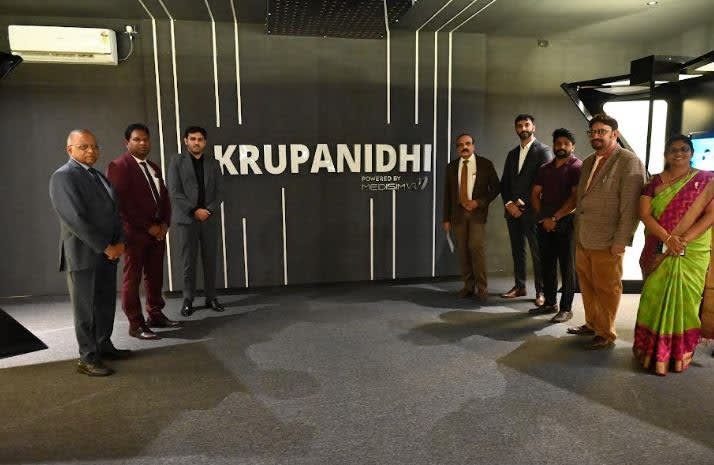
The opening was attended by Dr. Bhagavan B.C., Vice-Chancellor of Rajiv Gandhi University of Health Sciences, alongside senior leadership from the Krupanidhi Group and figures from the Indian simulation education community. The Vice-Chancellor tied the facility to clinical competence, professional confidence, and a culture of patient safety in nursing education.
Outcomes and intent
The stated objectives are improved learning outcomes, reduced variability in training across cohorts, and stronger clinical preparedness before students reach real patients. Both partners position the lab as a replicable model for medical colleges, nursing schools, and allied health programmes elsewhere in India, and connect it to national policy priorities around digital health, skill development, and standardisation in healthcare education.

