


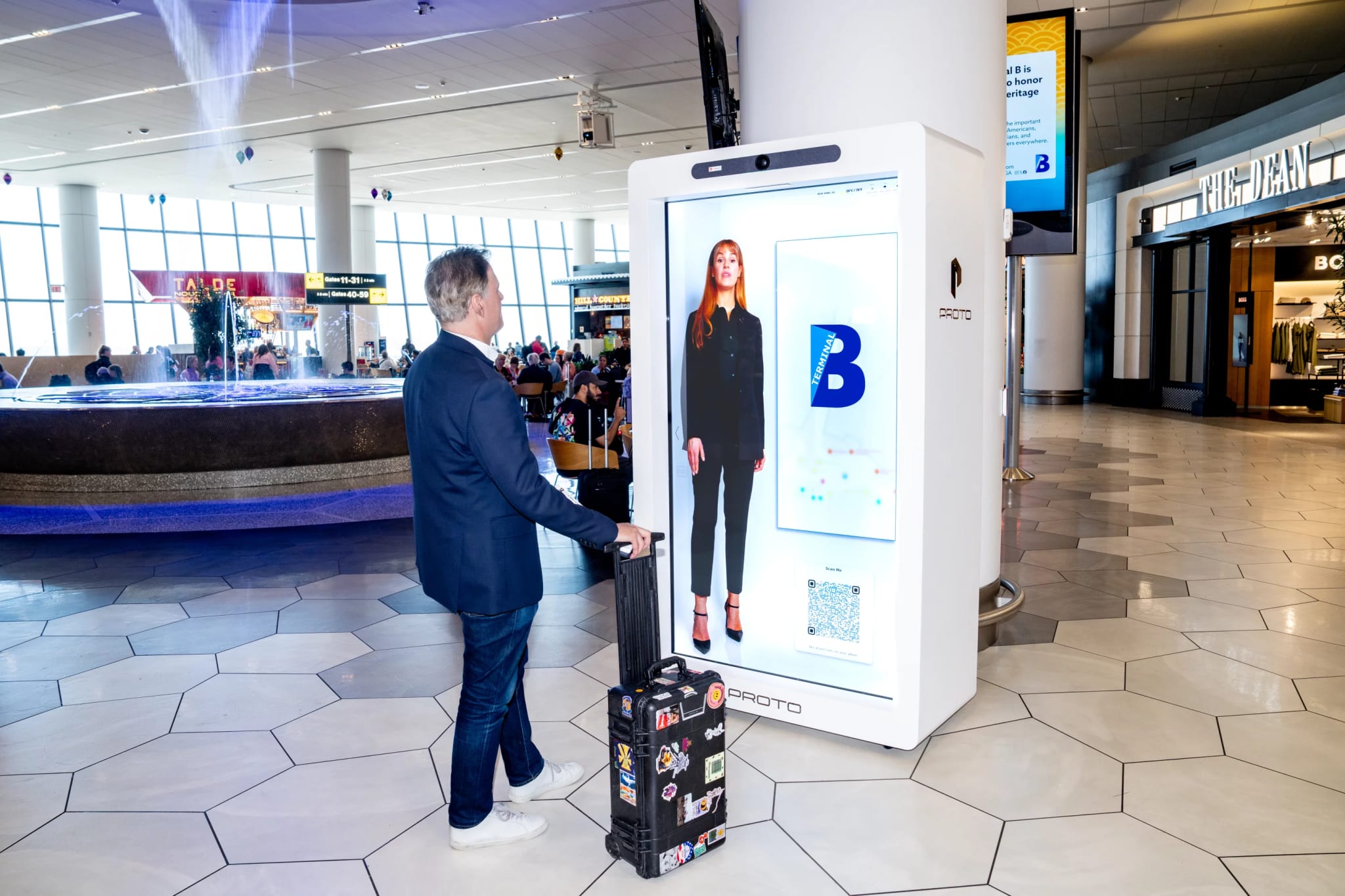
Background
Terminal B at LaGuardia Airport in New York City has installed Bridget, a life-size, conversational AI "hologram" concierge that answers travelers' spoken questions about gates, baggage claim, shops, lounges and other terminal services. The first unit stands near the Terminal B Food Hall, and the operator says more will be added across both of the terminal's concourses.
How it works
Bridget is a collaboration between two companies. Proto supplies the life-size display unit, and Holomedia provides the AI Concierge Wayfinder software platform that powers Bridget's conversation and pulls real-time terminal maps to give step-by-step directions on demand. Travelers speak to the unit in natural language and Bridget responds while displaying live wayfinding maps.
What it is (and isn't)
Proto's unit produces a life-size, brightly-lit avatar inside an enclosure that reads as a "hologram," but technically it is a flat-panel display, not a true volumetric or light-field hologram. It is best understood as an interactive AI kiosk with a pseudo-holographic (simulated-3D) presentation, rather than a glasses-free 3D or volumetric display.
Accessibility and languages
The deployment is designed to be inclusive. The kiosk is fully wheelchair-accessible, carries on-screen subtitles and high-contrast visuals, and currently converses in English and Spanish, with more languages planned.
Context
LaGuardia Gateway Partners, the private company that manages Terminal B, positions Bridget as operational backup for its human guest-experience team during peak demand rather than a replacement. The launch is part of a wider wave of conversational airport assistants; Miami International Airport unveiled its own multilingual holographic assistants around the same period, and Chinese hubs such as Guangzhou Baiyun have pursued large glasses-free 3D screens and biometric automation.

