


Background
The Los Angeles Police Department's Air Support Division is the largest municipal airborne law enforcement unit in the United States, flying patrol, pursuit, search and rescue missions over the city. Its chief pilot, Kevin Gallagher, has said the division struggled to rehearse mission-specific scenarios in the aircraft itself with the realism and frequency that effective training demands.
The deployment
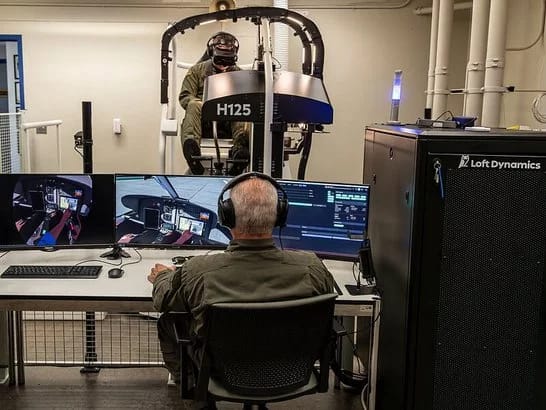
The division bought a full-motion virtual reality flight training device from Loft Dynamics, announcing the purchase at the APSCON public safety aviation conference in August 2024 and unveiling the delivered unit at its Hooper Memorial Heliport in downtown Los Angeles that November. In March 2025 the department went public with the training programme, saying it is the first US law enforcement agency to use VR for pilot training. Pilots trained at the vendor's Santa Monica facility while the device was being built.
How the training works
The simulator pairs a six-degrees-of-freedom motion platform with a full-scale replica cockpit of the Airbus Helicopters H125, the type the division flies. Pilots wear a VR headset for the out-of-the-window view and fly using the physical cockpit controls, which give force feedback. Loft Dynamics' VR flight simulation training devices are qualified by both the Federal Aviation Administration and the European Union Aviation Safety Agency.
Law enforcement scenarios
Rather than adapt civil training syllabi, the division worked with the vendor's engineers to build scenarios specific to police aviation:
- High-speed car chases, with adjustable suspect vehicle speed and route
- Use of the Tyler Special Operations Platform inside the virtual cabin
- Inadvertent entry into instrument meteorological conditions
- Low-altitude pursuit and night vision operations
- Engine failures, emergency landings and instrument approaches
Sharing the curriculum
The department also uses LofTWIN, a Loft Dynamics platform that lets a chief pilot record scenario- and manoeuvre-based lessons in VR. Gallagher has authored lessons covering aerial pursuit through to emergency landings; a trainee flies the lesson sitting beside his full-body avatar in the simulated cockpit, hearing his instruction as the exercise runs. Performance tracking lets pilots benchmark their flying against his, following evidence-based training practice. Because the lessons travel with the platform, operators at other Loft Dynamics simulators can fly the LAPD curriculum.
Scale
50 pilots train on the device at the heliport under a structured, VR-centric curriculum Gallagher designed. Loft Dynamics has pointed to the deployment as a template for other public safety flying roles, including aerial firefighting and disaster relief.

