

Background
Looking Glass is an app-based archive of Black life in Pittsburgh that uses augmented reality to anchor archival material to the streets where it belongs. It was created by Adrian Jones, a creative technologist and archivist who moved to Pittsburgh from Harrisburg in 2017 and began documenting how successive waves of urban renewal and gentrification had erased Black homes, businesses and institutions from the city's East End.
The idea took shape during the first cohort of the Collective Action School, an experimental programme for tech workers whose theme that year was Creative Protest. Jones began building in 2021, and the app spent roughly a year and a half in part-time development between grant cycles.
The deployment
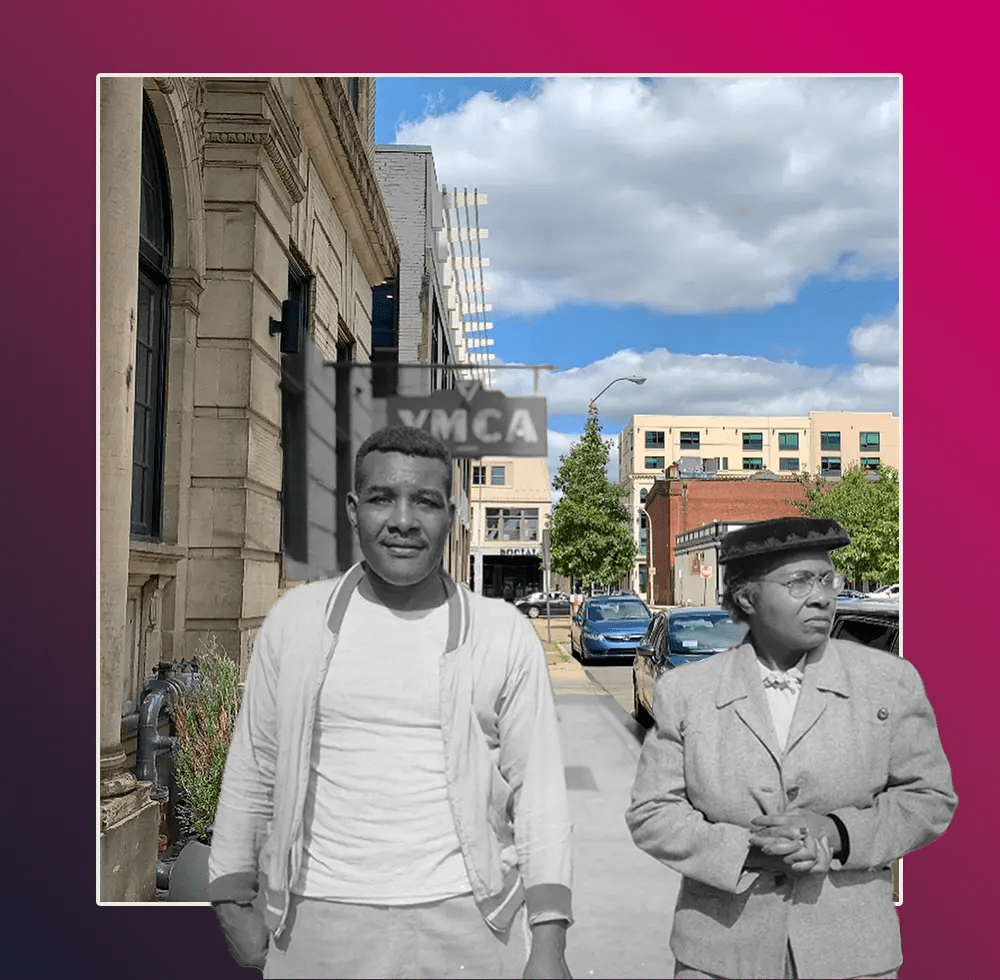
The app's primary feature is an explore view: a map of markers pinned to the exact coordinates of significant people, events and institutions. Walking to a marker brings it in range, and within 35 feet of a site the user can activate its AR lens and see archival photography, artifacts and site-specific 3D sculptures composited onto the present-day street.
The first release concentrates on East Liberty, a neighbourhood whose commercial and residential core was dismantled by a 1960s urban renewal programme. Documented sites include the Penn Plaza Apartments at Penn Avenue and Euclid, demolished in 2017, and a South Highland Avenue storefront that in the early 1960s housed the Pittsburgh Friends of COFO — the northern support network for the Council of Federated Organizations, the coalition of SNCC, CORE and the NAACP that registered Black voters across the segregated South. Neither is legible on the street today.
The beta launched on 29 June 2024 at Emerald City in downtown Pittsburgh, alongside VR story stations and a short film by Jones, A Walk to Enterprise & Frankstown, tracing the former site of Local 471, Pittsburgh's Black musicians union. The app shipped first on iOS, with an Android build following.
Technology
Looking Glass is a React Native application whose AR layer is built on ViroReact, the open-source AR renderer maintained by ReactVision. Jones, a web developer with no prior 3D background, chose it specifically to avoid a game engine: the project holds oral histories entrusted to him by community members, and keeping the stack open-source meant no licensing constraints and full visibility into where that data lives and how it moves through the app. ReactVision's Studio is used separately as a preview tool, letting 3D artists check how assets render before anything reaches the live app; it is not wired into production.
Content is anchored with geospatial AR to real GPS coordinates. Participants use their own smartphones — no hardware was deployed.
Community and archives
Jones consulted residents and subject experts before writing any code, among them Charlene Foggie-Barnett, archivist of the Carnegie Museum of Art's Charles "Teenie" Harris Archive; Joe Trotter, professor of history and social justice at Carnegie Mellon University; John M. Brewer Jr., historian and consultant on the Pittsburgh Courier archive project; Laurence Glasco of the University of Pittsburgh; and Terri Baltimore, creator of the Hill District's Black-Jewish history tour. The Teenie Harris collection at the Carnegie Museum of Art is a principal image source.
A group of BIPOC contributors shaped the app's other media: original music by Pittsburgh producer Danielle Walker (INEZ) with Matthew Maxwell and pvkvsv, and AR sculpture concept art by Victoria Elliott. Advisors Xiaowei Wang and Dorothy R. Santos, stewards of the Collective Action School, oversaw the project.
Funding
Looking Glass is a fiscally sponsored project of the Pittsburgh Center for Arts & Media. It has been supported by grants from the Awesome Foundation and the Opportunity Fund, and in 2025 received $50,000 through Advancing Black Arts in Pittsburgh, the grants programme run jointly by The Pittsburgh Foundation and The Heinz Endowments, to grow the platform and its community storytelling work.
What's next
Planned additions include an audio library pairing oral history interviews with original music, guided tours, deeper interaction with the 3D objects in each scene, and geospatial anchoring refinements. Jones is building partnerships with universities and high schools so that teachers can use the app in their curricula, and intends the archive to extend beyond East Liberty to the rest of the city — and, eventually, to serve as a template other cities could adopt.