

Background
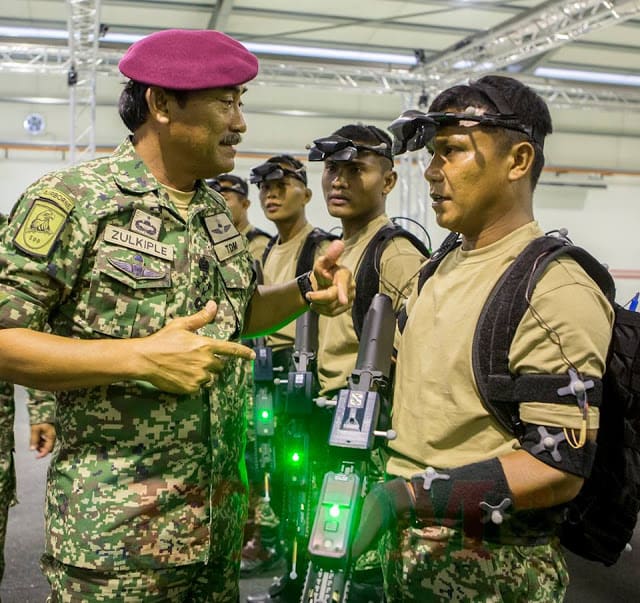
The Malaysian Army (Tentera Darat Malaysia) runs an immersive virtual combat training facility at its Army War Game Centre (Pusat Olah Perang) inside Kem Syed Sirajuddin in Gemas, Negeri Sembilan. The Chief of Army, General Datuk Seri Zulkiple Kassim, formally inaugurated the Immersive Virtual Training Simulator (VIRTSIM) there on 14 August 2017, by which point the system had already been operating for about two months. Malaysia was the third country in the world to field it, after the United States and the United Arab Emirates.
The arena
Sessions take place in the centre's Visual Simulation Centre (Pusat Simulasi Visual), in a tracked hall roughly the size of a basketball court. Soldiers walk, run and take cover on foot inside that space while the system renders a matching three-dimensional environment around them and reproduces their real body movements as virtual avatars. Because the terrain, weather and layout are software settings rather than physical ground, the Army can put a section into conditions it could not otherwise reach, and switch between them in minutes.
How a session runs
Between eight and 12 soldiers train together in a one-hour scenario, drawn from a library of 48 that the training team tailors to its own plan. Settings include villages, built-up areas, crowded public spaces and desert. The system records everything each participant does from every angle, so the section can watch the run back afterwards and work through its mistakes — and because the rounds are simulated, a badly executed drill costs nothing but time.
The equipment
- Head-mounted displays worn on a tracking headband, flipped up between runs
- Body-worn harnesses carrying reflective motion-capture markers on the torso, arms and legs
- Backpack-worn computers that let soldiers move untethered around the hall
- Instrumented weapon replicas that fire electronically, aimed and fired the same way as the real weapon
- Feedback devices on the uniform that deliver an electric jolt when the wearer is hit
Supply and procurement
The system was developed by Motion Reality, Inc. of the United States, which lists the Malaysian Ministry of Defence among its VIRTSIM partners. A US$7.9 million contract to supply it was awarded to the Malaysian firm Flumen Technologies in April 2016 at the DSA defence exhibition.
Continued use
The facility remained in regular use years after the opening. From 3 to 21 October 2022 the 26th Battalion, Royal Malay Regiment (26 RAMD) ran a three-week urban-combat package on it with one officer and 49 other ranks. Five sections met the Army's main training objective by defeating the simulator's artificial-intelligence opponents at intermediate level across every phase of combat, and one section reached the advanced level. The exercise was assessed by the battalion's B Company commander, Major Ahmad Safuan Abu Bakar, alongside the centre's simulator cell staff, and closed by the centre's director, Colonel Nazlee Abd Rahim.
The cost case
The Army's argument for the system is economic as much as tactical. Live demonstrations run to thousands of ringgit each, and the training land available to the service keeps shrinking; the simulator carries a single up-front cost and can be reset with the same tactical problem as often as a unit needs. General Zulkiple's expectation, set out at the opening and quoted below, was that of the repetitions a soldier needs to reach proficiency, most could now be done virtually, leaving only a couple to be run live. Colonel Abdul Razak Hussain, who directed the centre in 2017, described the same loop from the instructor's side: the computer captures what a trainee does and plays it back so the error can be corrected. Soldiers assigned to United Nations and other overseas missions also rehearse on the system before deploying.

