


Background
Healthcare-associated infections are a persistent threat in hospitals, and shared portable medical equipment such as blood pressure cuffs, glucometers and portable imaging machines is a known vector. Studies have repeatedly found that staff fail to clean and disinfect this equipment consistently, despite decades of conventional training. Infection control researchers at Mass General Brigham set out to test whether immersive technology could change that.
The deployment
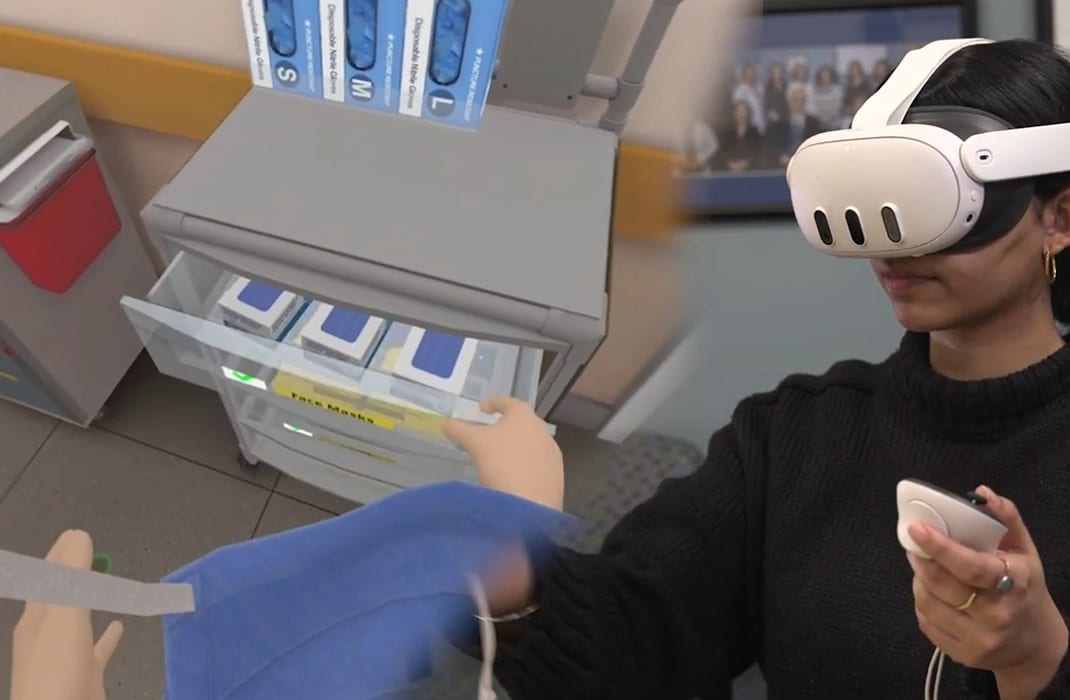
The team developed an immersive virtual reality module, delivered on head-mounted displays, that guides learners through a simulated inpatient healthcare environment. Inside the module, clinicians review and apply cleaning and low-level disinfection procedures to two devices: a vital signs machine and a point-of-care ultrasound machine. The experience incorporates gamification and visualises normally invisible contamination, letting learners "see the unseen" risk on equipment surfaces.
The tool, part of the Real IPC (infection prevention and control) training program, was piloted at seven facilities across the United States.
Study and outcomes
The pilot ran in two phases. An initial cohort trained on the module and gave feedback that was used to revise it; a second cohort then trialled the updated version. Of that second group, 88.6% reported an overall positive experience, with many comments highlighting their enjoyment of the immersive, hands-on environment. Around half reported some negative physical sensations such as motion sickness, common among new VR users, and a few noted difficulties with tasks like donning and doffing virtual gloves or transporting equipment.
The findings were published in Infection Control & Hospital Epidemiology. Further research is now under way, moving beyond user experience and acceptability to measure learners' knowledge, skills and competency after training with the module.
Funding
The work was supported by a cooperative agreement from the U.S. Centers for Disease Control and Prevention (CK22-2203). The CDC was not involved in preparing, submitting or reviewing the underlying manuscript.

