

Background
Matsuya Foods operates Japan's Matsuya beef-bowl (gyumeshi) restaurants and several other formats. New part-time staff were trained through a mix of manuals, e-learning and on-the-job coaching in the store. That worked poorly for two groups the chain increasingly relies on: high-school students with no service experience, and overseas staff still learning Japanese. Training quality also varied between branches, because it depended on whichever trainer happened to be on shift.
The deployment
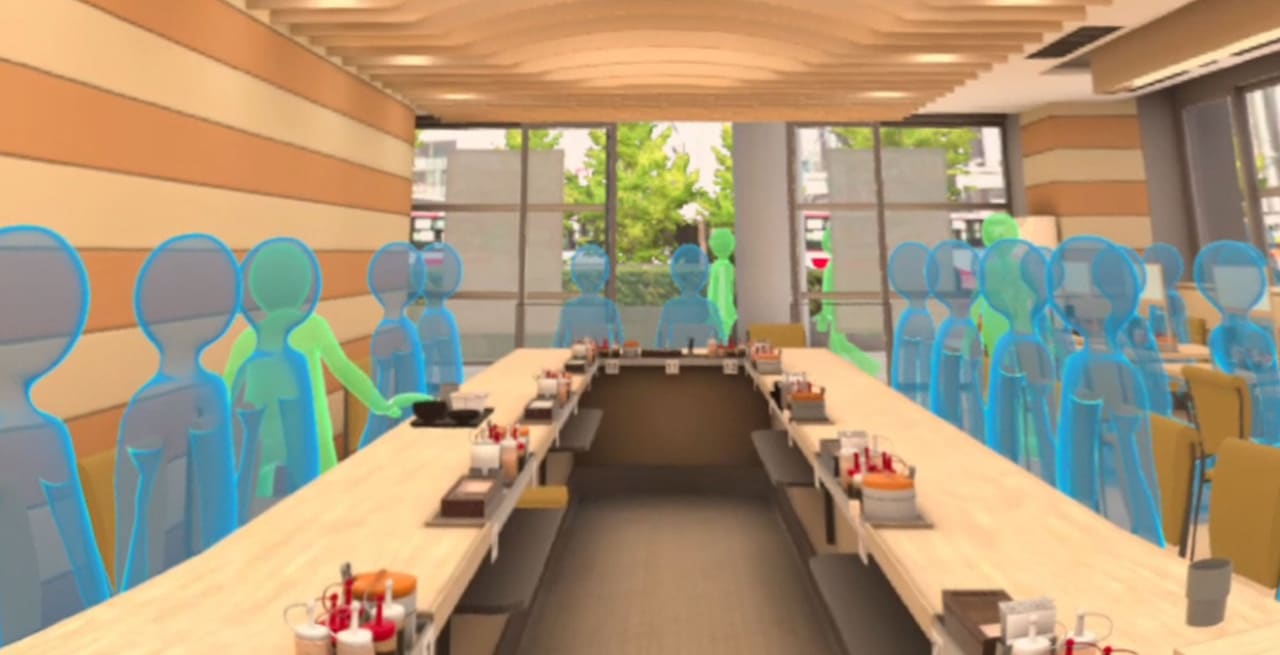
In 2019 the company started an internal virtual-reality programme it calls MaVROS (Matsuya VR Operation System). The first release recreated a Matsuya restaurant in full CG and let a recruit rehearse the customer-service sequence -- greeting a guest, pouring water, taking an order, carrying a tray to the table -- while seated and wearing a headset.
In December 2020 the programme was extended from front-of-house service to core store operations. Five further modules cover cooking, ticket-machine operation, peak-time congestion, trouble handling and service in self-order outlets. The trainee follows a computer-generated demonstration and repeats each movement, with narration carrying the coaching points a trainer would otherwise give in person.
Automatic assessment
The distinguishing feature is an automatic scoring function. It checks cooking steps and utensil handling, and also measures the volume and speed of the spoken greetings that Japanese restaurant service requires, along with where the trainee is looking. A step that falls below the set standard cannot be passed, so the recruit repeats it until it is right. Congestion scenarios are presented as three- or four-option quizzes, which the company says keeps trainees engaged while the correct routine becomes habit.
Who built it
- Digital Knowledge supplied the training solution and the surrounding e-learning
- Tsumiki Seisaku produced the computer-generated environments and the VR content
Outcomes and rollout
Matsuya Foods reported that the first VR release, combined with its existing e-learning, covered almost the whole of a new part-timer's induction and cut store managers' working hours, although it published no figures. Managers quoted by the supplier noted a practical limit of roughly twenty minutes per headset session, which shaped how much content each module carries. The training is offered in Japanese, Vietnamese and Chinese so overseas recruits can learn in their own language, and the company has said it is working towards deployment across its 1,170 restaurants nationwide, led by the Matsuya beef-bowl format.

