


Background
Mitsubishi Electric UK (MEUK) has operated in the UK since 1969, leading the HVAC market with domestic and commercial heat pumps, VRF air conditioning, and IT cooling systems. Its Living Environment Systems Division runs a large-scale technical training programme covering internal staff, external installers, and business partners — more than 3,600 people attended courses for a single product alone in 2023. Pressure to modernise this programme had been building since the pandemic, and MEUK was also confronting a wider industry challenge: a critical shortage of young engineers entering the HVAC sector.
Challenges
Three problems drove the shift to immersive training. Traditional online content lacked the interactivity needed to hold attention, reducing knowledge retention. A shortage of trainer availability created delays for new starters who couldn't always wait for a session. And logistics were a growing burden: with UK-wide offices but training centres initially at only two locations, some employees faced long-distance travel and overnight stays.
Beyond operational issues, MEUK identified a strategic imperative: demonstrating that engineering careers in HVAC could be as engaging and technology-driven as any other sector, to attract a new generation of talent.
The Deployment
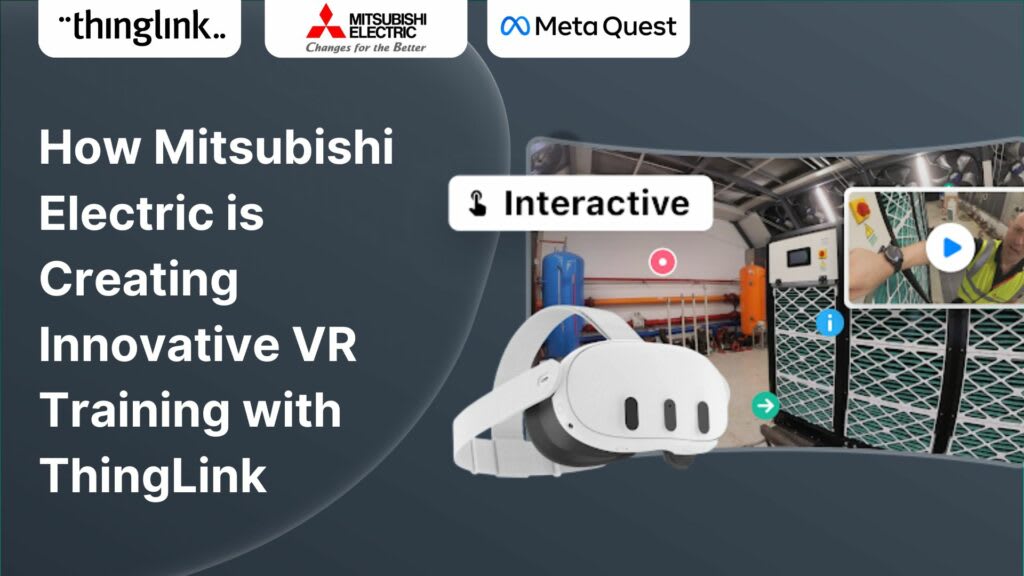
Technical Trainer Steve Clark of MEUK's Living Environment Systems Division led the content creation. Using a 360° camera, he filmed photospheric images and videos of the internal workings of MEUK's product range — including the Ecodan residential heat pump, CAHV commercial air source heat pump, MEWall IT cooling system, and Hybrid VRF air conditioning unit — and published them on ThingLink, annotating each environment with embedded video, voiceovers, images, and interactive hotspots.
All content is created entirely in-house. Steve Clark found the platform accessible from the outset, despite no prior experience with it. Content is delivered primarily via Meta Quest 3 headsets, and also supports full fallback access via laptop, tablet, and mobile — ensuring training remains available regardless of hardware availability. MEUK also integrated ThingLink with 360Learning to build a scalable, self-paced LMS ecosystem, delivering interactive learning paths to thousands of engineers each year.
The training has been extended beyond digital delivery: MEUK now takes the VR package on the road to trade shows and educational events, using it as a recruitment and outreach tool to show students and school leavers what a career in HVAC engineering looks like.
Results
- 99% of course attendees said they would recommend the new format
- A like-for-like comparison of 2023 (in-person) vs 2024 (blended VR + online) showed combined consumables and catering savings of £211,870: paper (1,202,760 sheets) saved £96,220; plastic folders (9,252) saved £23,130; catering at £10/head saved £92,520
- 462,600 travel miles saved during the initial rollout (50-mile round trip per attendee)
- Up to 90 engineers can participate in a single interactive online session simultaneously
- If all product courses are converted to VR, MEUK expects more than 5,000 people to use the content each year
Global Rollout
Following the success of the UK programme, training teams at Mitsubishi Electric operations worldwide have contacted MEUK requesting guidance on replicating the approach. A coordinated, global VR training content strategy is now under development, with the potential for further cost and travel savings across international locations.


