


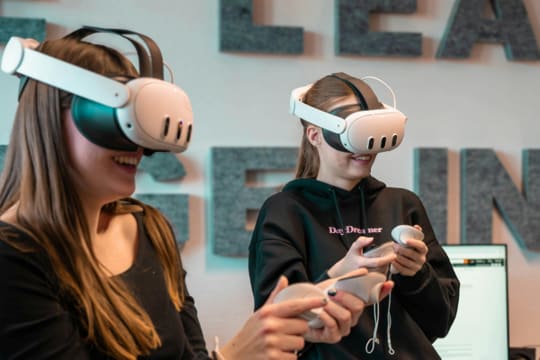
NHS Highland's Employability Team used virtual reality to give Highland school pupils a realistic view of health and social care careers, in a project funded by NHS Highland Charity.
The board identified that young people across Highland communities were unsure about their next steps after school and had "limited understanding of the 350+ careers available within health and social care" - a sector-wide figure it cites as context. The problem was sharpest in remote and rural areas, where distance and travel limitations restricted access to in-person career experiences and pupils had limited exposure to clinical settings. Traditional career talks, the board says, "rarely provide the depth or realism needed to help pupils picture themselves in NHS roles".
Sara Smith and Megan Glass of the NHS Highland Employability Team developed an immersive career exploration project and pitched it on 25 February 2025 to a Dragon's Den-style panel in Inverness, securing NHS Highland Charity endowment funding. The award covered the rental of VR headsets and access to the Care Reality FLO simulation platform.
In June 2025 the team delivered VR-enhanced Career Inspiration sessions to 25 S4 to S6 pupils in Inverness, Caithness and Fort William, alongside hands-on workshops led by NHS practitioners. Pupils quoted anonymously on the board's page described the experience as engaging and realistic - "It was good to have a go at activities you couldn't do in person" and "VR felt like it was happening in real life" - and the board reports that the ability to "step into" a practitioner's role gave a deeper understanding of the responsibilities, pressures and rewards across a range of roles.
In the evaluation, 92% of pupils said VR helped them understand clinical tasks and how their skills aligned with NHS careers. VR was seen as comparable to real-life workshops in helping pupils picture themselves in NHS settings, and most pupils found the technology easy to use even without prior experience. The team also recorded practical difficulties: occasional motion sickness, pupils adjusting to wearing the headsets, and issues with Wi-Fi connectivity.
Findings were communicated to the Employability and Widening Access Oversight Group, and the source reported plans to present a poster at the NES Annual Conference in April 2026 titled "Opening Doors to Careers in Health and Social Care for Students in Remote and Rural Areas". Building on the results, the source reported that the Employability Team hoped to pilot VR-only workshops in remote areas, and a 12-month project was being developed to support school pupils and individuals furthest from the labour market.

