


Background
More than 3,500 people in England are currently waiting for a cornea transplant. These procedures can restore vision for patients affected by a range of serious eye conditions, making the availability of donor tissue critical. A persistent bottleneck has been the time required to train specialist eye retrieval staff: traditionally, qualifying as an eye retrieval specialist took up to six months, limiting workforce capacity and the volume of corneas available for transplant.
The programme
NHS Blood and Transplant (NHSBT), through its Tissue and Eye Services and Digital Learning Teams, developed what is believed to be the world's first blended eye retrieval training programme incorporating virtual reality. The programme compresses the qualification timeline from six months to 12 weeks by combining immersive digital experiences with hands-on physical simulation across four learning modules.
Immersive content and hardware
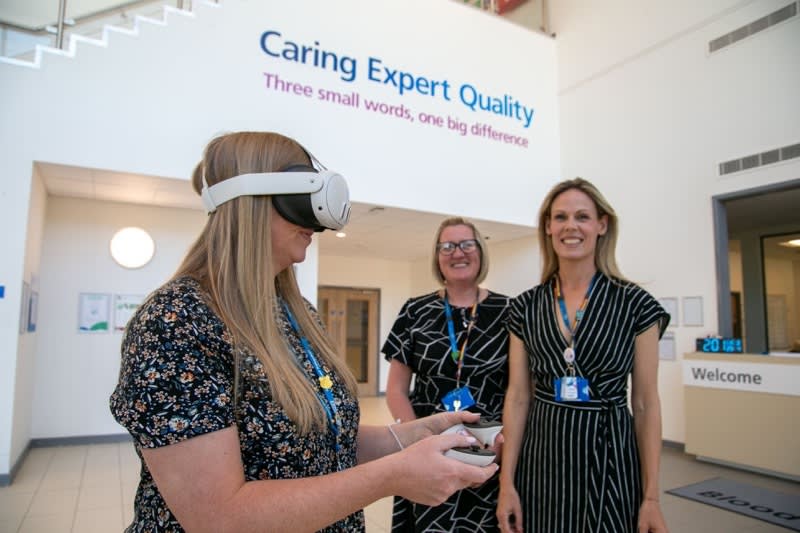
Trainees use a VR headset to experience a 180-degree stereoscopic film of a real-life eye retrieval procedure, placing them in a first-person viewpoint of the entire process. A separate 360-degree virtual tour allows trainees to visit a mortuary environment before ever setting foot in one physically, building familiarity and confidence with a location that can be difficult to access for training purposes. The immersive modules are complemented by hands-on practical simulation using dummy heads, simulation eyes, and responsive feedback controls, giving trainees a tactile element alongside the digital experiences.
Deployment and reach
Claire Price, National Tissue Retrieval Manager at NHS Blood and Transplant, described the programme as enabling new staff to become highly skilled eye retrieval specialists more quickly, increasing staff capacity and helping to ensure more corneas are available for transplant. Paul Ladley, Digital Learning Manager at NHS Blood and Transplant, noted that the mix of VR and immersive filming technologies, combined with blended learning elements, allows trainees to experience the role of eye retriever in a flexible and scalable manner.
The programme is deployed across NHSBT's eye retrieval centres in London (Colindale), Liverpool (Speke), Bristol (Filton), and Barnsley. More than 60 eye retrieval staff have now completed it.
Outcomes
The accelerated 12-week pathway is expected to expand workforce capacity significantly, with the potential to increase the number of corneas available for the thousands of patients currently on the transplant waiting list. The programme has also been presented at the European Association of Tissue and Cell Banks, reflecting its wider significance to the international tissue and eye services community.

