


Background
Ohio University's Russ College of Engineering and Technology faced a persistent challenge: state-of-the-art industrial automation labs in Athens could not be accessed remotely, making it difficult to connect the university's multiple campuses, industry partners, and government collaborators — including the U.S. Air Force. In 2025, the university partnered with Virtualware and HTC VIVE to launch the Digital Enterprise Collaboratory (DEC), a multi-site XR infrastructure designed to eliminate those geographic constraints.
The deployment
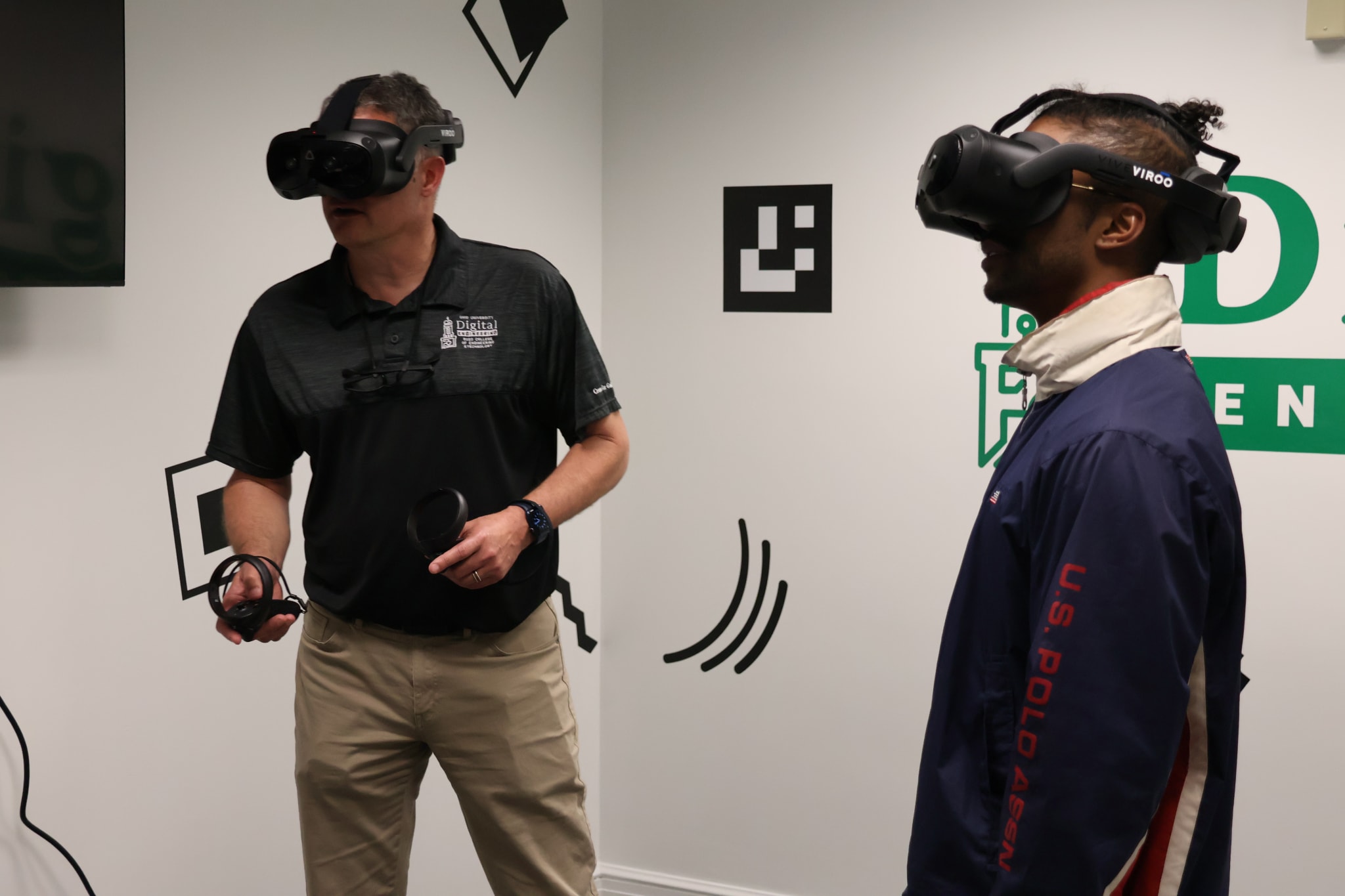
The DEC comprises two dedicated labs: one at the Athens Campus and one at the Digital Transformation Center (DTC) in Dayton, operated in partnership with the University of Dayton Research Institute (UDRI). Both labs are equipped with VR headsets and connected through VIROO, Virtualware's enterprise XR platform, enabling real-time collaboration, project sharing, and digital twin creation from within the labs or from any remote desktop, classroom, or home.
The platform supports a mix of devices — HTC VIVE Focus Vision, PICO 4, Meta headsets, and standard desktop interfaces — allowing participants to join shared virtual environments regardless of location or hardware.
Key capabilities
- BIM and CAD design review: Teams import native Building Information Modeling and CAD files directly into VIROO for real-time walkthroughs. In one demonstration, participants reviewed the Revit model for UCF's new School of Nursing building, manipulating virtual assets as if on-site.
- Virtual commissioning and digital twins: The DEC integrates Simumatik, a robotics simulation tool, with VIROO to create high-fidelity digital twins of manufacturing lines. Engineers can program industrial robots and PLCs offline, reducing downtime and accelerating commissioning.
- Mixed reality demonstrations: The initiative includes cinematic MR sessions that overlay digital elements within the physical DEC space, supporting immersive training and spatial visualization.
Workforce and research programmes
The DEC directly supports ASCENT (Appalachian Semiconductor Education and Training), an Intel-supported consortium of 13 institutions preparing a specialised workforce for semiconductor and advanced manufacturing sectors, including Intel's Ohio One facility. Engineering curricula at Ohio University are being updated to embed digital design, modelling, simulation, and test capabilities, with faculty noting the platform brings abstract concepts to life.
Scale and reach
In November 2025 the DEC conducted what organizers described as potentially the first and largest multi-location VR collaboration of its kind, linking four physical sites across three countries on two continents — Athens, Orlando, Bilbao (Virtualware HQ), and Toronto — in a fully synchronised virtual session. Interest in replicating the model has come from other universities, companies, and federal agencies.


