


Background
Cataract remains the world's leading cause of blindness even though it is treated with a short operation, and the shortage of trained surgeons is sharpest in the countries where the backlog is largest. Residents in low-resource settings get limited rehearsal time: practice tissue, instruments and supervised theatre lists are all finite.
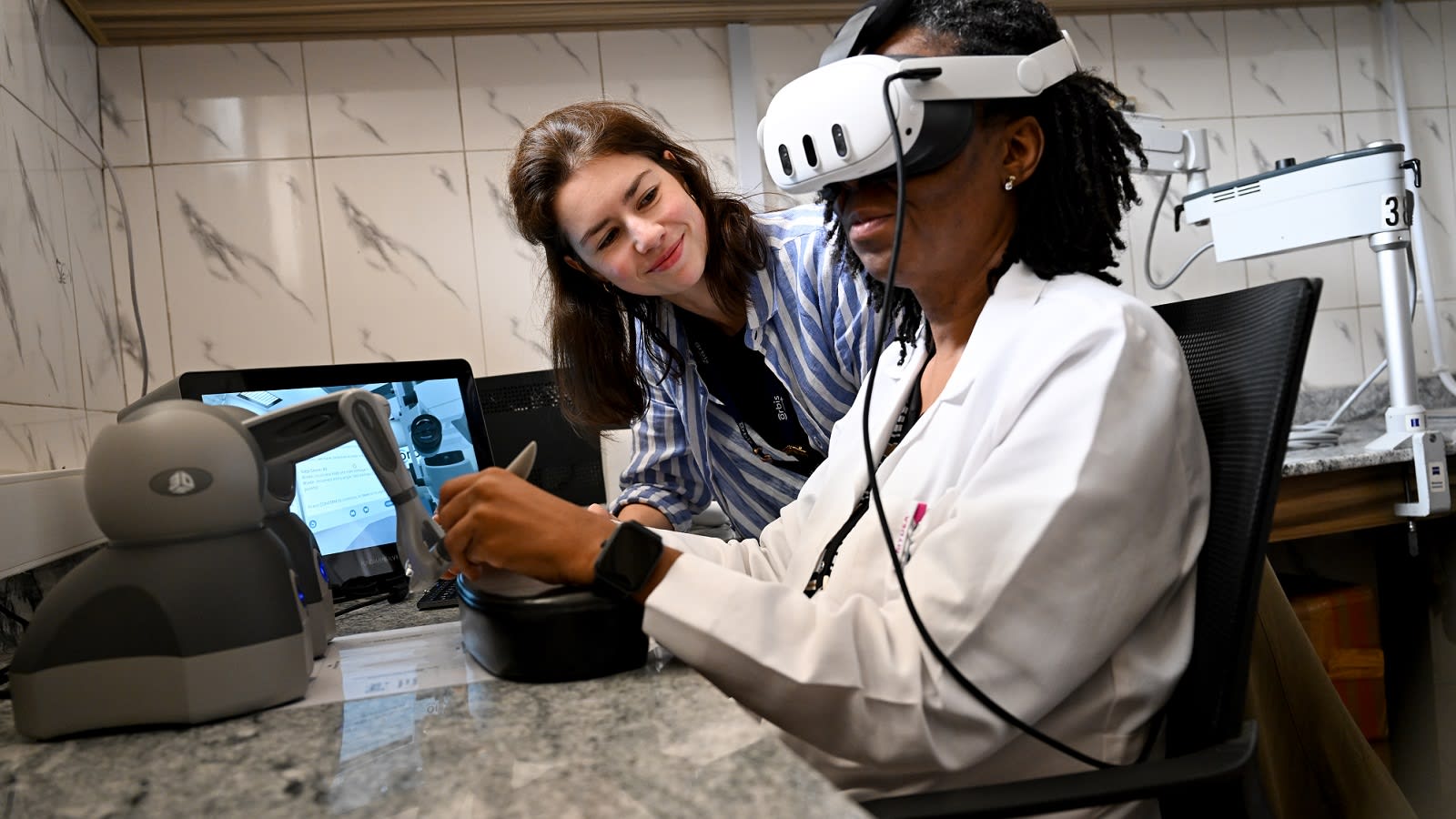
Orbis International, the eye-care nonprofit behind the Flying Eye Hospital and the Cybersight telemedicine platform, worked with UK technology company Fundamental XR (formerly FundamentalVR) to build a virtual reality trainer for manual small incision cataract surgery (MSICS) — the technique most commonly performed in low- and middle-income countries. Launched in April 2024 at the ASCRS annual meeting, the tool pairs a VR headset with force-feedback haptics and cloud-based assessment, and runs on off-the-shelf hardware to keep the price within reach of resource-limited partners.
The deployment
Five simulator kits are in use across four African countries — Rwanda, Ethiopia, Zambia and Ghana — and the wider Orbis programme now reaches 22 partner institutions in nine countries across Africa, Asia and South America. Trainees work through the procedure step by step at their own pace, with automated performance monitoring and feedback, and can supplement the simulator with Orbis's free Cybersight MSICS course.
Ghana: simulation before the wet lab
Korle Bu Teaching Hospital in Accra has become one of the programme's highest-volume sites. Its clinical faculty built a mandatory curriculum in which the simulator is a prerequisite: virtual training first, then wet lab, then live cases, with residents rotating through clinic and laboratory blocks during working hours so a single simulator serves the whole cohort.
In the first half of 2026, 13 first-year residents logged more than 230 hours of simulation between them — over 14 hours and more than 40 complete MSICS procedures each. Adolf Ollennu, Orbis's country director in Ghana, presented the results at the 2030 IN SIGHT Live meeting.
Outcomes
Faculty at Korle Bu report that because residents arrive already fluent in the basic surgical sequence, wet lab instruction has shifted from step-by-step teaching to higher-level mentoring, with fewer errors, less wasted practice tissue and lower consumption of sutures and viscoelastic. Trainees at the Rwanda International Institute of Ophthalmology in Kigali described similar gains, reporting better recall of procedural steps and immediate feedback that flagged errors for correction.
Across the programme, Orbis and Fundamental XR count more than 2,700 training sessions and 1,100 hours of simulated practice by close to 400 users, with partner institutions extending the kits to external student workshops. The collaboration has picked up a Brandon Hall Group Gold award for best AR/VR solution and India's Digital Health Excellence Award.
Hardware and software
- Headsets: Meta Quest 3, Meta Quest Pro or Oculus Rift S, connected to a laptop over Quest Link and configured through the Oculus PC app
- A pair of desktop 3D Touch haptic arms with a wrist rest and alignment placemat, giving kinesthetic force feedback for instrument handling under the microscope view
- Fundamental XR's simulation, accessed through the Fundamental Surgery Hub, with cloud-recorded assessment data and a learning dashboard

