


Background
Between roughly 1327 and 1331, Alina de Braose extended the Chapel Tower at Oystermouth Castle in Mumbles, Swansea, commissioning a crucifixion fresco depicting angels beneath a Gothic canopy alongside the de Braose family's heraldic shields. Over seven centuries the painting was lost beneath whitewash and decay, leaving visitors with no sense of the chapel's original colour and devotional purpose.
The deployment
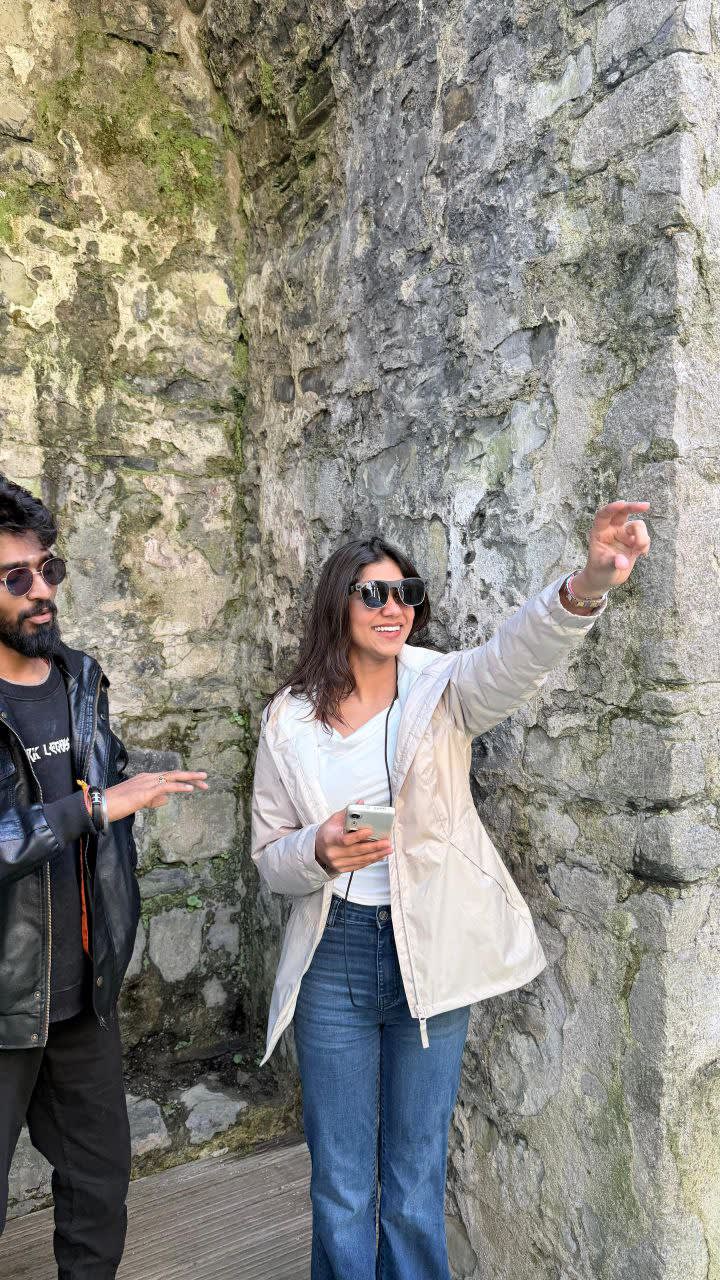
Sands of Time AR digitally reconstructs that lost artwork and registers it spatially onto the chapel's stonework, so a visitor wearing AR glasses sees the fresco reappear in the recess where it once hung. The experience reconstructs four elements — the central rood-screen crucifixion, the seraphim angels, the wider chapel interior, and the de Braose heraldry — positioned where the medieval originals are believed to have been. It was developed as an MSc Virtual Reality research project at Swansea University (2024–2026) and deployed on site at Oystermouth Castle, which is operated by Swansea Council Heritage Services.
Hardware and software
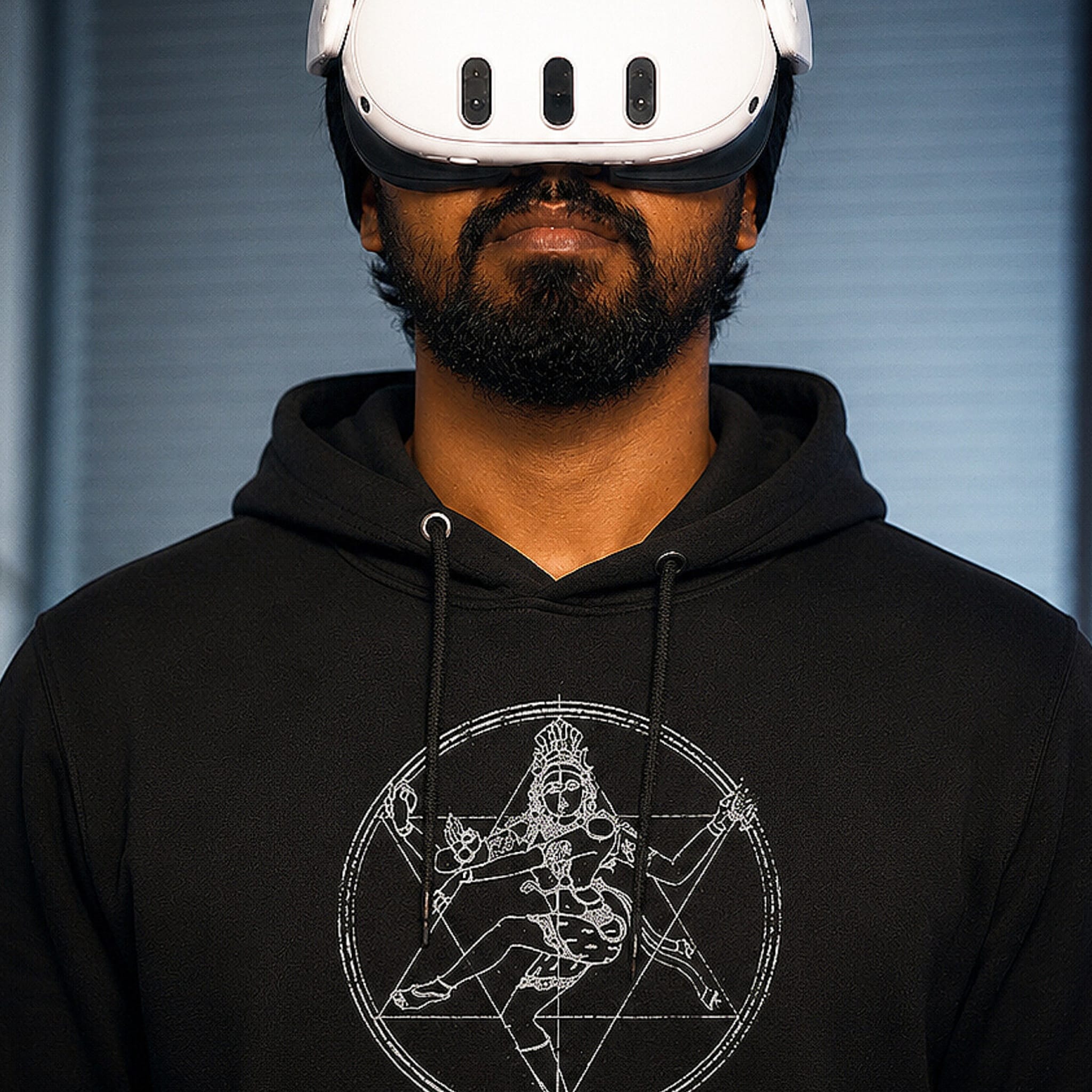
The shipped prototype pairs two devices: lightweight XREAL Air 2 Ultra AR glasses (around 72g, 6DoF tracking, micro-OLED 1920×1080) worn at the eye, driven by an XREAL Beam Pro handheld compute unit running the Unity-built Android application. The final build runs entirely on-device — no markers, no Wi-Fi, no external infrastructure — with the reconstructed content fixed two metres in front of the user.
From markers to markerless
The team iterated through four prototypes. An early iPad LiDAR-plus-Vuforia build achieved ±2mm precision but was incompatible with the Android-only XREAL glasses; a hybrid Vuforia–XREAL SDK approach failed on camera-access conflicts; and a marker-based build proved environmentally fragile, with detection dropping sharply in sunlight and shadow and Wi-Fi unreliable through the castle's stone walls. Only the simplified markerless Version 4 reached formal user testing.
Results
Version 4 was evaluated in a mixed-methods study with 10 participants at the chapel in March 2026, followed by a public field study with live visitors on Easter Sunday, 5 April 2026. It scored a mean System Usability Scale rating of 84.0 (excellent tier), 100% unaided task success, and an overall UEQ score of 2.04, with 90% of participants saying they would definitely recommend it. Participants, several of whom are quoted below, highlighted how seeing the fresco in place aided spatial understanding and how simple the headset was to use compared with phone-based AR.
What comes next
The roadmap extends the reconstruction to the full chapel interior and other areas of the castle, and plans an AI-driven medieval narrator ("Alina") offering conversational, multilingual (Welsh/English) storytelling, with a longer-term vision of a multi-site AR platform across Welsh castles such as Caerphilly, Conwy, Harlech and Caernarfon.


