

Background
Petone Engineering, a structural steel fabricator in Seaview, Wellington, specialises in seismically strengthening New Zealand buildings — work that demands tight tolerances and complex assemblies that are hard to read from 2D drawings alone. To raise accuracy and speed on the shop floor, the company became the first structural steel firm in New Zealand to adopt augmented reality for quality assurance.
The deployment
Fabricators wear a Microsoft HoloLens 2 mixed-reality headset running FabStation, an AR steel-fabrication tool from Canadian software company Eterio Realities. The software registers the job's 3D model directly over the physical steelwork, so a fabricator looking through the headset sees exactly which parts go where and can confirm an assembly is built correctly. When properly calibrated the overlay is accurate to within 1.5 mm — tight enough for the quality checks structural steel demands — and the fabricator drives the interface with hand gestures, keeping both hands free.
Lambton House
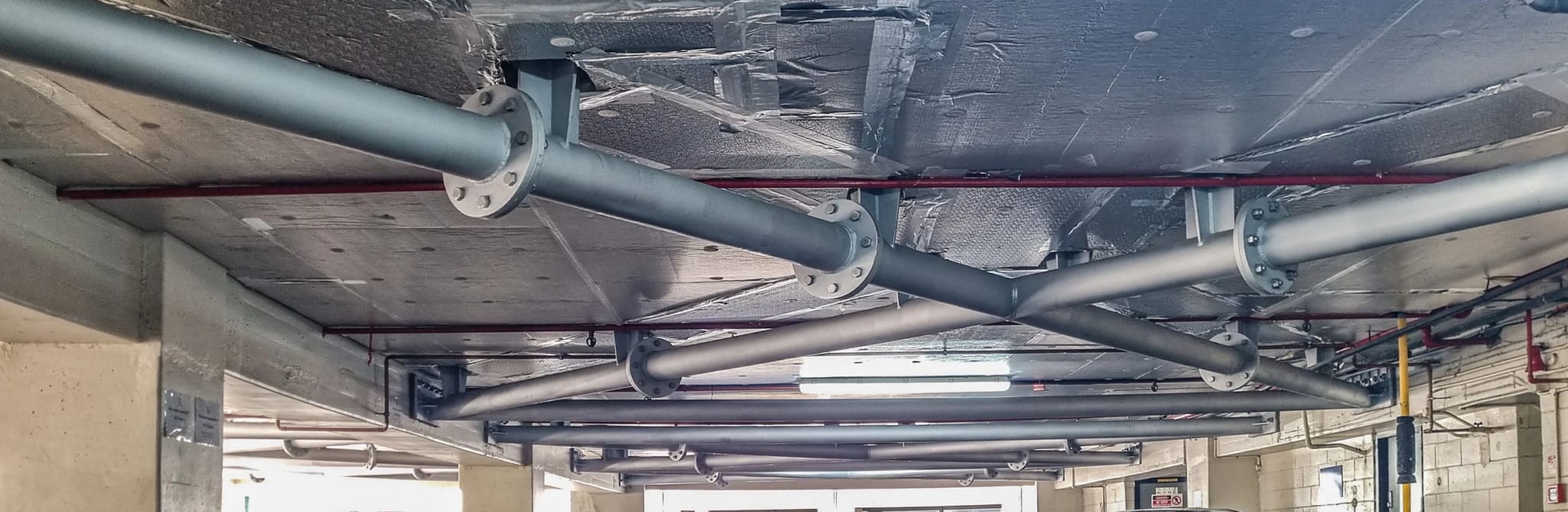
The approach was showcased on the Lambton House seismic retrofit in Wellington, where circular-hollow-section bracing was anchored to the building's concrete floors under tight headroom and access constraints. Working from cloud-scanned Tekla models, Petone Engineering used the FabStation overlay to verify each assembly before it left the workshop, allowing the steelwork to be pre-assembled as complete units and eliminating on-site welding. The project won the SCNZ Excellence in Steel Awards 2024 in the Earthquake Strengthening category.
Recognition
FabStation, the software behind the deployment, won Best Enterprise Solution at the 2026 Auggie Awards, Augmented World Expo's recognition of standout enterprise XR.

