


Background
Purdue Global, Purdue University's online university for working adults, teaches nursing to a cohort that is largely already employed and balancing jobs, families and irregular schedules. Traditional clinical preparation depends on physical skills labs, simulation mannequins and scarce hospital rotations, none of which fit that cohort well. The school turned to virtual reality to give students repeatable, assessed clinical practice without requiring them to travel to a campus.
The deployment
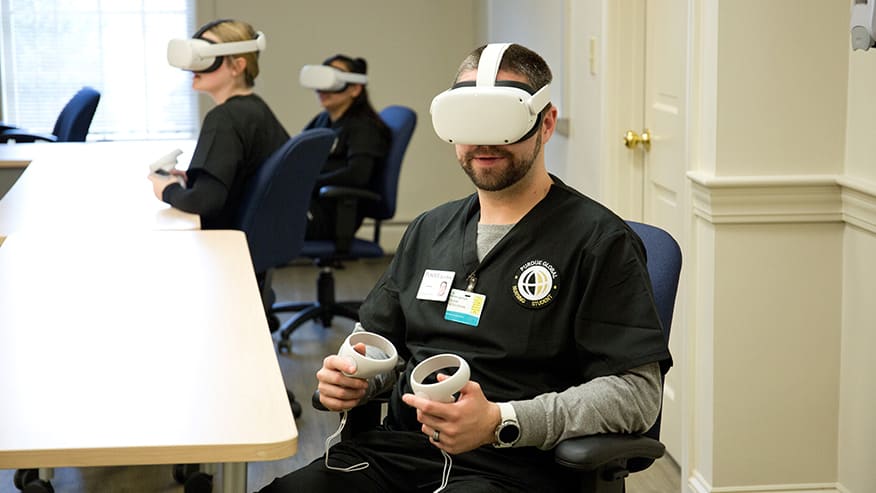
Students work through simulated clinical encounters in standalone headsets they can use at home, needing only a Wi-Fi connection. Inside a virtual hospital room they carry out head-to-toe patient assessments with handheld controllers, run infant wellness checks, speak with virtual patients, and practice both procedural skills and the interpersonal side of care. Each simulation is scored, students receive detailed feedback afterwards, and a scenario can be repeated as many times as a student wants.
VR was introduced course by course, beginning with Fundamentals of Nursing for undergraduates and an acute care skills lab for graduate students. It now runs across the associate degree and nurse practitioner programmes, and the university has said it is exploring extending immersive learning to its doctor of nursing practice and RN-to-BSN programmes, and beyond nursing into law, criminal justice and science.
Software and hardware
Two simulation platforms run on the headsets, split by cohort:
- PCS Spark — used by nurse practitioner students. An AI-driven virtual-patient platform with speech recognition, letting students conduct spoken patient interviews and returning automated scoring and feedback.
- Oxford Medical Simulation — used by undergraduates for scenario-based virtual patient cases.
Both embed AI components, which the school treats as a secondary learning objective in its own right: students graduate having worked alongside AI tools. Faculty and programme coordinators are trained on the headsets as well, and use the platform's data to see how students are handling each simulation, including whether they assessed the patient correctly and reached the right diagnosis.
Outcomes
Purdue Global reports a 10% increase in pass rates for the NCLEX-RN, the US national registered-nurse licensing exam, since introducing VR, and says 92% of students found the virtual patient scenarios prepared them for clinical practice. Roughly 4,000 nursing students have trained this way. Students also rated the VR work more highly on learning activities and relevance to their careers.
The wider simulation programme has since been recognised externally: in February 2026 Purdue Global's nursing simulation programme received an INACSL Healthcare Simulation Standards Endorsement covering its Associate of Science in Nursing and Master of Science in Nursing programmes, alongside four hospital-based simulation centres in Iowa and Maine.

