
XRHQ
United Kingdom
Education

Queen’s University Belfast uses VR to explore parents’ understanding of vision loss

A Belfast study used personalised Empatheyes VR sessions to help parents understand their visually impaired children’s experiences.

Added on

Worked on this project?

Get credited on this page

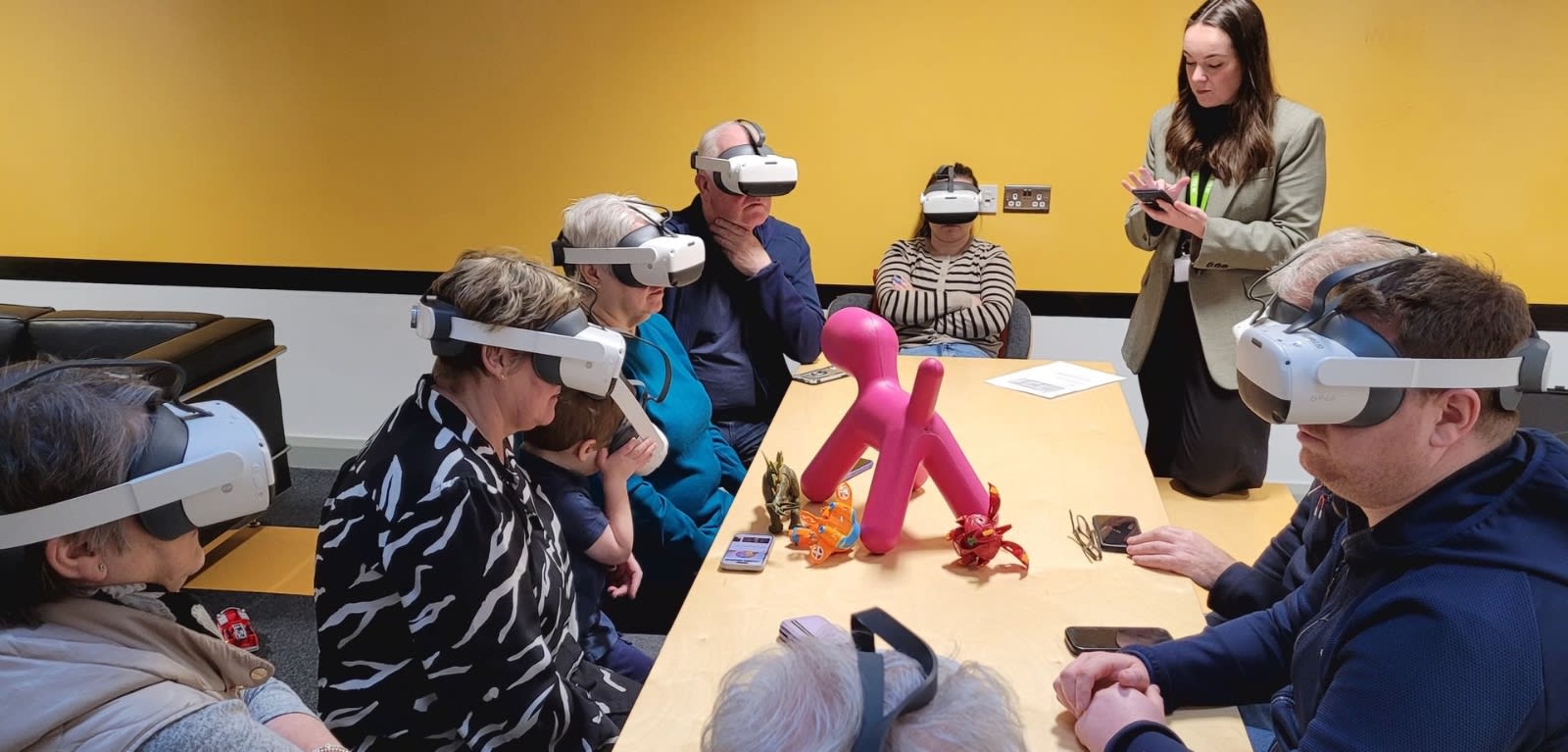
Participants wearing white VR headsets sit around a table while a facilitator operates a phone.
Families using Empatheyes alongside Rebecca McCracken, Clinical Lead for Angel Eyes NI

Data Points (1)

This information is available to registered members of XRHQ. Sign up for free below.

Queen’s University Belfast partnered with Angel Eyes NI on a study using virtual reality to help parents understand how their visually impaired children experience the world. The work brought together the university’s Centre for Medical Education, the charity and colleagues from Belfast Health and Social Care Trust.

Parents and carers attended individual sessions at Angel Eyes NI’s offices in Belfast. Each experienced a personalised Empatheyes simulation through a Pico Neo 3 Pro headset. The study authors report that each VR session lasted approximately 40 minutes. Angel Eyes NI developed the simulator within the charity and carried out the software development and research activities directly.

Participants’ qualitative accounts described greater understanding of their children’s vision and behaviour, empathy, and confidence in explaining visual difficulties to teachers. These were participants’ reported experiences; the study did not assess longer-term effects. One parent described feeling better equipped to explain how their child’s vision affected classroom experiences when speaking with school staff.

Quotes

““This research addresses a longstanding challenge: how many families struggle to understand what their child can actually see, which can affect learning, development, and engagement with professionals. “By demonstrating how VR can bridge this understanding gap, and by grounding the work in collaboration with a trusted local charity, the study highlights an innovative and accessible tool with the potential to strengthen family relationships, promote empathy, help parents advocate more effectively, and encourage more inclusive practice across education and healthcare.””

““Taking part in the VR training gave me a much clearer understanding of how my son experiences the world day to day, including the impact of his visual acuity, photophobia, depth perception and colour contrast difficulties. “I am incredibly grateful to have had the opportunity to experience exactly what life looks like from his perspective. It provided an insight into his visual disability and has given me far greater empathy and understanding of the support he needs.””

“It really gives you an insight into what your child is dealing with and what they can see. Until you can see that you honestly don’t know.”

“It has given me more of a sense of, like, empathy with her… I can actually understand why she would be doing those sorts of things…it’s not just her not looking… I’m going to be more patient, definitely.”

“I think it’s very emotional for anybody. I wouldn’t say that it’s in any way easy to watch. I think I did find it uncomfortable at times, but I know that it’s for the best to see it. It’s all very positive to be able to understand it.”

“I feel that I would be better equipped if I was going into school to speak to the SENCO [special educational needs co-ordinator] or the teachers involved. I have a lot more knowledge now behind me to be able to go and explain to them how his vision is affected in the classroom, rather than what it would’ve been beforehand”

Project Summary

This information is available to registered members of XRHQ. Sign up for free below.

Experience

Available to XRHQ members

Hardware

Available to XRHQ members

Software

Available to XRHQ members

Partners & Service Providers

Available to XRHQ members

Sources

Available to XRHQ members

Know more about this project? Help us fill in any missing details.

Edit this project →

Worked on this project?

Get credited on this page

This write-up is free to reuse with credit — CC BY 4.0.