

Background
Acquired communication disorders -- most commonly aphasia following stroke or surgery -- leave patients able to practise language skills in clinical settings but often struggling to transfer those skills to real-world situations. Queensland Health's Communication Cafe project, led by Dr Clare Burns, Advanced Speech Pathologist and Research Coordinator at the Royal Brisbane and Women's Hospital (RBWH), addresses this gap by placing patients inside a configurable 3D virtual coffee shop via a VR headset.
The Deployment
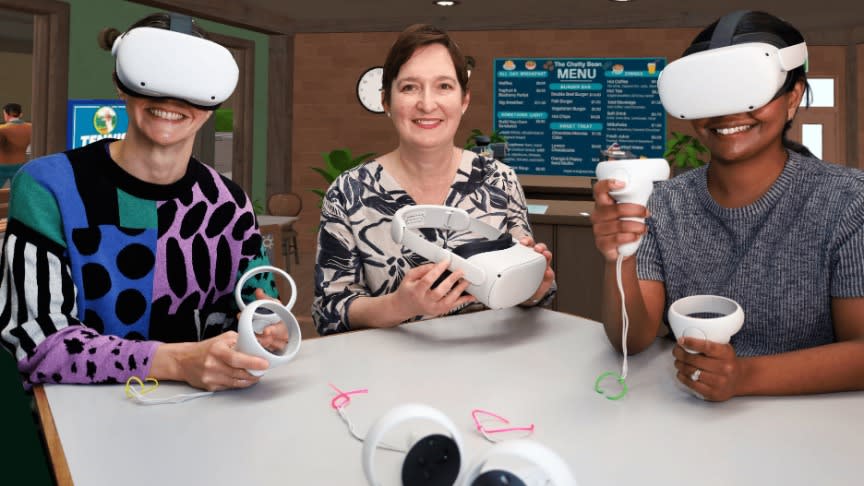
Using an immersive VR headset, a patient, their speech pathologist, and a communication partner enter a virtual cafe environment together. The cafe can be adjusted by the clinician to vary ambient sights and sounds, mirroring the complexity of a real coffee shop. The aim is to let patients build confidence and generalise communication strategies in a realistic, low-stakes setting before attempting equivalent interactions in the community.
The program originated at RBWH and expanded to PA Hospital (Princess Alexandra Hospital, Brisbane) as part of a broader Queensland Health pilot, with 20 patients due to trial the program across 2025. Both Metro North Health and Metro South Health are co-design collaborators.
Research and Funding
The project is a collaboration between Queensland Health and the University of Queensland, in partnership with the RECOVER Injury Research Centre and the Queensland Aphasia Research Centre. The current implementation phase is funded by a Queensland Health Clinical Research Fellowship awarded to Dr Burns.
Outcomes
Clinicians at PA Hospital report early positive reactions from patients of varied ages, including those in their 80s, and express strong optimism about the program's potential for patients with a range of acquired communication disorders.

