
XRHQ
DeploymentPilot

Red Cross Upper Austria Pilots VR Journeys for Hospice Guests

Red Cross Upper Austria pilots VR trips for hospice guests in Vöcklabruck, Ried and Linz, running to the end of 2026.

Austria
Healthcare
Added on

Worked on this project?

Get credited on this page

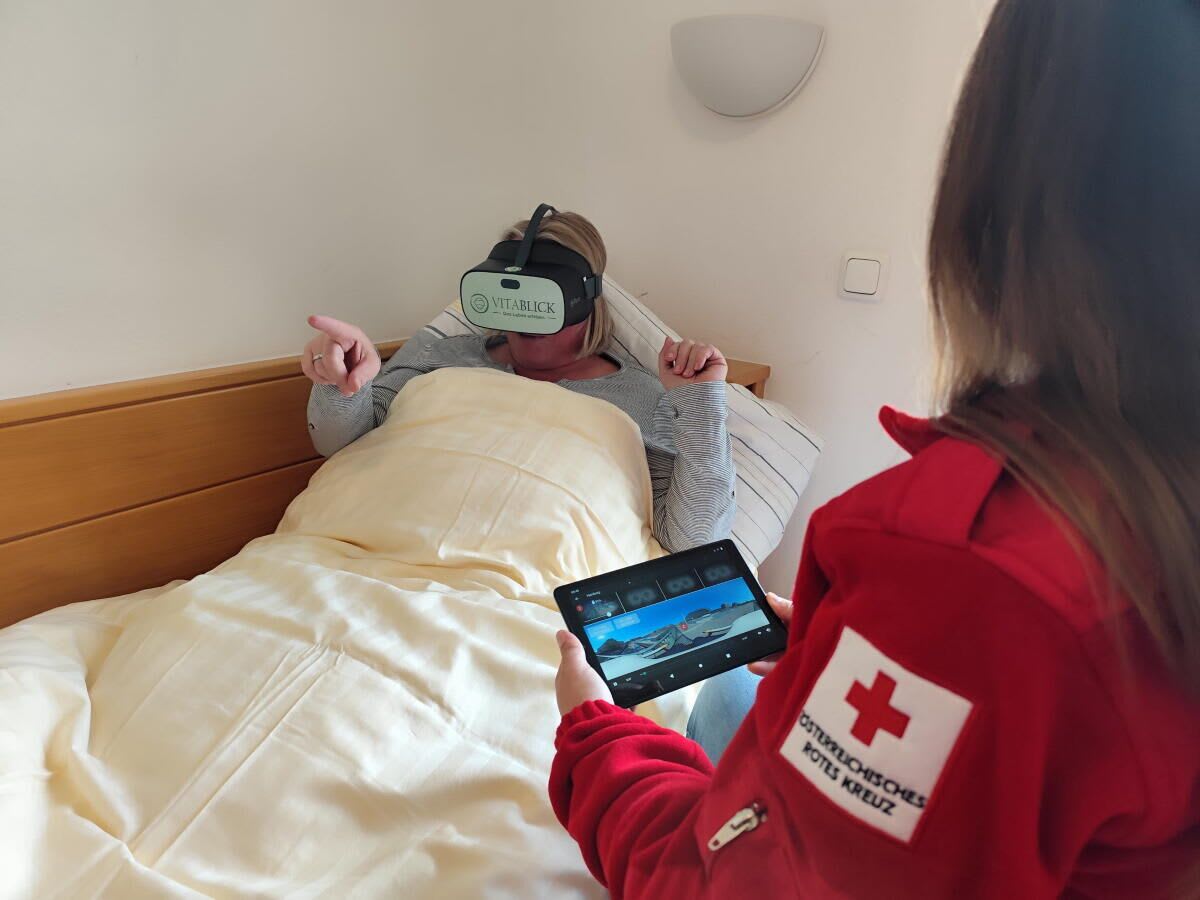
A woman lying in a bed wearing a VR headset branded VitaBlick points at something, while a volunteer in a red Austrian Red Cross jacket holds a tablet showing a 360-degree scene.
Travelling virtually to familiar places: VR headsets give seriously ill people in the St. Barbara hospices special experiences.Photo: OÖRK/BST Ried

Sign in to view 1 more media item

Data Points (2)

This information is available to registered members of XRHQ. Sign up for free below.

Red Cross Upper Austria (Rotes Kreuz Oberösterreich) is piloting virtual reality journeys for people in hospice care. Under the project Virtuelle Lichtblicke, seriously ill guests put on a VR headset and travel to familiar or new places, even from their sickbed. The pilot is run with the Zentrum für Zivilgesellschaft – Verein füruns and the VR provider VitaBlick, and is being tested in the St. Barbara hospices in Vöcklabruck, Ried im Innkreis and Linz until the end of 2026.

How it works

Trained volunteers accompany each virtual outing and steer it from a tablet. They explain how to use the headsets safely, ease uncertainty, and talk with guests afterwards about what they experienced. Relatives can join guests on these memory journeys. More than 135 destinations are available, according to tips.at in October 2026.

Rollout

By 7 July 2026, the füruns press release reported that training of the first 35 volunteer hospice workers had begun at the Ried site, with training starting at Linz and Vöcklabruck. By late October, local media reported that journeys had taken place: one guest revisited Croatia, where he had spent holidays for years, and two others explored Hallstatt together. The project extends an earlier pilot in disability-care facilities, which used VR headsets from April 2025; results from that earlier phase are separate from the hospice pilot. An expansion of the model to Vienna and Lower Austria is reported as being in planning.

Aims

Project partners describe the goal as giving people in difficult life situations some quality of life, joy and time together, with the person rather than the technology in focus. The Red Cross district managing director said the approach makes journeys possible in mobile and inpatient hospice care where physical limits have been reached.

Quotes

“These experiences bring variety to everyday life. People really look forward to telling their relatives about them.”

“For us, the technology is not the focus, but the person and the chance to give a little quality of life, joy and time together.”

“Our experience from the first project period shows that VR creates real added value here and enables participation where physical limits have been reached.”

“We use digital innovations specifically where they make sense and have an immediate effect for those affected.”

“Innovative approaches like that of VitaBlick and the Zentrum für Zivilgesellschaft – Verein füruns now make these journeys possible virtually in mobile and inpatient hospice care too, where physical limits have been reached. Both approaches give people in difficult life situations a little quality of life.”

“Whether familiar or previously unknown places are visited, it simply enlivens and makes you happy!”

Project Summary

This information is available to registered members of XRHQ. Sign up for free below.

Experience

Available to XRHQ members

Hardware

Available to XRHQ members

Partners & Service Providers

Available to XRHQ members

Sources

Available to XRHQ members

Know more about this project? Help us fill in any missing details.

Edit this project →

Worked on this project?

Get credited on this page

This write-up is free to reuse with credit — CC BY 4.0.