


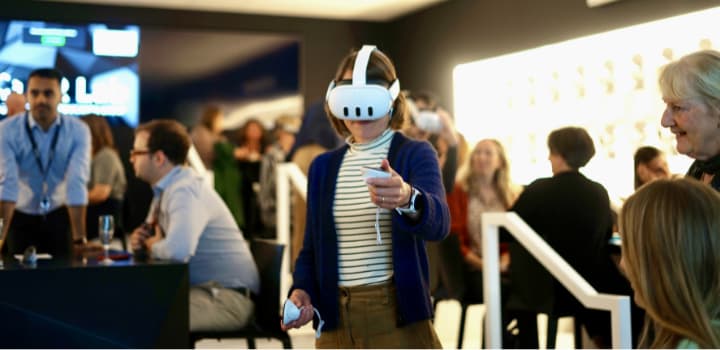
Rural Minds uses immersive film to help GPs and medical students recognise mental distress and suicide risk in farming communities. Developed by Suffolk doctors Daniel James, Richard West and Jordan Tsigarides with Revolve Labs, it brings rural experiences into clinical education without requiring every learner to visit a farm.
Inside the experience
Viewers follow a fictional farmer, Robert, through financial pressure, isolation and family life, before seeing how professional support can help. Scenes include a call to the bank, time in his workshop and conversations around the kitchen table. Filming took place on a working farm in Little Stonham, Suffolk, with Nick Murray-Brown and Clare Hawes playing Robert and his wife.
The 360° perspective immerses learners in the setting. The aim is to help them recognise distress that farmers may describe as exhaustion, physical symptoms or stress, and develop conversations that feel relevant to agricultural life. The creators explain this clinical focus in their April 2026 BJGP Life article.
What clinicians learn
The module groups its learning objectives into three areas:
- Understanding and empathy: recognise farming-specific pressures, mental health risks and inequalities.
- Recognition and diagnosis: understand how relatives and others can identify difficulties, and how clinicians can discuss symptoms and suicide risk.
- Support and management: connect people with NHS and voluntary services, understand relevant ethical issues, and identify resources for rural communities.
Two audiences, wider access
Alongside the clinician module, the team developed an eight-minute version for farmers, intended for community outreach and conversations about seeking help. A November 2025 Farmers Weekly follow-up describes YANA’s role in taking it to events across East Anglia.
The resource is described as free to access. By May 2026, the published notes for Daniel James’s Rural Road to Health interview confirmed a version that streams on computers and mobile phones for people without a headset.
Rural Minds remains listed in the Revolve 360 training library. The library supports Quest 3 and Quest 3S; a Quest 3 is also visible in the project’s launch photograph.
Development and rollout
The project grew from the doctors’ clinical experience and conversations with farming communities. The Felix Thornley Cobbold Agricultural Trust funded the work, and Revolve Labs supplied the production and technology. Partners named by the project include Woolpit Health Centre, Suffolk Agricultural Association, YANA and the Farm Safety Foundation, with RCGP endorsement.
The module credits Daniel James and Aruna Stannard as authors, and Jordan Tsigarides and Richard West as reviewers. Its acknowledgements also name contributors from UEA and Norfolk Constabulary.
- May 2025: previewed at the Suffolk Show.
- 21 October 2025: officially launched at Eastern Education Group’s XR Lab in Bury St Edmunds.
- November 2025: presented at the House of Lords. Follow-up reporting described rollout to GPs and medical students and use within an educational programme for doctors.
- 8 December 2025: the DEMEC programme listed a hands-on workshop with James and Tsigarides covering development and initial evaluation.
- 2026: the creators continued explaining the approach through professional publications and interviews; the module remained publicly listed in September.
October coverage reported use in Suffolk, North East Essex and South East London.
Evaluation and evidence
The 2026 research-fair booklet, pages 77–78, outlines a proposed evaluation supervised by Adrian Leddy and Jordan Tsigarides. It suggests before-and-after measures of empathy, mental health understanding, stigma and help-seeking intentions, with interviews or focus groups to explore acceptability.
This is a research proposal, not a results report. The DEMEC listing mentions initial evaluation but supplies no findings.

