

Background
The Level-1 rapid infusion system delivers fluid or blood at speed to patients losing blood volume through hypovolemic shock, severe trauma or massive bleeding. Operating it quickly and correctly can decide whether a patient survives, but it is used rarely enough that emergency nurses struggle to build and hold the necessary proficiency. Hands-on practice is the most effective way to learn the procedure, yet giving every nurse individual, device-specific tuition is expensive and hard to schedule.
The deployment
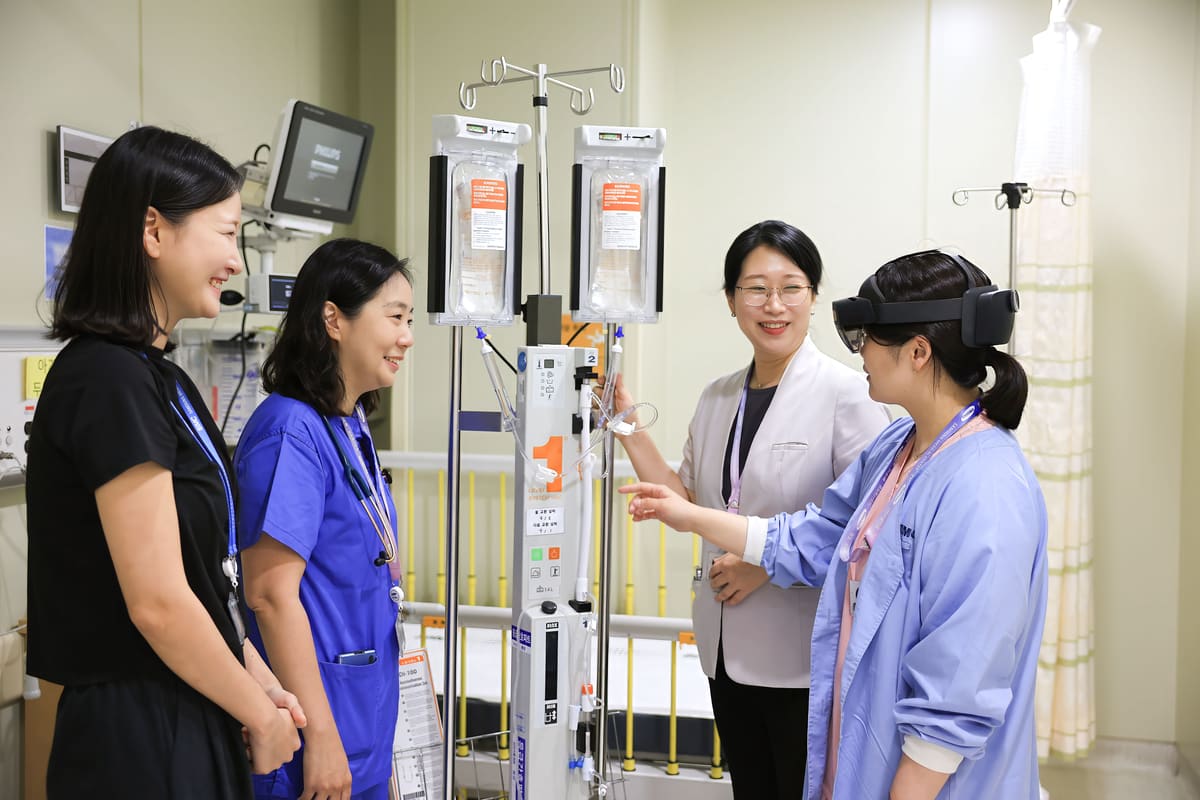
Samsung Medical Center's Department of Emergency Medicine and the emergency nursing part of its nursing division built an augmented reality training module for the device and tested it in a randomized controlled trial. Registered nurses from the hospital's emergency department were recruited between 17 and 20 July 2023, and the trial ran to September that year.
Forty-two nurses with no prior experience of the Level-1 were split into two groups of 21. One group trained wearing an AR headset while handling the real infuser; the other studied the hospital's printed Level-1 nursing practice guidelines on their own, as had been standard practice.
How the training worked
A physical anchor fixed to the infuser gave the headset a spatial reference, so instructions stayed pinned to the equipment itself. As the trainee worked through the setup and operation sequence, the headset overlaid:
- step-by-step visual instructions and learning objectives
- checklists of the materials needed at each stage
- finger-shaped holograms pointing to the correct buttons
- short video clips demonstrating the more complex steps, including a trainer's hand movements
- a step navigator that advanced when the trainee looked at an on-screen arrow
The effect was closer to a senior nurse giving one-to-one instruction at the bedside than to reading a manual. The training was authored as holographic work instructions and delivered on a single headset.
Outcomes
AR training took longer to complete — the median learning time was 18.02 minutes against 8.98 minutes for manual self-study, and the study's mean figures showed the same pattern. The picture reversed once the nurses were put in front of the actual device.
Time spent preparing the equipment fell to 3.67 minutes for the AR group from 9.85 minutes for the manual group, a reduction of about 62%. Total performance time, covering setup, fluid delivery and transfusion, was 5.83 minutes against 13.63 minutes. The published results also recorded higher clinical competency scores (91.67 versus 63.81) and greater self-efficacy and satisfaction among the AR-trained nurses.
Independence separated the two groups as well: the AR group completed the procedure without once asking a senior colleague for help, while the manual group needed assistance, which the researchers read as a sign that self-directed manual study leaves gaps in accuracy and confidence.
Funding and publication
The work was supported by the nursing department's own 2023 research fund and by a Korea Health Technology R&D Project grant administered by the Korea Health Industry Development Institute and funded by the Ministry of Health and Welfare. The detailed results were published in JMIR Medical Education, and the trial is registered as NCT06506851.

