

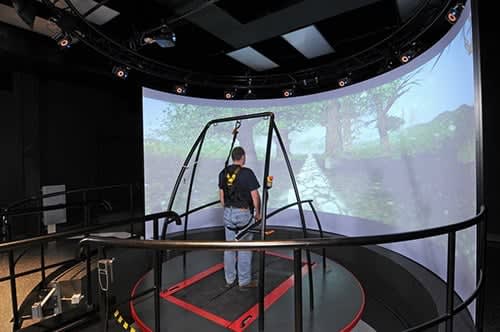
The Ottawa Hospital Rehabilitation Centre runs a Rehabilitation Virtual Reality (RVR) Lab built around the CAREN Extended System, a computer-assisted rehabilitation environment. The system was installed in 2010 in partnership with the Canadian Armed Forces, and the lab serves residents of the Champlain Region as well as members of the Canadian Forces. The hospital describes itself as one of only two in Canada with a CAREN system that both provides patient care and is used for research.
How the system works
CAREN combines room-sized 3D graphics, a platform that moves with the person as they explore the virtual world, a dual-tread remote-controlled treadmill and motion analysis technology. Curved screens spanning 180 degrees work with surround sound, and patients interact with the platform and screen through motion tracking. The system creates scenarios such as walking on busy streets, moving over varying terrain, and skiing or snowboarding down a hill. Patients wear a harness attached to a fall-restraint system, so challenging situations can be practised safely.
Who uses it
CAREN was initially used in part to help injured soldiers returning from Afghanistan. Since then, many civilian patients have used it, including people with traumatic brain injuries, spinal cord injuries, neuromuscular disease, amputation, chronic pain and stroke.
Funding
The lab was made possible by financial support from The Ottawa Hospital, Canadian Forces Health Services, the community and The Ottawa Hospital Foundation.
A patient's account
Canadian diplomat Bushra Saeed-Khan, who has a prosthetic right leg after wounds sustained in Afghanistan, used the CAREN system as part of her rehabilitation. According to Legion Magazine, it proved critical in reclaiming her mobility, independence and confidence outside clinical settings. In her own account, it helped her move past a plateau in her physical therapy, test what she could manage mentally outside the hospital, learn the full extent of what her prosthetic leg could do, and practise responding safely to different situations while learning her limits. This is a single patient's attributed account, not a measured outcome.


