

Background
Transport for NSW ordered seven near-identical commuter ferries — the Parramatta River Class — to replace the ageing RiverCats on the Parramatta River to Circular Quay run, operated by Transdev. Each 200-passenger catamaran was designed by Australian naval architects Incat Crowther and built by Richardson Devine Marine in Tasmania. The first vessel, Frances Bodkin, entered service in May 2024.
The brief carried an unusual fixed constraint: the new design must not require fresh training for crews. Sydney Harbour already runs several vessel classes, and neither the owner nor the operator wanted to add complexity. Satisfying that meant consulting a wide group — the owner, the operator, the shipyard and the ferry workforce — on a design none of them could yet walk through.
Sitting in a wheelhouse that does not exist
Incat Crowther authored the vessel in SSI ShipConstructor and streamed the model into Microsoft HoloLens headsets at full scale. Ferry masters could virtually sit in the wheelhouse, understand what was being proposed and say whether further edits were needed — feedback that went back into the model rather than into a revision cycle of drawings. The model was also streamed to screens so groups could review the vessel without everyone wearing a headset.
Verifying the build on the shop floor
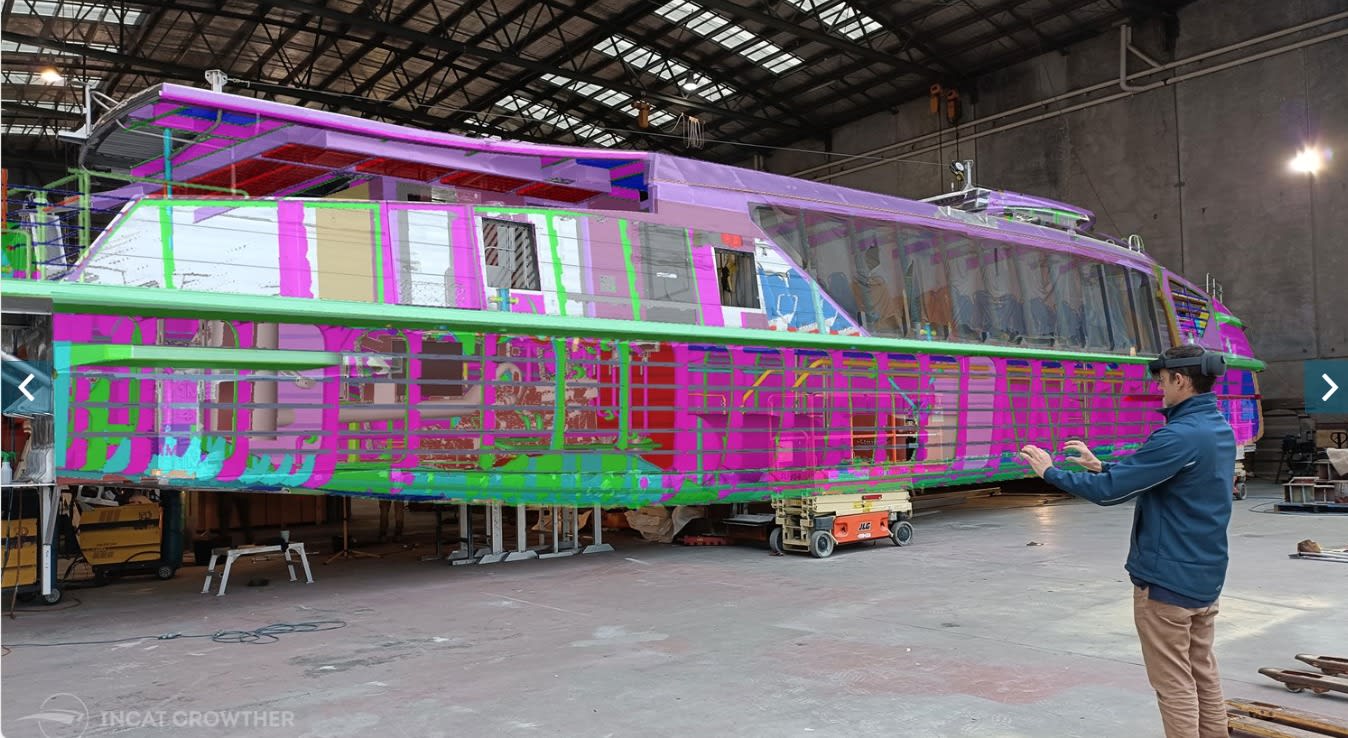
The same model did a second job during construction. Incat Crowther generated a structural model of just the frames and brackets, loaded it onto HoloLens, and walked the shipyard floor overlaying the virtual structure onto the physical hull to confirm every member was in the right place — deliberately before the aluminium shell plates were cut and fitted, when a correction is still cheap.
Quality assurance closed the loop the other way. Every space in the vessel was captured by 3D laser scan, and the scan was overlaid onto the ShipConstructor model in Autodesk Navisworks to reconcile the two. That harmonisation is what let the stakeholders treat the digital twin as an accurate stand-in for the physical ship rather than an idealised drawing.
Why it suited this order
- A seven-vessel series multiplies the value of getting the first design right, and of proving each hull against the same model.
- Consultation with masters and crew happened on the design itself, at full size, instead of through interpretation of 2D drawings.
- Design verification and as-built reconciliation ran on one model rather than two parallel processes.
- The same full-scale model can serve vessel-specific familiarisation before launch, shortening time-to-service — an application Incat Crowther flags for future orders rather than one deployed here.
The seven ships were built as near-identical sisters, but Incat Crowther notes that future orders with different configurations or propulsion could have those changes communicated the same way — engine room or wheelhouse, including onboard systems and controls.


