

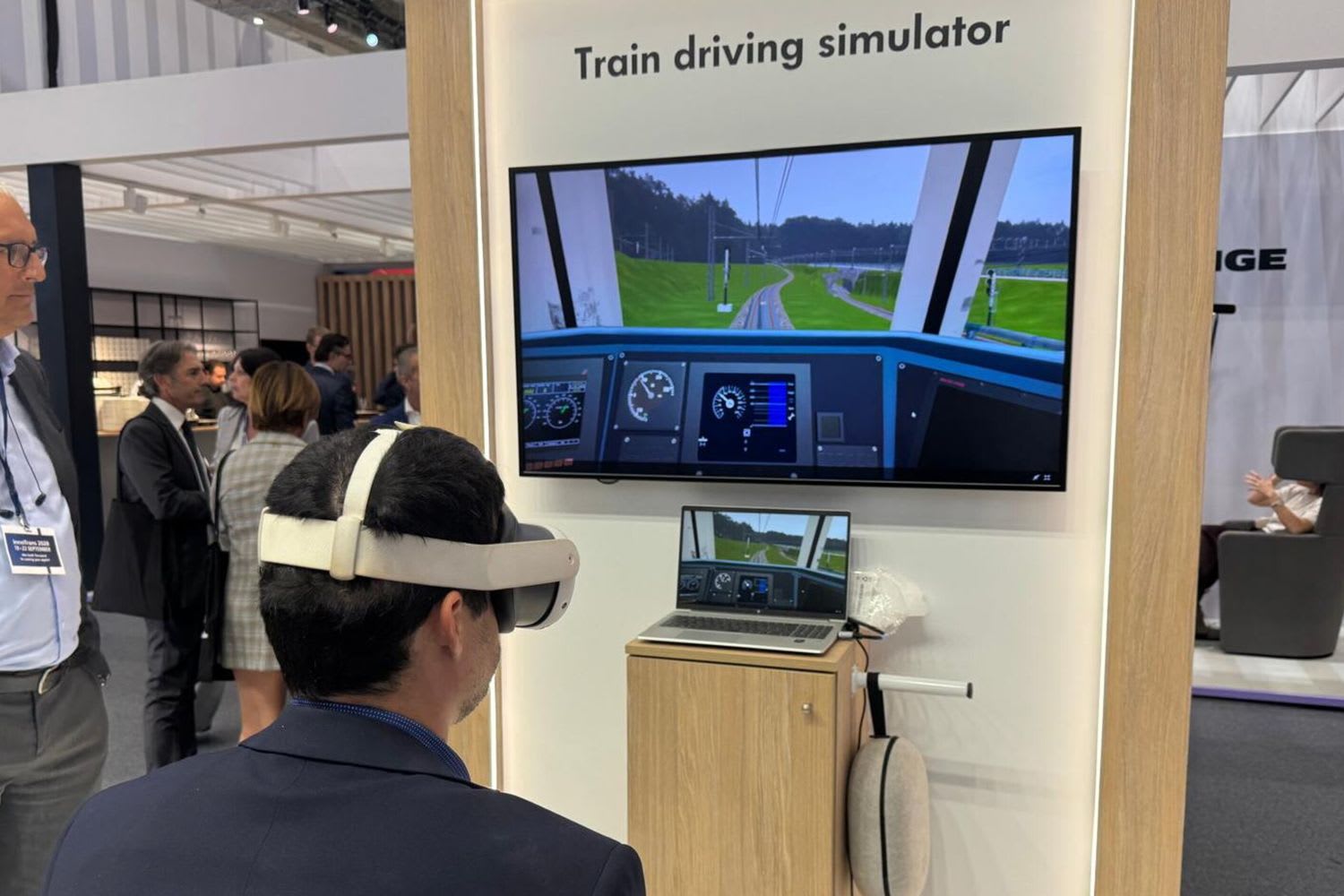
Trenitalia is piloting a new generation of virtual reality driving simulators to train its more than 6,000 train drivers across Italy. The project, developed with FSTechnology and in collaboration with Leonardo, was shown at InnoTrans 2026 in Berlin, where visitors could try it at the Trenitalia stand.
Today Trenitalia has five physical simulators at three sites (Rome, Florence and Milan). They carry high maintenance and energy costs and are slower to update with new technology. The VR simulators are meant to complement them.
How it works
The pilot reproduces an E.464 locomotive with six coaches. Wearing a VR headset, the driver enters a realistically rebuilt cab and uses a basic physical control desk with levers and the main controls, some of which give tactile feedback. A photo from the trade fair shows a visitor using a white Meta Quest 3 headset. Leonardo describes the experience as running through a headset and a native app on a modular cloud architecture.
The route currently reproduced is Orte-Chiusi, covering both the conventional and the high-speed line, including interconnections and the signalling system. The system lets drivers practise in varied operating scenarios, including critical or abnormal situations that are hard to recreate in a normal training session.
Public experience
A separate VR experience was built for visitors, students and enthusiasts. It lasts about seven minutes, is guided by a multilingual virtual instructor, walks the user through the instruments, start-up procedures and communications, and ends with an assessment.
What comes next
The roadmap is still at the planning stage, and the figures below are targets, not results:
- A line generator based on Rete Ferroviaria Italiana data, intended to create new virtual routes and progressively cover the roughly 16,000 km rail network.
- At least one simulator or headset in every region.
- Completion of the design and consolidation of the prototypes by the end of 2026.

