

Background
Drones have reshaped the war in Ukraine, where Varjo estimates that uncrewed systems now account for 70–80 percent of battlefield casualties. Preparing soldiers to spot and defeat fast-moving first-person-view (FPV) drones — under realistic pressure but without live munitions — has become an urgent training problem.
The deployment
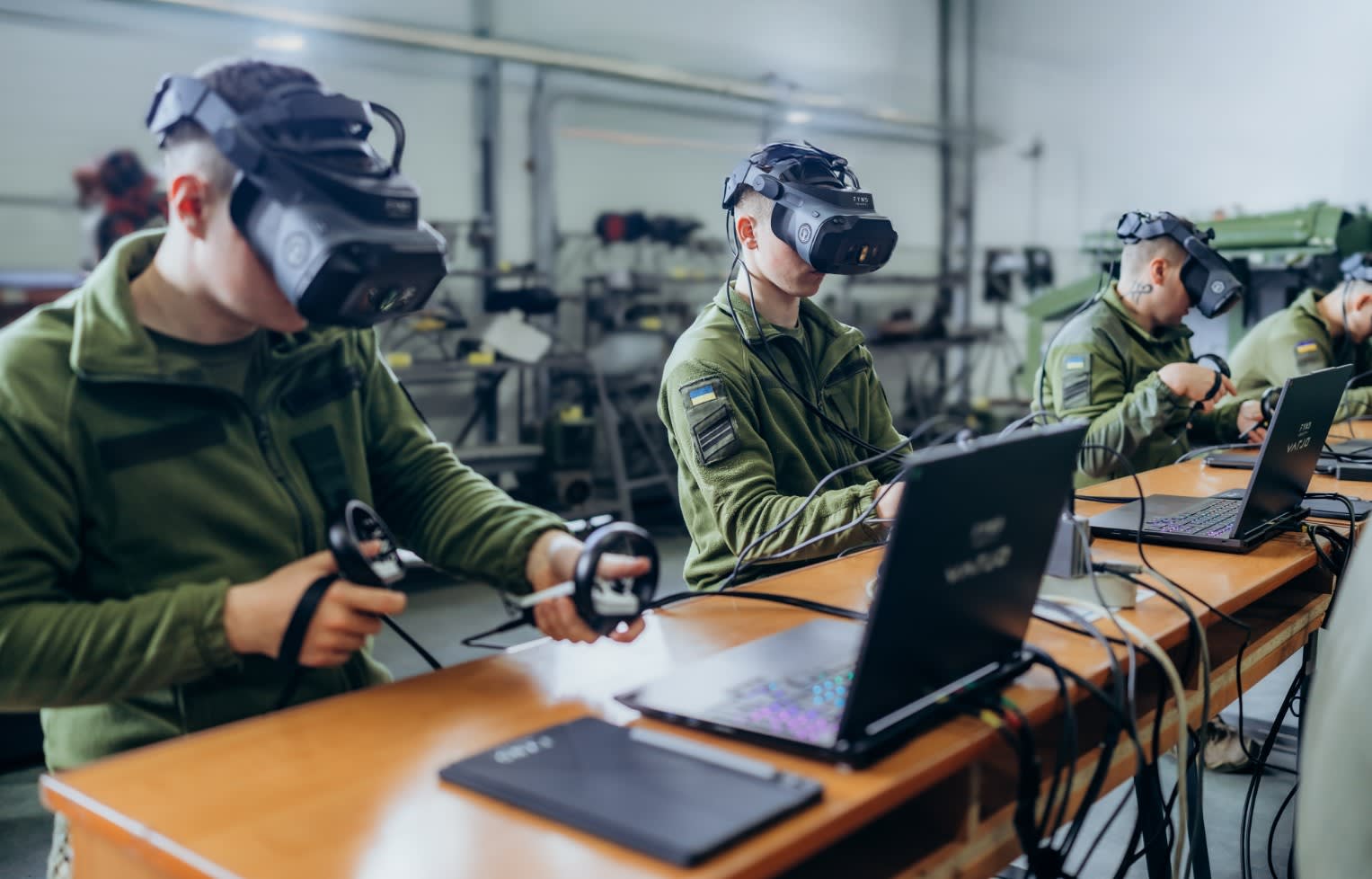
The Ukrainian Armed Forces have begun training troops on Horizon Guardian, a counter-drone (counter-UAS) simulator developed by Australian firm Applied Virtual Simulation and delivered as part of Varjo's expanding XR support for Ukraine. The same system is simultaneously undergoing trials with the Australian Defence Force.
How it works
Wearing a high-fidelity mixed-reality headset, trainees enter a simulated engagement built on real-time 3D and motion-capture technology:
- One operator flies an FPV drone while a second trainee must detect and neutralize the threat with a motion-tracked replica weapon.
- The platform is weapon-agnostic, working with different firearm configurations, and can pit trainees against either AI-controlled or human-operated drones.
- Instructors can adjust difficulty, environmental conditions, signal interference, and jamming effects.
- Integrated after-action review tools replay each run for performance analysis and decision evaluation.
Because the engagement runs locally in a safe indoor space, units can rehearse high-stakes counter-drone drills repeatedly without expending live drones or ammunition.
A wider XR training network
The counter-drone simulator adds to a growing set of XR training capabilities fielded for Ukrainian forces. Earlier in 2026, 39 mixed-reality training systems were supplied through a partnership between Varjo and Finnish software developer Fynd Reality under Norway's Nansen support programme, covering familiarization, procedural, and maintenance training for platforms such as the Leopard 2A4 main battle tank — Fynd Reality's Leopard 2 training is already in use at the Military Institute for Tank Troops at NTU "Kharkiv Polytechnic Institute." Ukraine has separately received an F-16 mixed-reality cockpit simulator from Czech company Dogfight Boss. In-country delivery and coordination across this network has involved XR studio SensoramaLab.
Varjo's chief executive, Timo Toikkanen, quoted below, framed the counter-UAS simulator as evidence that mixed-reality training is solving a real operational challenge in Ukraine and that military training must now move with unusual speed and agility.

