


Background
Poor teamwork and communication are implicated in the large majority of health care errors, and burnout continues to push experienced nurses out of the profession. The UNC School of Medicine's Department of Surgery set out to test whether an immersive training experience could change how surgical teams behave in the operating room, rather than only what they know on paper.
The deployment
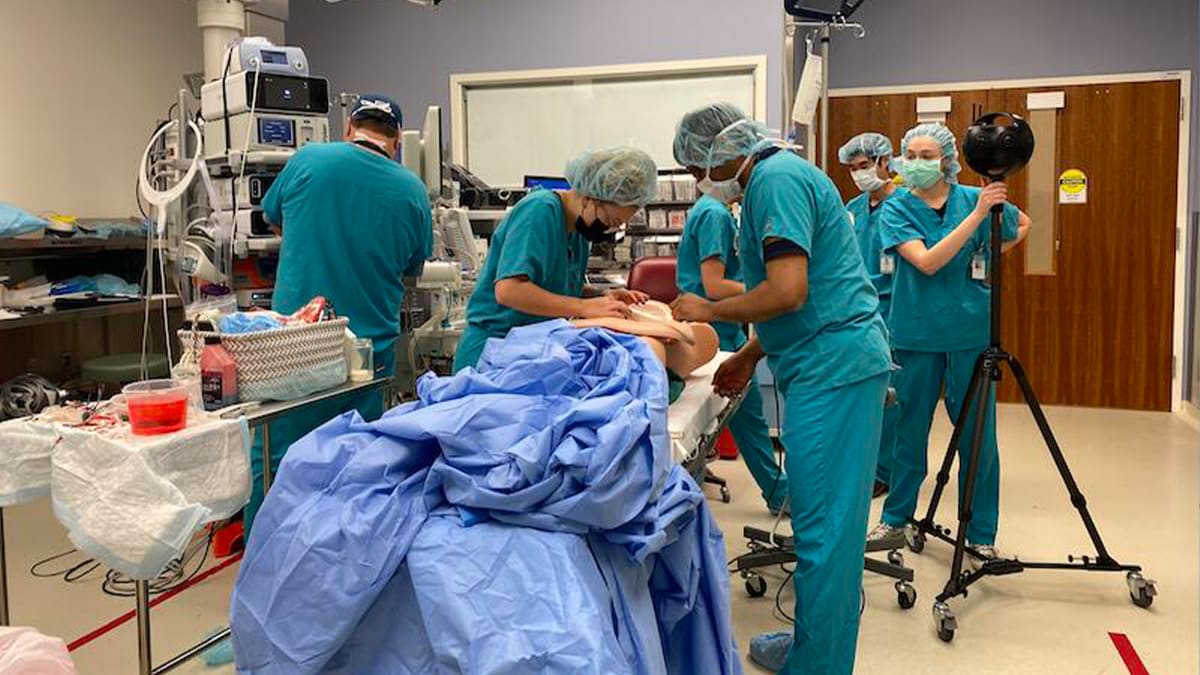
Surgeons at the university's academic medical center in Chapel Hill, North Carolina — a facility with 55 operating rooms — were put through Bizon360 Teamwork, an immersive 360-degree video training programme built by MaiaZura, a UNC-affiliated startup founded by Lukasz Mazur, an academic in industrial engineering, human factors and patient safety who holds appointments across the UNC medical, public health and information science schools. Dr. Jin Ra, Professor of Surgery and Associate Chair for Quality and Safety, was a co-investigator and is shown using the training.
How the training works
The learner is dropped into a routine operation that quietly goes wrong: an attending steps out, a drain overfills, a pulse check comes too late, and the case ends in a death and a phone call to the patient's family. Rather than a procedural drill, the scenario is built to expose breakdowns in communication, leadership and situational awareness — and the learner can take the viewpoint of the attending physician, the nurse or the patient, following the story through to the nurse's family dinner table afterwards.
Mazur describes the programme, in the quotes below, as a motivational layer that sits underneath a hospital's existing teamwork methods rather than replacing them; the modules are designed to plug into frameworks such as TeamSTEPPS, Lean and Six Sigma.
Technology
The content is 360-degree video filmed in real clinical settings with real health care professionals, delivered on the Uptale immersive-learning platform and viewed in Pico Neo 3 Pro Eye headsets during the study. The modules are also playable on desktop, tablet and phone, and are built to drop into a hospital's existing learning management system over LTI 1.3 with single sign-on.
Results
In a pilot study published in JMIR Medical Education in May 2025, safety behaviours were scored during actual surgical cases using the validated Teamwork Evaluation of Non-Technical Skills instrument. Surgeons who took the training scored significantly better on 18 of 20 observed safety behaviours than an untrained control group, averaging 2.5 against 2.1 on a 0–3 scale. Baseline observations ran from October 2022 to February 2023 and the pilot itself from April to November 2023.
The training session is reported at roughly 30 minutes of immersive content within a 45-minute session that includes pre- and post-debriefing.
Funding and origins
The work grew out of UNC research and was supported by an Innovation Pilot Award from the UNC Center for Health Innovation in 2022; MaiaZura later received a KickStart Commercialization Grant from Innovate Carolina in 2024 to take the programme to market.

