

Background
Glaciers across Central Asia are shrinking rapidly as the climate warms, and the meltwater they release underpins the region's drinking water, irrigation and hydropower. To mark the International Year of Glaciers' Preservation and the opening of the Decade of Action for Cryospheric Sciences, the UNESCO Regional Office in Almaty launched Glacier Lifelines, a virtual reality experience that takes users into the region's mountains to see how climate change is reshaping them.
The experience
Glacier Lifelines was developed by the Zurich University of the Arts (ZHdK) under the GEF-UNDP-UNESCO Cryosphere Project, a regional programme running from 2022 to 2027 that helps Central Asian countries assess glacio-nival systems and adapt to climate change. It was produced in collaboration with the University of Zurich and the University of Fribourg, whose researchers supplied the scientific content.
The experience is built around four interactive chapters, each set at a real location in the region:
- Irrigation — how glacier melt feeds agriculture
- Hydropower — the role of meltwater in electricity generation
- Glacier monitoring — how scientists measure ice loss
- Disaster risk reduction — managing hazards such as glacial lake outburst floods
Each chapter sets out the challenges climate change creates at that site and asks the user to carry out tasks aimed at improving the situation. The scenes are built on measurements gathered by partner research institutions rather than generic environmental imagery.
Training and handover
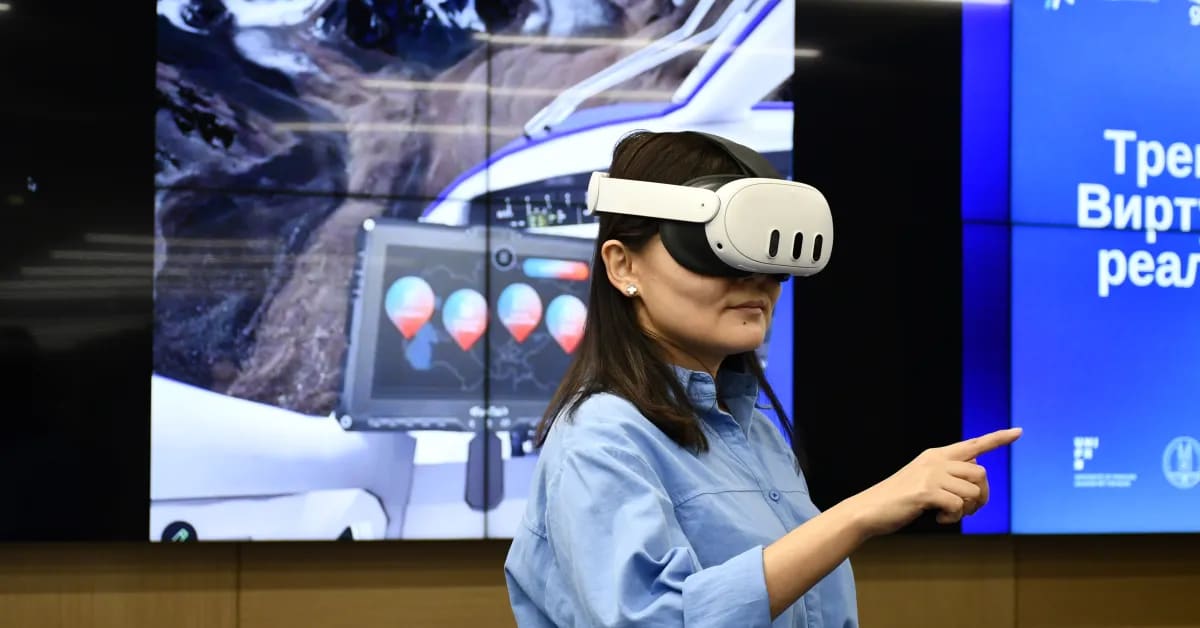
In early November 2025, ZHdK visual designers Noemi Chow and Jonas Christen ran a two-day workshop at the UNESCO Regional Office in Almaty for representatives of universities and academies from across Central Asia. Participants were briefed on how the experience was made, how to operate and maintain the headsets, and how to fold the technology into their own teaching and outreach. Chow, quoted below, described virtual reality as a way to reach people emotionally on climate change.
The institutions represented were Al-Farabi Kazakh National University, the Kyrgyz National University named after Jusup Balasagyn, the National Academy of Sciences of the Republic of Tajikistan, the Turkmen Agricultural University named after S.A. Niyazov, and the Mirzo Ulugbek National University of Uzbekistan.
Following the workshop, sets of headsets were provided to the partner universities. By early 2026 the Cryosphere Project had handed over VR sets — headsets carrying the Glacier Lifelines experience, tablets and supporting materials — to national partners in Kazakhstan, Kyrgyzstan, Tajikistan and Uzbekistan. Al-Farabi Kazakh National University received its set on 11 February 2026, during the International Day of Women and Girls in Science.
Hardware and reach
The experience runs on standalone Meta Quest 3 headsets, which need no external PC or tracking hardware — practical for equipment distributed across five countries and used in classrooms, at conferences and in public outreach. It is localised into seven languages — English, Russian, Kazakh, Kyrgyz, Tajik, Turkmen and Uzbek — each with recorded voice-over.
Knowledge Hub
A companion web Knowledge Hub sits alongside the headset experience, setting out the scientific background, the underlying data and the story behind Glacier Lifelines, and mapping the institutions and projects that monitor the Central Asian cryosphere.

