

Background
The University of Alberta Faculty of Nursing ran an immersive virtual reality (iVR) pilot project in its Nursing Simulation Centre — one of the largest of its kind in Canada — from September 2025 to April 2026. Virtual reality was added as a new layer on top of the centre's existing simulation tools, which range from simple task trainers to high-fidelity mannequins that breathe, blink and respond to student interventions.
The pilot
Nearly 900 undergraduate nursing students stepped into virtual hospital rooms to work through close to a dozen clinical scenarios, from a patient in heart failure to an overdose, mpox care, and helping a mother through labour. The scenarios let students take charge of high-stakes situations they would rarely handle unsupervised on a real placement, and make mistakes without putting a real patient at risk.
In the simulation
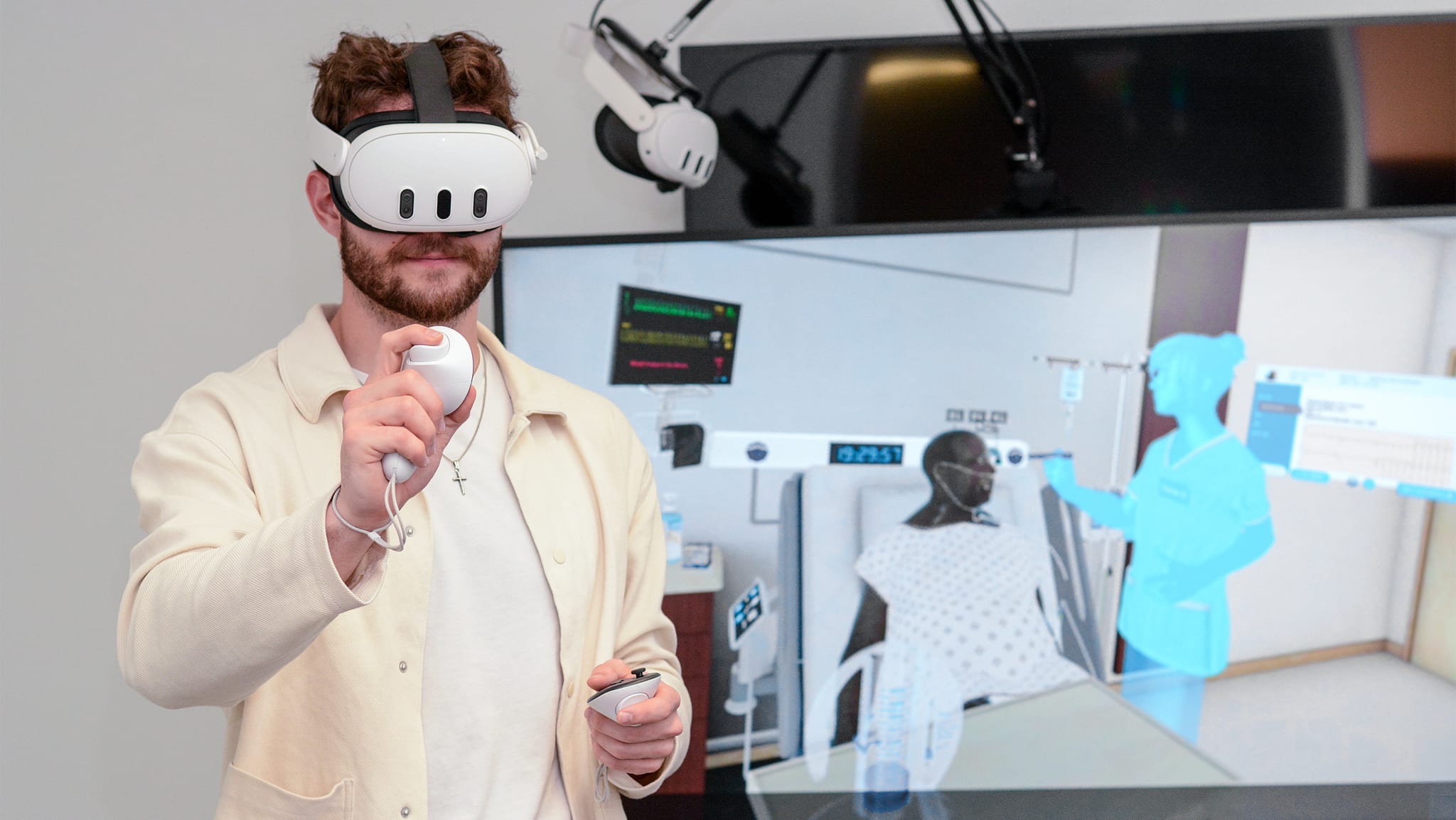
Standing inside a tracked play area, students assess the patient, interpret vital signs, prioritise interventions and respond in real time as the scenario unfolds around them. Because students cannot turn to classmates for help mid-scenario, the centre's leaders say the format pushes on-your-feet clinical reasoning, clinical judgement and communication. Students do not need to be in the same physical room to take part in the same simulation.
Hardware
The deployment uses standalone VR headsets with motion controllers, identified from deployment photography as Meta Quest 3 devices. Learners' visual and auditory senses are engaged through the headset and hand controllers in a computer-generated 3D hospital environment.
Outcomes and expansion
Faculty report overwhelmingly positive student feedback, and staff who facilitated the scenarios say the experience built their own confidence and knowledge. From spring 2026, iVR was integrated into mental health nursing practice courses, and the programme is being expanded for the cohort starting in fall 2026 — adding more rooms and equipment to roughly double its current size. Although still formally a pilot, the faculty's stated aim is to make VR a permanent feature of the nursing programme.

