

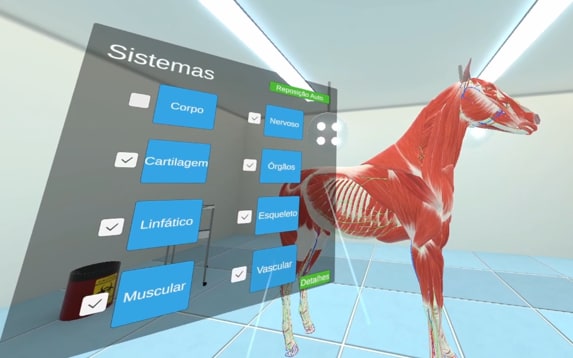
The Universidade de Trás-os-Montes e Alto Douro (UTAD) plans to use virtual reality to help students understand three-dimensional concepts in engineering and veterinary medicine. Its VR-EDU 3D project was developed with INESC TEC through the institutions' shared MASSIVE Virtual Reality Laboratory, targeting teaching in Computer Graphics, Embryology and Anatomy I and II.
The project is designed for the 2025/2026 and 2026/2027 academic years and draws on UTAD's existing immersive infrastructure, including a dedicated room equipped with 20 Meta Quest 3 headsets. Applications are tailored to each subject: computer graphics students can follow ray-tracing algorithms and observe the effects of light, reflection and refraction in real time, while veterinary anatomy students can interact with three-dimensional dog, horse and bovine models, dissect anatomical structures and view them in different planes.
INESC TEC's July 2026 report describes classroom testing and real-world case studies as planned work. The research aims to determine where VR adds value and whether it has an effect compared with traditional teaching methods. VR-EDU 3D was one of three projects selected in UTAD's 2025 pedagogical innovation competition, each awarded €2,000 for implementation and validation in a real teaching context by July 2027.

