


Background
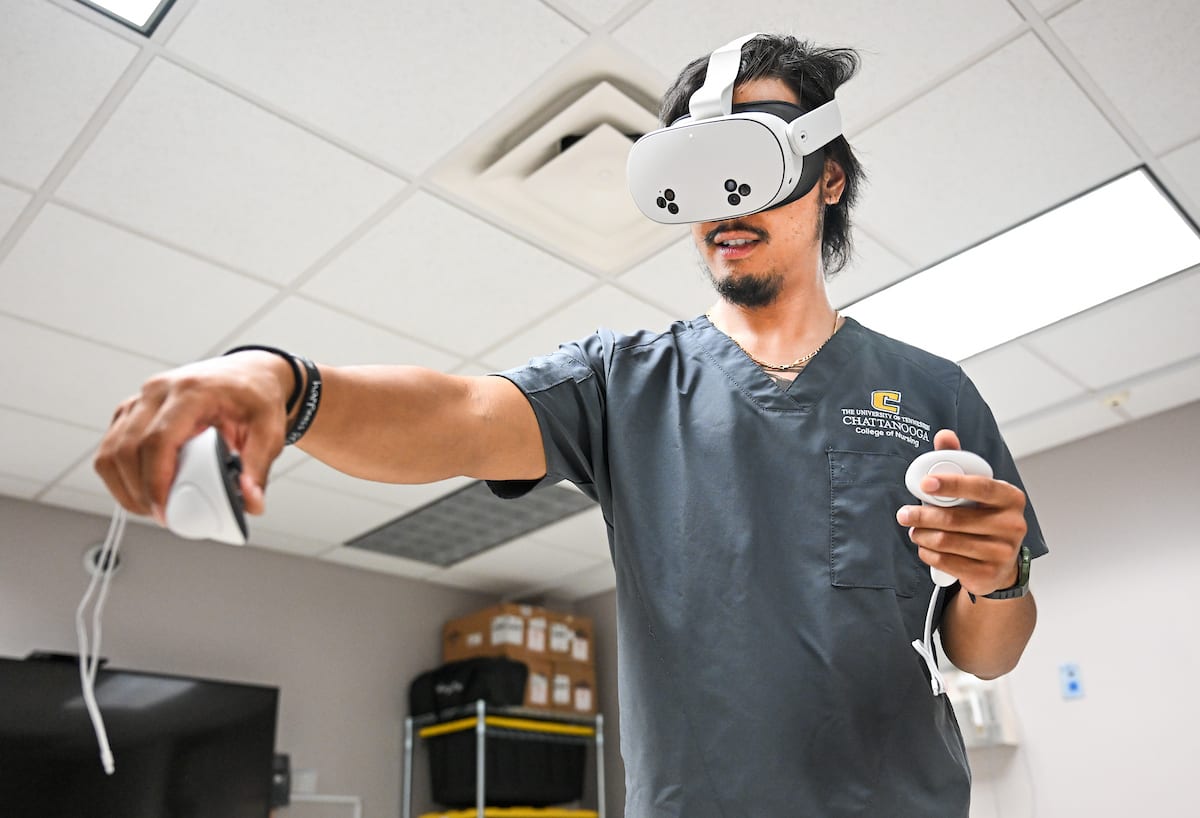
The University of Tennessee at Chattanooga's College of Nursing has begun piloting virtual reality simulation in its accelerated Bachelor of Science in Nursing (ABSN) program. Funded by a High Impact Practices Grant from the UTC Walker Center for Teaching and Learning, the pilot introduces immersive VR scenarios into two second-semester clinical courses, NURS 3155 (Maternal-Newborn Clinical) and NURS 3165 (Pediatric Clinical). It is the first time the college has used VR simulation in this way.
The accelerated program compresses the same clinical requirements as the traditional track into a much shorter timeframe, requiring 59 credit hours across three semesters with 21 dedicated to hands-on clinical work. Faculty say the central challenge is consistency: on a slow day at a hospital placement, or across different student groups, learners may never encounter key situations such as a postpartum hemorrhage, a C-section or an asthma exacerbation.
The deployment
Faculty hand-selected scenarios they judged most valuable rather than letting students browse the platform's full library, prioritising cases that are hard to guarantee during limited hospital rotations. The pilot pairs small-group VR sessions with faculty-facilitated debriefing and a three-part structured reflection designed to track how students' clinical reasoning develops across both courses, mirroring the preparation, debriefing and reflection elements of traditional simulation.
A key advantage is flexibility. Where conventional simulation requires a faculty member present with a fixed group at a set time, the VR format can run more asynchronously, fitting the program's compressed schedule. The longer-term goal is for students to book available times and complete assigned scenarios around the rest of their coursework.
Hardware and software
Students wear standalone VR headsets with motion controllers and step through realistic clinical scenarios. Faculty noted the fidelity of the experience: an IV running can be seen dripping, a pump can be seen operating, pulses can be felt, a heartbeat heard, and a pen light shone into a patient's eye produces a realistic pupil response. The platform also enforces correct procedural order, such as scanning a patient's armband and confirming identity before administering medication, helping students build habits and muscle memory early.
The simulations run on UbiSim, an immersive VR platform built specifically for nursing education. The College of Nursing's simulation lab supplied the headsets at no additional cost to the grant.
Outcomes and next steps
The grant funds $1,980 in UbiSim student licenses for roughly 20 second-semester accelerated nursing students. Faculty plan to collect and analyse outcome data through the platform's AI narrative analysis, present findings at the Walker Center grant symposium in autumn 2026, and pursue opportunities to share the work at a national nursing simulation conference and in a peer-reviewed journal.
The timing aligns with the College of Nursing's new Dorothy and Jim Kennedy Health Sciences Building, scheduled for completion in 2027, which will include a room designated for VR simulation. Program leaders frame the pilot as a way to learn how best to use that future space, and to supplement clinical hours as enrolment grows faster than clinical placement availability. If the summer pilot succeeds, UbiSim licensing could eventually be built into future ABSN program fees.

