


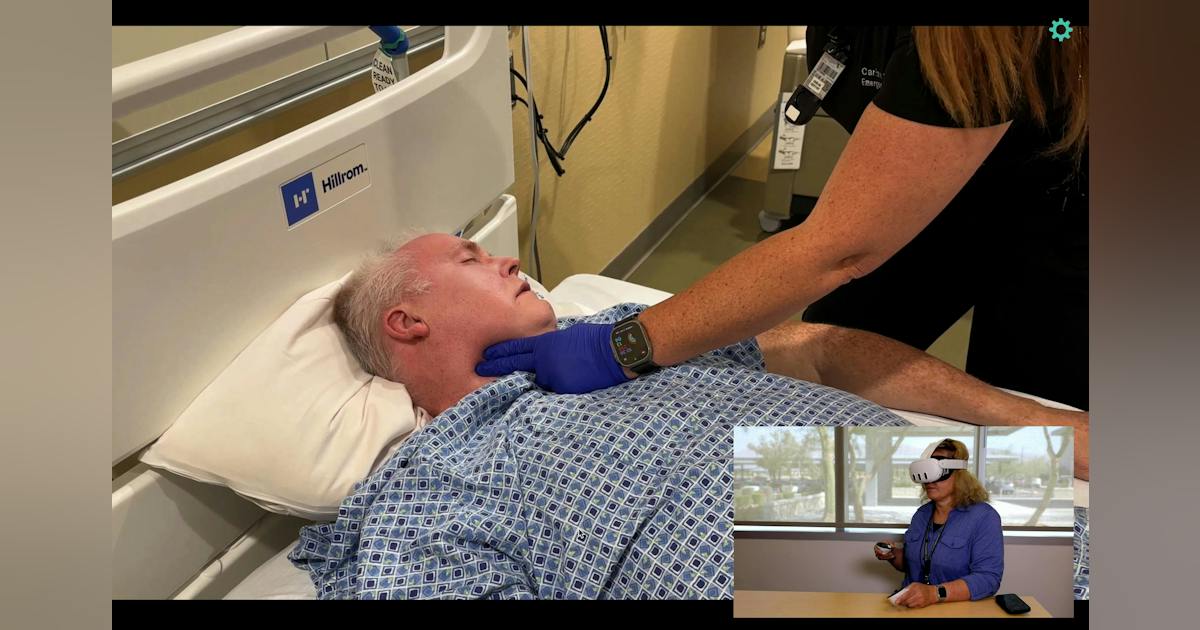
The Simulation Center at the VA Southern Nevada Healthcare System (North Las Vegas VA Medical Center) built an on-demand staff-education program combining AI-enabled virtual-human patients — for soft-skills scenarios such as de-escalating disruptive patients, addressing suicidal ideation, substance-abuse counseling, delivering a death notification, and disclosing adverse events — with 360-degree video VR recordings of real VA workspaces, covering scenarios including the first minutes of a code, a mass-casualty incident, PPE donning/doffing, and new-staff ED orientation, playable on computer or through a VR headset. Developed by simulation technician Bonnie Barti with simulation coordinator Quentin Hart, the program lets staff train any time, on any schedule, and repeat scenarios to improve. It is running as a two-year proof-of-concept pilot; roughly 250 staff went through it in the first pilot year, and the facility now maintains 60 reassignable licenses across six 360-degree courses and 25 virtual-human patient personas. A related cardiac-arrest response module, built by Dr. Carissa Hernandez for non-critical-care nurses, launched at the same center on July 1, 2025. Reported outcomes include a 12.7% average knowledge-score gain (range 7.2%-32.5% by course) and a roughly 11.5-fold reduction in per-person training cost (about $130 to about $11 per session), alongside self-reported gains in staff confidence for de-escalation and disruptive-behavior management. The work earned Barti a 2026 Healthcare Innovation Innovator Award. The specific VR/AI platform vendor and headset model are not named in any source reviewed.
Data Points (5)
Quotes
“Since the program is no-code, it is very easy to create training by following the pattern of information needed for the AI virtual human to be exactly what we need for any verbal training scenario.”

