


The Allalin ice grotto, cut into the Fee Glacier above Saas-Fee and long promoted as the largest ice pavilion in the world, drew around 40,000 visitors a year until the summer of 2024, when so much of the surrounding ice had melted that Saastal Bergbahnen had to close it. That left the operator with an empty room at the top of the Metro Alpin funicular, 3,500 metres up at Mittelallalin, and a glacier its guests could no longer walk into.
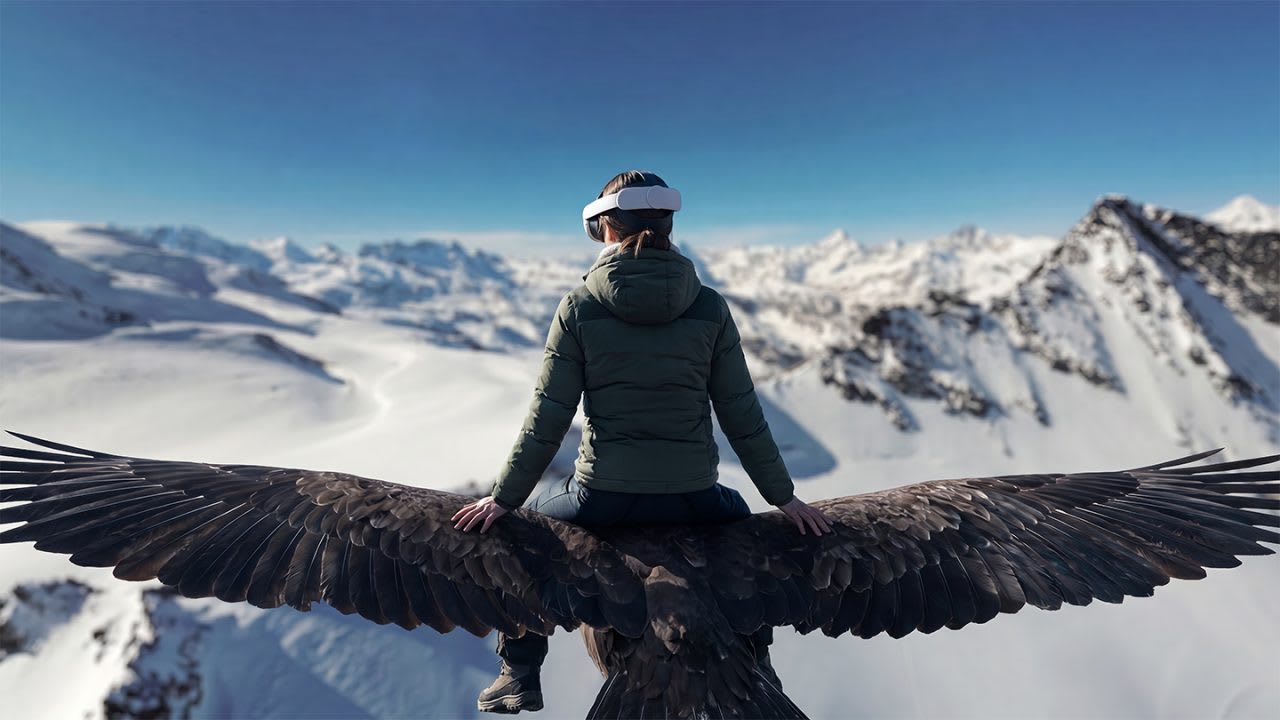
VirtuAllalin is what went into that room. Built by the Zurich studio Bandara VR for Saastal Bergbahnen and Saastal Tourismus and opened at the end of June 2025, it is a 15-minute virtual reality experience running on nine headsets in the space the grotto used to occupy. Guests follow the trail of Johann Josef Imseng, the priest and tourism pioneer remembered as the first skier in the Saas valley: they ride on the back of an alpine chough over the Fee Glacier, rope down into a crevasse, work out a series of puzzles and end up in a hidden chamber inside the ice.
The studio combined 3D-modelled scenes with filmed 360-degree footage, so guests still get the panorama of the 18 surrounding four-thousand-metre peaks when the weather outside the station has closed in. Guests steer with their hands rather than controllers, and the headsets have their audio built in, which keeps the handover between visitors quick in a room with a queue behind it.
The experience closes with a conversation rather than a credits roll. Guests can put questions to a "wise glacier" character whose replies are generated by an AI model, and more than 10,000 questions have been asked so far — from "How old are you?" through "Is there a McDonald's here?" to "How can I make my family happy?" It is the part of the piece that gives the visit a different shape each time, and it is also what the Best of Swiss Apps jury singled out when it gave VirtuAllalin Gold in the Extended Interaction category and Bronze in Innovation in November 2025.
Take-up in the first season was steady rather than spectacular: close to 4,000 guests between the opening and early September 2025, against the 40,000 a year the physical grotto used to draw. Admission is CHF 30 for adults and CHF 18 for children, or included with the Metro Plus ticket, and the room runs daily until a 15:00 last entry. It is recommended from age 10, because guests read and solve on their own inside the headset. For summer 2026 the operators added a second room on the same ticket — roughly ten more minutes of free-roaming exploration on the glacier.
The operators are candid that the attraction rests on an uncomfortable premise. "The development is tragic, but in tourism terms we have to work with what we have," Iwan Bitschin of Saas-Fee Tourismus told SRF, describing the piece as a light version of an offer that would still work in a valley without glaciers. Susanne Voide of Saastal Bergbahnen put the operator's stake more plainly: the glacier is the foundation of the business, so being able to keep showing it matters even once the ice itself is gone.


