

Background
Virtual OV ("Virtual Public Transport") is a virtual-reality training platform that teaches neurodivergent people, including those with autism or an acquired brain injury, to travel independently on public transport. It was created by Dutch studio Changefied to lower a practical barrier to taking part in society: the crowding, unpredictability and social demands of buses and trains. Rather than route-planning, the training builds the underlying skills that make independent travel possible, executive function, procedural memory and social confidence.
The concept was initiated by behavioural expert Joke de Haan, whose graduate research explored how VR could open up public transport for special-education pupils, and was developed with Changefied founder Tim van Dam (CEO) and Erik Welling (CTO) and a small team of developers.
How the training works
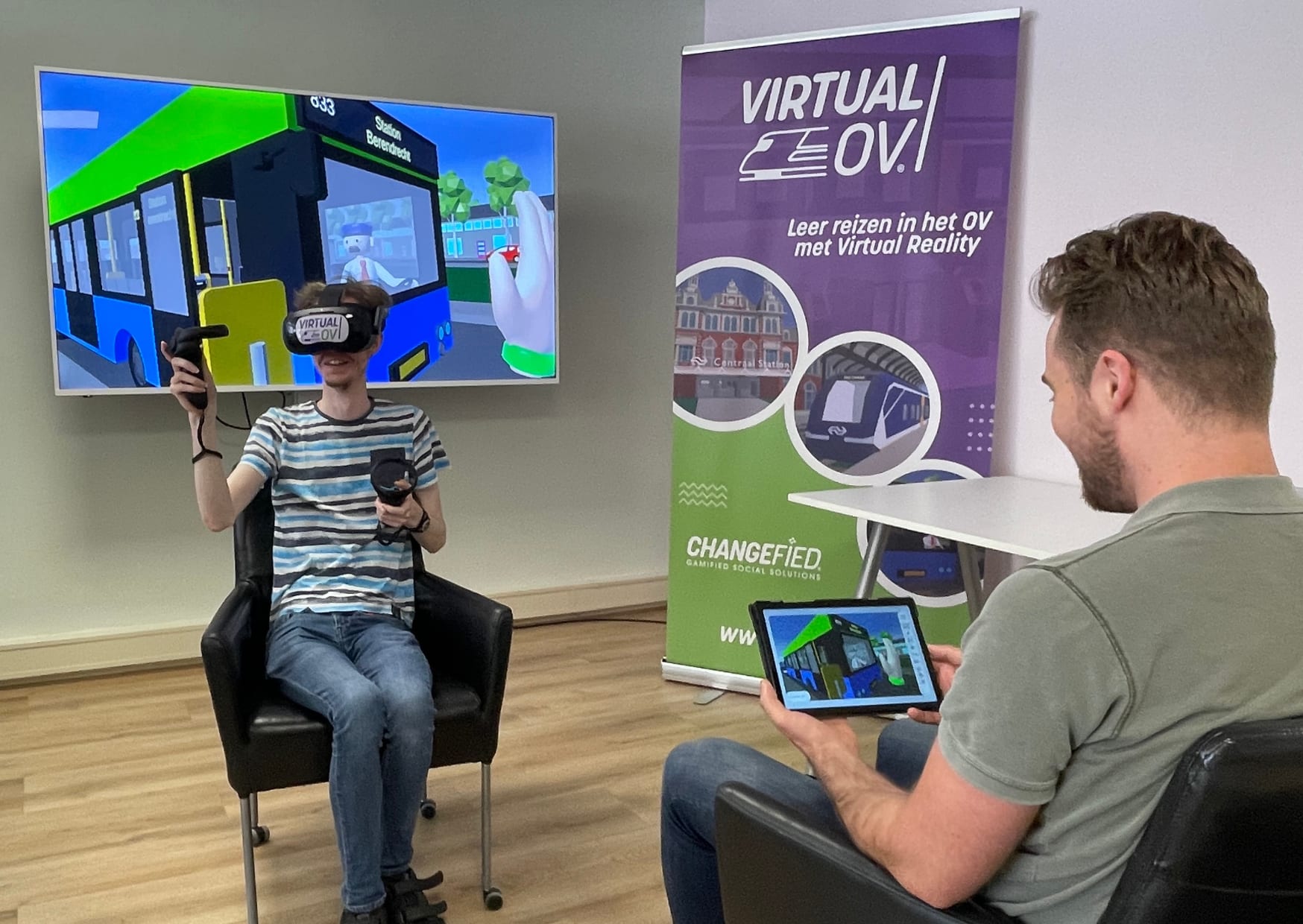
Learners progress through levels in a low-stimulus virtual environment, practising every step of a real journey: buying and topping up an OV-chipcardt, checking in and out, reading the departure board, making a transfer and staying calm when a train is delayed or a route changes. A supervisor can turn the level of sensory stimulation up or down, from an empty, stimulus-free scene to "King's Day" crowds, so the difficulty matches the individual. Because learners actually carry out each action in VR rather than just being told about it, the skills transfer more readily to the real world.
The course is delivered as a plug-and-play package that needs only a VR headset and the accompanying software, backed by a "train-the-trainer" programme so teachers and carers can support learners themselves. Under the Province of Noord-Holland programme it runs as a 12- or 19-week course depending on school size.
Technology
Virtual OV is a 6DoF (six-degrees-of-freedom) VR application built in Unity,running on standalone headsets including Meta Quest, Pico and HTC Vive Focus 3. It works offline as a single-user experience.
Scalability
Virtual OV’s modular design allows for easy adaptation to other countries’ public transport systems. Core skills remain universal, while local elements, such as payment systems, station layouts, or cultural norms, can be customized. This scalability is proven within the Netherlands and, combined with offline-capable hardware and a train-the-trainer approach, makes the platform ready for global deployment.
Partners and funding
The original build was subsidised by the New Mobility Foundation (chaired by former Dutch prime minister Jan Peter Balkenende), a fund that tackles "mobility poverty" among vulnerable groups. During development Changefied worked closely with transport operators NS (Dutch Railways), Transdev and Connexxion to make the simulated journeys accurate.
In September 2025 the Province of Noord-Holland made Virtual OV freely available to every special-education (VSO) school in Noord-Holland Noord, Haarlem/IJmond and Gooi en Vechtstreek, financing the headsets and software for three years to summer 2028. It is one of the largest regional VR education initiatives in the Netherlands.
Deployment and outcomes
Virtual OV is embedded in the curricula of special-education (VSO) and practical schools, giving concrete form to the national "basic citizenship skills" objective. Named deployment sites include Stormvogel in Hoorn, De Kameleon and Kranenburg Praktijkonderwijs in Roosendaal and care provider Avelijn in Nijmegen, with the programme reaching schools across Noord-Holland and West-Brabant.
Reported outcomes from the programme:
- More than 4,000 young people trained, with around 30% moving to public transport some six months earlier than usual.
- Deployed in 60 schools and growing, with further modules covering citizenship, living independently and emergency preparedness.
- Fewer taxi and shuttle (special-transport) trips as learners gain independence, cutting cost and reducing reliance on door-to-door services.
Beyond the numbers, teachers and carers report greater confidence and less anxiety in real-world travel. For governments, the programme supports inclusion goals and obligations under the UN Convention on the Rights of Persons with Disabilities.


